Introduction
Protein glycosylation, the addition of monosaccharide or oligosaccharide chains (glycans) to peptide backbones,
including proteins, lipids, or other organic molecules, is a common post-translational modification (PTM) that
confers various biological function. Glycosylation analysis is challenging due to the complexity and isobaric nature
of linked glycans.
N-glycosylation, in which the glycan is attached to the nitrogen side chain of asparagine, is the most widely known
form of glycosylation in biotherapeutics. N-glycans have been reported to regulate a variety of biological
processes, such as ligand-receptor interactions, immune responses, protein secretion and transport, and plays an
important role in a variety of diseases. Therefore, analyzing the link between N-glycan structure and its function
is an important research area in elucidating molecular mechanisms involved in pathogenesis, monitoring diagnosis,
prognosis, and biopharmaceutical development and quality control.
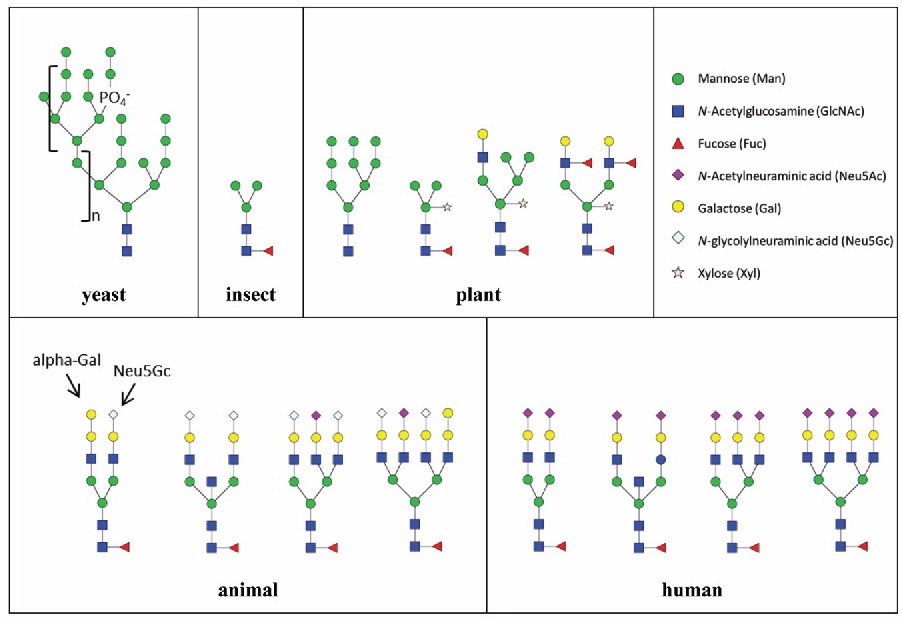 Fig. 1.
Examples of N-glycans found in the commonly used expression systems. (Zhang L, et al., 2016)
Fig. 1.
Examples of N-glycans found in the commonly used expression systems. (Zhang L, et al., 2016)
Our Services
LC-MS-based N-glycan analysis is now the mainstream analysis method. Creative Proteomics provides
the following N-glycan analysis services to analyze glycans and their species, including but not limited to.
Experiment Process
 Fig. 2. Workflow for N-glycan profiling
service.
Fig. 2. Workflow for N-glycan profiling
service.
N-Glycans Analysis by MALDI-TOF MS
Matrix-assisted laser desorption/ionization time-of-flight mass spectrometry (MALDI-TOF MS) is a new type of
ionization biological mass spectrometry developed in recent years. It is suitable for high-throughput screening of
proteins or other biological macromolecules with high sensitivity for the structural characterization of
glycosylated compounds. After the N-glycans of the sample are released using N-glycosidase A or F enzymatic
reactions, the released glycans can be rapidly analyzed by MALDI-TOF MS, where neutral and sialylated glycans are
analyzed simultaneously in positive ion mode. We offer the following two analysis methods.
Permethylated N-Glycans Analysia by MALDI-TOF MS
Glycan permethylation with methyl iodide was used to improve ionization efficiency and stabilize sialylated glycans,
then N-glycans were detected by MALDI-TOF MS.
- Protein denaturation.
- Enzymatic removal of N-glycans.
- Labeling (permethylated).
- Glycan analysis by MALDI-TOF MS.
- Report.
Sialylated N-Glycans Analysis by MALDI-TOF MS
Stabilizes sialic acids by linker-specific sialic acid esterification, focusing on the differentiation of α-2,3 and
α-2,6 sialic acid linkages and NeuNAc and NeuNGc residues in the N-glycan profile.
- Protein denaturation.
- Enzymatic removal of N-glycans (PNGAse F).
- Enrichment of sialylated glycans.
- Stabilization of sialic acid residues by esterification/lactonation.
- N-glycan analysis by MALDI-TOF MS.
- Report.
N-Glycan profiling by HILIC-UHPLC MS
Hydrophilic interaction chromatography (HILIC) can be used for N-glycan analysis. [4-amino-N-(2-diethylaminoethyl)
benzamide]-labeled N-glycans (procainamide-labeled N-glycans) were analyzed by fluorescence and mass spectrometry
detection. Compared with the traditional labeling methods of 2-aminobenzamide (2-AB) and 2-aminobenzoic acid (2-AA),
we provide procainamide [4-amino-N-(2-diethylaminoethyl) benzamide]-labeled N-glycans show enhanced ESI ionization
efficiency and fluorescence intensity, and thus improve identification of low abundance N-glycans.
- Protein denaturation.
- Enzymatic removal of N-glycans (PNGAse F).
- Fluorescence labeling of N-glycans with procainamide.
- Glycan analysis by HILIC-UHPLC MS.
- Report.
*Note: Creative Proteomics can also perform glycan studies at the glycopeptide or glycoprotein
level, providing you with complete N-glycan characterization services for glycosylation.
Advantages of Our N-Glycan Analysis Service
- Excellent retention and powerful separation.
- Advanced technology platform.
- The analysis speed is fast, and the information is intuitive.
- High throughput with sensitivity and specificity.
- Stability and consistency without extensive re-testing.
- Fully custom designed one-stop service.
ICH Q6B guidelines require comprehensive characterization of glycosylation of glycoproteins. With years of experience
and an experienced scientific team, Creative Proteomics provides high-quality N-glycan analysis
services. Additionally, we can provide fully custom project designs to meet any specific requirements. If you are
interested, please contact us or send us an inquiry directly.
References
- Zhang L, Luo S, Zhang B. (2016) Glycan analysis of therapeutic glycoproteins. MAbs. 8(2):205-215.
- Kotsias M, Blanas A, van Vliet S J, et al. (2019) Method comparison for N-glycan profiling: Towards the
standardization of glycoanalytical technologies for cell line analysis. PLoS One. 14(10):e0223270.