Mass Spectrometry Based Protein Sequencing
- Home
- Services
- Protein Sequencing
- Mass Spectrometry Based Protein Sequencing
Service Details
Creative Proteomics supports protein, peptide, and antibody characterization with terminal sequencing, de novo analysis, peptide mapping, intact mass measurement, and site-specific PTM identification.
Service Scope
Terminal Sequencing
Determine N-terminal and C-terminal sequence information for structural characterization.
De Novo Sequencing
Reconstruct unknown protein or antibody sequences without prior database records.
Peptide Mapping
Verify sequence coverage, key peptide regions, and molecular consistency.
PTM Analysis
Detect and localize phosphorylation and other post-translational modifications.
Proteins
Support for purified proteins, gel bands, and complex research samples.
Peptides
Peptide-level evidence for sequence confirmation and site localization.
Antibodies
Sequence reconstruction and characterization for challenging antibody projects.
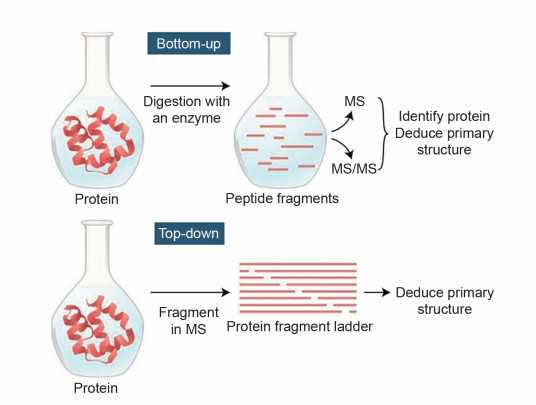
Mass spectrometry based protein sequencing analysis is the analysis of the amino acid sequence of a sample (protein, antibody, peptide). Mass spectrometry for peptide and protein sequence determination includes bottom-up proteomics and top-down proteomics.
The former is the mainstream technology of mass spectrometry sequencing, i.e., the protein is cleaved into small fragments by specific enzymatic or chemical hydrolysis, and then the molecular weight of each product peptide is detected by mass spectrometry, and the obtained peptide spectrum data is entered into a database to search for known proteins corresponding to it to obtain the protein sequence to be measured.
This method can effectively identify amino acid isomers and post-translational modifications. Due to the introduction of cleavage, it is difficult to resolve and grasp the overall sequence information of the protein using this method, and it is difficult to identify proteins with low content.
The latter method starts from the whole protein molecule, which can be introduced into the mass spectrometry by electrospray or matrix-assisted laser-resolved ionization, and then dissociated and analyzed by tandem mass spectrometry.

Mass spectrometry and Edman degradation are both used for protein sequence analysis, but they differ significantly in sample compatibility, sequence depth, and modification analysis. For modern protein sequencing projects, mass spectrometry offers broader analytical coverage and greater flexibility for complex samples.
| Feature | Mass Spectrometry | Edman Degradation |
|---|---|---|
| N-terminal blocking or modification | Sequence analysis can still be performed through peptide-level or intact-protein workflows. | Blocked N-termini may prevent sequencing. |
| Sample purity requirement | Can handle purified samples and more complex mixtures. | Typically requires very high purity. |
| PTM analysis | Supports phosphorylation, glycosylation, and other PTM characterization. | Limited for comprehensive PTM analysis. |
| Sequence coverage | Broad coverage through bottom-up and top-down approaches. | Usually limited to N-terminal residues. |
| Complex sample compatibility | Suitable for mixed or difficult samples. | Less suitable for complex mixtures. |
| Sensitivity | Effective for low-abundance targets with modern high-resolution instruments. | More challenging when sample amount is limited. |
| Leu/Ile differentiation | May require specialized fragmentation or orthogonal strategies. | Can be distinguished directly. |
Mass spectrometry is especially valuable for complex mixtures, modified proteins, monoclonal antibodies, and projects requiring broader sequence coverage or structural characterization.
At Creative Proteomics, we pride ourselves on offering a comprehensive range of protein sequencing services to meet the diverse needs of our clients. Our expertise and advanced technologies enable us to deliver accurate and reliable results for a variety of sequencing projects.
Protein sequencing by mass spectrometry can be performed using bottom-up proteomics, top-down proteomics, or a combined strategy depending on the sample type and analytical objective. Bottom-up workflows digest proteins into peptides for LC-MS/MS analysis, while top-down workflows analyze intact proteins to preserve more complete sequence context.
Sample type, purity, quantity, and project objectives are evaluated to determine the most suitable sequencing strategy.
Depending on the sample format, proteins may undergo cleanup, enrichment, in-gel digestion, or intact protein preparation.
Peptides or intact proteins are analyzed using high-resolution mass spectrometry platforms to generate accurate mass and fragmentation data.
Data are processed using database search, peptide mapping, mutation analysis, or de novo sequencing workflows to reconstruct sequence information.
A comprehensive report is provided with sequence results, peptide evidence, modification information if applicable, and expert interpretation.
Bottom-up proteomics is widely used for routine sequence determination and complex mixtures, whereas top-down proteomics is particularly valuable for intact protein characterization and higher sequence continuity.

For enzymatic digestion, we employ a diverse set of proteases beyond the traditional Trypsin. This includes Chymotrypsin, Asp-N, Glu-C, Lys-C, and Lys-N, which are specifically selected based on the sample and the experimental objectives. This strategy enhances peptide sequence coverage and facilitates the analysis of complex samples.
To ensure comprehensive coverage and to accurately identify post-translational modifications, we utilize both Higher-energy Collisional Dissociation (HCD) for generating b and y ions and Electron Transfer Dissociation (ETD) for preserving labile post-translational modifications. These techniques, available on our Orbitrap systems, provide complementary information that enhances sequence coverage and modification detection.
Our suite includes the Thermo Scientific Orbitrap Fusion Lumos Tribrid Mass Spectrometer and the Bruker Daltonics timsTOF Pro. These instruments are renowned for their exceptional resolution, mass accuracy, and sensitivity, enabling the precise measurement of peptide masses and the identification of proteins even at low abundances.
For data analysis, we employ sophisticated software solutions such as the Mascot search engine and Proteome Discoverer for protein identification and quantitation. These tools are critical for interpreting the complex data generated by mass spectrometry and for ensuring the accuracy of our protein sequencing efforts.
Mass spectrometry is a powerful strategy for protein sequencing, but certain analytical challenges must be considered during project design. By combining optimized sample preparation, tailored digestion strategies, and advanced fragmentation methods, these challenges can be effectively addressed.
We apply complementary enzyme strategies, targeted fragmentation, and orthogonal sequence interpretation approaches when residue-level differentiation is critical.
We optimize cleanup, enrichment, and instrument conditions to improve peptide detectability and sequence confidence.
MS-based workflows can analyze internal peptides and intact proteins even when terminal sequencing is restricted.
LC-MS/MS separation and database-supported peptide analysis improve identification in mixed samples.
Fractionation, enrichment, and tailored fragmentation strategies help improve recovery of modified peptides and support confident sequence analysis in structurally challenging samples.
This integrated approach supports reliable protein sequencing for purified proteins, gel bands, complex mixtures, and structurally challenging samples.
We employ cutting-edge mass spectrometry platforms with resolution exceeding 100,000 and mass accuracy within 1 ppm, ensuring the highest level of precision and sensitivity.
Our instruments are capable of processing up to 500 samples per day, enabling rapid data generation without compromising quality.
We adhere to rigorous quality control measures, with a data accuracy rate exceeding 99.9% and a reproducibility rate of 98%, ensuring reliable and consistent results.
Our team of bioinformatics experts provides comprehensive data interpretation, delivering detailed insights and actionable conclusions.
Our work has resulted in over 500 peer-reviewed publications in prestigious journals, underscoring our expertise and contributions to the field.
We develop customized workflows tailored to each project's unique requirements, resulting in optimized efficiency and cost-effectiveness.
| Sample Type | Volume/Amount | Preparation Guidelines |
|---|---|---|
| Pure Proteins | 10-100 µg |
|
| Complex Mixtures | 100 µg - 1 mg |
|
| FFPE Samples | 10 sections (10 µm thick) |
|
| Cell Lysates | 100 µg - 2 mg |
|
| Tissue Samples | 10-100 mg |
|
Unambiguously identifying proteins in complex mixtures, crucial for understanding cellular processes and disease states.
Detecting and characterizing PTMs, essential for grasping protein function and regulation.
Quantitative proteomics, providing insights into differential expression patterns under various conditions.
Elucidating the interaction networks, pivotal for deciphering signaling pathways and functional dynamics.
Target identification and validation, accelerating the development of therapeutic agents.
Identifying disease-specific proteins, enhancing diagnostic and prognostic capabilities.

Comprehensive deliverables designed to support interpretation, downstream analysis, and confident scientific decision-making.
An exhaustive report detailing the methods, parameters, and outcomes of the analysis.
A list of identified proteins, along with their confidence scores and relevant peptides.
Information on detected PTMs, including location, type, and quantification when applicable.
For quantitative projects, a dataset illustrating protein abundances across samples or conditions.
Files compatible with common bioinformatics tools for further analysis and visualization.
Post-analysis consultation with our experts to discuss findings and guide subsequent steps or further analyses.
Published Research Example
Sample
Recombinant TcPolβ
Prep
In-gel digestion
Platform
NanoLC-MS/MS
Output
25 phosphosites
To investigate kinase-dependent regulation of TcPolβ, the client performed in vitro phosphorylation assays and used mass spectrometry to identify modified peptide regions and localize phosphorylation sites. The study focused on how different kinases modulate TcPolβ, a DNA polymerase involved in kinetoplast DNA repair and replication.
Sample Type
Recombinant TcPolβ phosphorylated in vitro by TcCK1, TcCK2, TcAUK1, and TcPKC1.
Sample Preparation
TcPolβ bands were separated by SDS-PAGE, excised from the gel, and subjected to in-gel trypsin digestion.
Mass Spectrometry Analysis
Recovered peptides were separated by NanoLC and identified by MS/MS scan.
Data Analysis
Raw MS files were searched against the TcPolβ reference sequence using MaxQuant for phosphosite localization and sequence alignment.
Key Insight
Mass spectrometry enabled site-specific mapping of kinase-dependent phosphorylation patterns on TcPolβ, including detection of rare tyrosine phosphorylation events.
Service Value
Key Findings
Total phosphorylation sites identified across all kinase treatments
TcCK1
12 sites
TcCK2
3 sites
TcAUK1
3 sites
TcPKC1
7 sites
The workflow supported detection of both serine/threonine phosphorylation and rare tyrosine phosphorylation events.
Reference
Maldonado E, Canobra P, Oyarce M, et al. In Vitro Identification of Phosphorylation Sites on TcPolβ by Protein Kinases TcCK1, TcCK2, TcAUK1, and TcPKC1 and Effect of Phorbol Ester on Activation by TcPKC of TcPolβ in Trypanosoma cruzi Epimastigotes. Microorganisms. 2024;12(5):907.
For research use only, not intended for any clinical use.