Introduction
Protein structure is the result of non-covalent interactions of amino acid residues in three-dimensional space.
Typically, proteins fold into one or more specific spatial conformations to perform their biological functions.
Protein structure involves four different levels, namely primary structure, secondary structure, tertiary structure,
and quaternary structure. Among them, primary structure is the basis of protein biological function, and its
determination and structure are the premise of understanding protein structure and function. The determination of
protein primary structure mainly includes the determination of the number of polypeptide chains, the type, number
and arrangement of amino acids in each polypeptide chain, as well as the position and number of intra- or
inter-chain disulfide bonds in polypeptide chains. Nowdays, with the development of analytical tools, mass
spectrometry has become a powerful tool for protein determination. In proteomic studies, the technology can even be
used to sequence protein mixtures. However, in most cases, a combination of techniques is used to produce the most
reliable results.
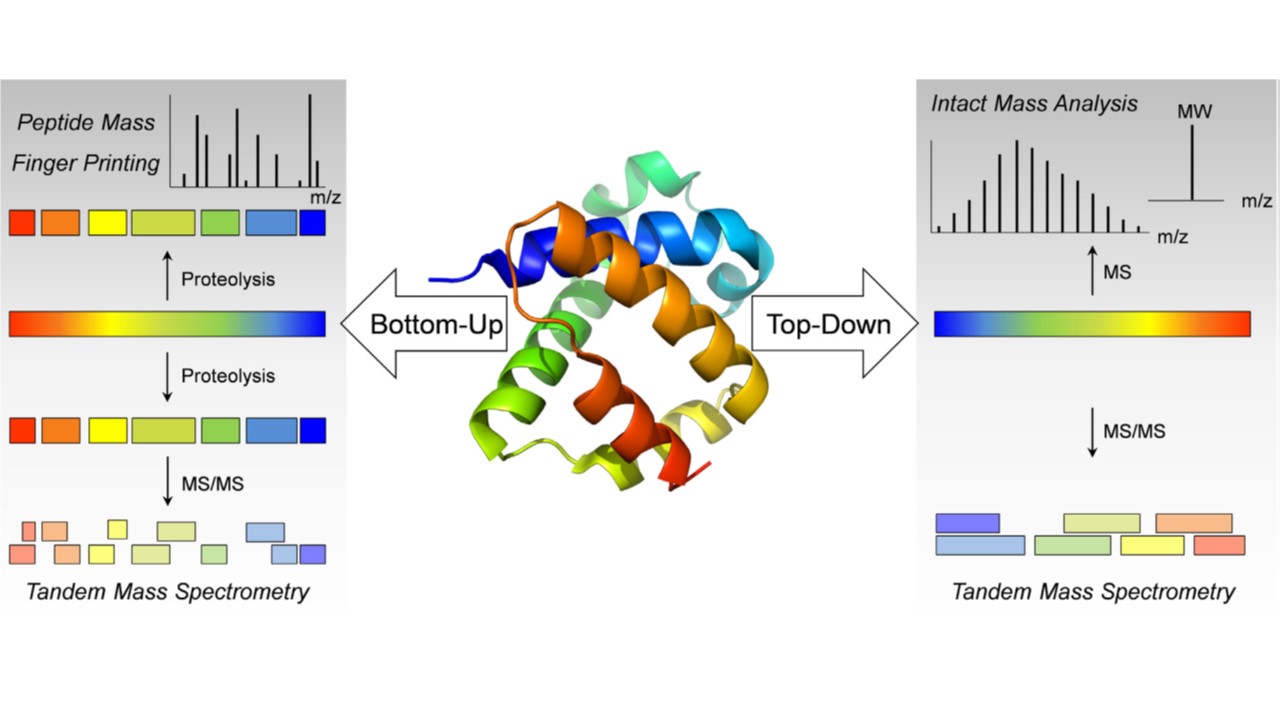 Fig.
1. Bottom-up and top-down analysis for the structural characterization of peptides and protein pharmaceuticals by
mass spectrometry. (Leurs U, et al., 2015)
Fig.
1. Bottom-up and top-down analysis for the structural characterization of peptides and protein pharmaceuticals by
mass spectrometry. (Leurs U, et al., 2015)
Our Services
Structural analysis of a protein usually begins with the determination of the amino acid sequence of its primary
structure, and the determination of primary structure is the first most necessary and critical step you take in
protein research for drug development.
At Creative Proteomics, with many years of sequencing experience, our protein structure
identification services are able to meet customer requirements for specific targets, and the successful
implementation of this service relies on peptide mapping MS/MS analysis and de novo sequencing technology developed
by my scientists.
During protein sequence analysis, six proteases (trypsin, chymotrypsin, Asp-N, Gluc-C, Lys-C, and Lys-N) are used by
our highly skilled to digest your protein of interest and the resulting peptides can be reliably isolated and
identified segment, then drill down to the complete sequence information of the protein. During this process, while
peptide fragments are obtained by mass spectrometry, 100% certainty of the protein sequence is done by splicing
between peptides. Each amino acid composition and surrounding amino acid microenvironment, including disulfide bond
information, can then be displayed.
Here, our experienced scientists provide you with comprehensive and reliable protein primary structure analysis
techniques, some of the outstanding services include:
- Sequence-Based Intact Quality Confirmation
- Amino Acid Sequence Confirmation
- N/C-Terminal Variant Analysis
- Disulfide Bond Structure
In accordance with the regulatory requirements of ICH Q6B, we use a combination of molecular mass spectrometry (MS)
and peptide mapping analysis to determine your protein's primary structure (amino acid sequence).
Additionally, our experienced professional scientists will use de novo sequencing techniques to characterize your
protein's primary structure (amino acid sequence), when the protein sequence was not available in open protein
or genome databases.
Thanks to our powerful mass spectrometry sequencing platform, Creative Proteomics, as a first-class
protein sequencing service provider, is committed to providing global customers with all protein structure
identification service to accelerate their project research journey. Our services guarantee accurate and reliable
results, at quick turnaround time! Please contact us If you are interested
in our services.
References
- Vandermarliere E, Stes E, Gevaert K, et al. (2016) Resolution of protein structure by mass
spectrometry. Mass Spectrom Rev. 35(6):653-665.
- Mouchahoir T, Schiel J E. (2018) Development of an LC-MS/MS peptide mapping protocol for the NISTmAb. Anal
Bioanal Chem. 410(8):2111-2126.