Introduction
Phosphorylation is one of the most important post-translational modifications in cellular activities, and it is
involved in the regulation of almost all cellular activities, including cell proliferation, differentiation, and
apoptosis. Phosphorylation modification has the characteristics of simplicity, flexibility and reversibility, and
the availability of ATP, a donor of phosphate groups, is a common regulatory means in eukaryotic cells and plays a
role in various cellular activities, including glycolysis, protein -protein interactions, protein degradation,
enzyme inhibition, homeostasis, etc. Protein phosphorylation is the reversible process of attaching phosphate groups
to proteins catalyzed by enzymes, mainly on serine, threonine or tyrosine residues. Notably, mass spectrometry (MS)
has revolutionized signal analysis by allowing rapid identification of phosphorylation sites in a precise and
sensitive manner and is a powerful tool for phosphorylation analysis.
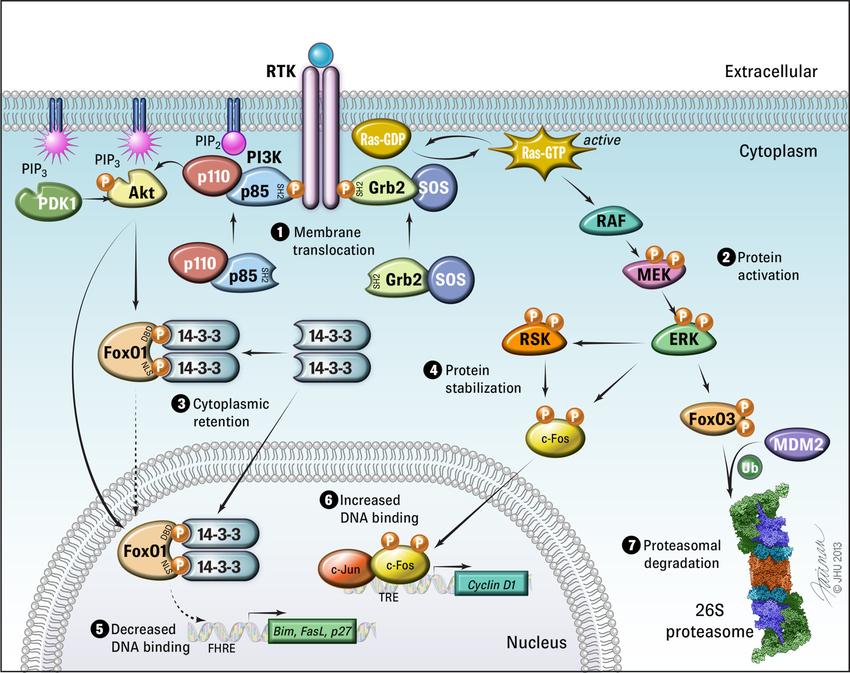 Fig. 1. Functional
significance of protein phosphorylation. (Roux P P, et al., 2013)
Fig. 1. Functional
significance of protein phosphorylation. (Roux P P, et al., 2013)
Our Services
Creative Proteomics provides a high-quality and highly sensitive phosphoproteome analysis platform
to determine phosphorylation and phosphorylation sites by applying mass spectrometry to your phosphopeptides.
At Creative Proteomics, we can perform large-scale analysis of complex samples, which often requires
enrichment of peptides prior to mass spectrometry analysis. Our highly skilled personnels provide various enrichment
methods for phosphorylated peptides according to experimental needs, including TiO2 and IMAC enrichment,
solid-phase metal affinity chromatography (IMAC) enrichment, and phosphorylated antibody enrichment.
Based on our well-established phosphoproteome analysis platform, Creative Proteomics can provide an
accurate one-stop phosphoprotein analysis service package, including protein extraction, digestion, phosphopeptide
enrichment, peptide separation, MS analysis and bioinformatics analyze.
Here, we can provide but not limited to:
- Phosphorylation Analysis
- Phosphopeptide Enrichment
- Phosphorylation Site Identification
- Phosphorylation Site Mapping
- Protein-Protein Interaction Analysis
Advantages of Our Services
Our analytical services strictly follow ICH Q6B guidelines, and a high-quality phosphorylated protein analysis
services are provided through high-performance mass spectrometry (MS) and liquid chromatography systems, etc., which
ensures that our phosphorylated protein assays have the following attractive features.
- High precision: A high-throughput and high-precision detection results can be guaranteed using phosphorylated
protein enrichment and sensitive MS analysis.
- Extreme accuracy: Combined with iTRAQ/TMT labeling to reduce within-sample variability, yield consistent and
accurate phosphorylation identification.
- Eperienced professionals: Our experienced team of scientists and analysis help with phosphorylated protein
analysis.
- Customized service: Customized service based on sample type and project to meet your special requirements.
- Advanced mass spectrometry platform: It ensures reliable and reproducible results.
- Detailed report: You will receive an easy-to-understand report describing the data analysis and results step by
step, as well as a folder with all tables and figures.
Sample Requirements
- Tissue samples: Plant tissue samples > 200 mg, blood samples > 1 mL (with EDTA for anticoagulation of
plasma), serum > 0.5 mL, urine> 2 mL, animal tissue samples > 1 g, cell samples > 5X10⁷
cells, and microorganisms > 200 mg (dry weigh).
- Protein samples > 1 mg.
Thanks to our powerful mass spectrometry sequencing platform, Creative Proteomics provides a
one-stop hosphorylated protein analysis service. Our experienced scientists work with you to develop tailor-made
analytical solutions. All you need to do is send us your samples, communicate your research goals with our experts,
and we'll go through the next steps and provide you with a full technical report. Please feel free to contact us with any questions regarding hosphorylated protein analysis.
References
- Roux P P, Thibault P. (2013) The coming of age of phosphoproteomics--from large data sets to inference of
protein functions. Mol Cell Proteomics. 12(12):3453-3464.
- Dephoure N, Gould K L, Gygi S P. et al. (2013) Mapping and analysis of phosphorylation sites: a quick
guide for cell biologists. Mol Biol Cell. 24(5):535-542.