Phage ImmunoPrecipitation Sequencing Service
Proteome-Wide Epitope Mapping

Phage ImmunoPrecipitation Sequencing (PhIP-Seq) Service

Bridge the gap between massive antigen diversity and quantitative NGS. Scan millions of epitopes in single-microliter samples with industrial-grade automation and proprietary statistical de-noising for translational biomarker discovery.

Million-Scale Peptide Tiling Automated Robotic IP Negative Binomial Hit-Calling 2-5 µL Micro-Sample Compatible

Technical Specifications

High-Throughput Immunomics

biotech

Library Depth

1.2M+ unique overlapping peptides for zero-blind-spot coverage.

Input Volume

Requires only 2-5 µL of serum, plasma, or CSF per assay.

Automation

Robotic IP washing protocols for large 1,000+ cohort scale.

Resolution

Precise 7-15 amino acid linear binding motif reconstruction.

Overview & Platform

Libraries

Workflow & QC

Deliverables & Applications

Case Study

FAQ

What is PhIP-Seq? The High-Dimensional Discovery Engine

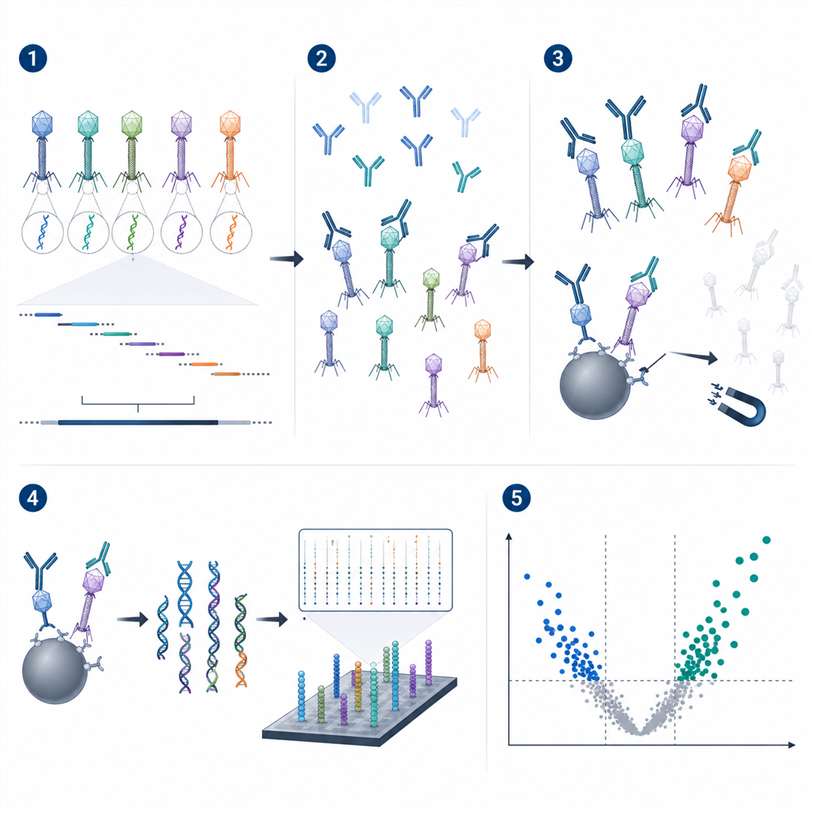
Phage ImmunoPrecipitation Sequencing (PhIP-Seq) is a massive-scale proteomics technology used to scan the entire human antibody repertoire. Unlike traditional immunoassays that look for one target at a time, PhIP-Seq uses bacteriophages to display millions of overlapping peptides representing entire proteomes or viromes.

When mixed with a patient's serum, antibodies bind to their specific phage-displayed peptide targets. These antibody-phage complexes are then isolated via immunoprecipitation (IP) and deep-sequenced using high-throughput NGS.

By digitizing the physical interaction between antibodies and antigens, PhIP-Seq provides an unbiased, log-scale map of immune activity. It empowers researchers to discover novel biomarkers for autoimmune diseases, track viral exposure histories, and decode complex immune responses at a proteome-wide scale.

Diagram illustrating the PhIP-Seq methodology and workflow.

PhIP-Seq vs. Traditional Immunoassays

The strategic decision to adopt PhIP-Seq is driven by the need for unconstrained discovery power, transitioning from targeted validation to unbiased, global immunomic scanning.

Feature Conventional ELISA / WB Protein Microarrays PhIP-Seq Service
Antigen Capacity 1 - 10 discrete targets 100 - 9,000 targets 1,000,000+ Peptides
Discovery Logic Validation only Targeted screening Unbiased Proteome Scanning
Epitope Resolution Full protein (Low) Domain-level (Medium) Linear Motif (7-15 aa)
Sample Input High (20-50 µL per target) Medium Ultra-low (2-5 µL total)
Dynamic Range 10² (Colorimetric) 10² (Fluorescence) 10⁴ (Log scale sequencing)
Reproducibility Operator-dependent Surface-chemistry sensitive Automated & Quantifiable

PhIP-Seq Platform: Industrialized Immunomics Infrastructure

Automated PhIP-Seq Robotic Platform
robot_2

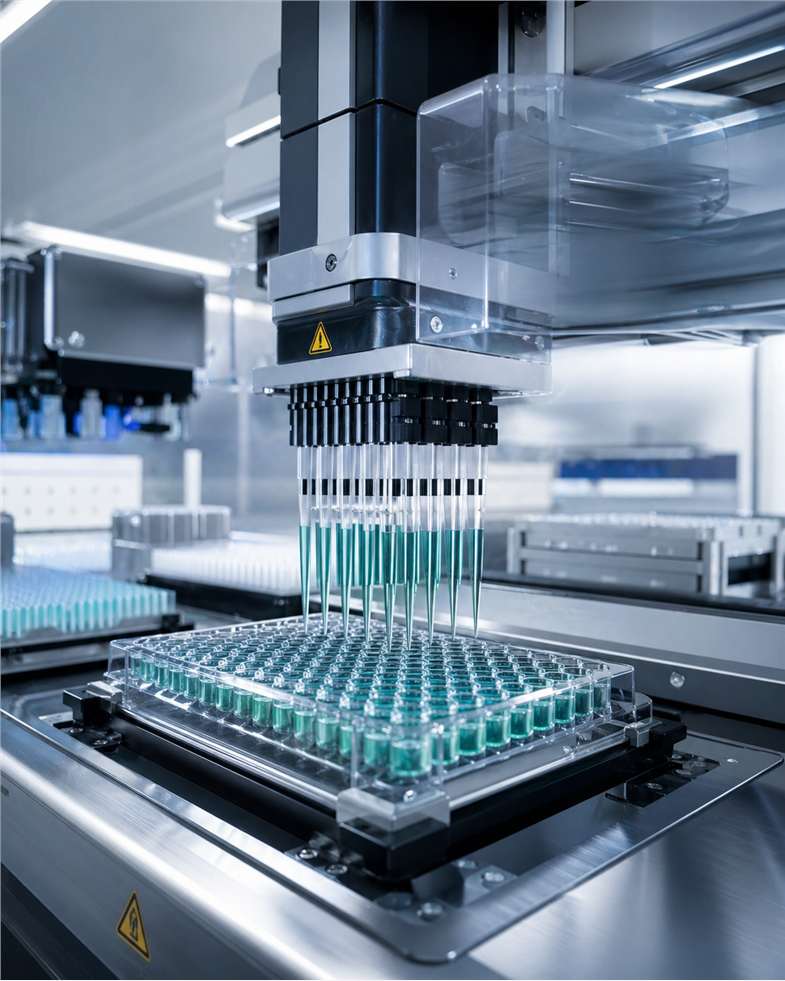
Automated IP Robotics

The immunoprecipitation (IP) phase is the most sensitive stage. We deploy automated magnetic bead processing workstations (e.g., KingFisher™ Flex) to execute multi-stage, high-stringency wash cycles, eliminating operator-induced batch effects.

dynamic_feed

Ultra-High Throughput NGS

To capture rare, highly-enriched clones within a million-member library, we utilize Illumina NovaSeq™ 6000 and NextSeq™ platforms to deliver mean peptide coverage exceeding 100x.

analytics

Statistical De-noising Core

Utilizing proprietary Negative Binomial (NB) modeling algorithms that mathematically strip background phage "stickiness" to isolate true antigenic binding events with high confidence.

terminal

HPC Computational Cluster

PhIP-Seq data analysis is a massive-scale statistical challenge. Our dedicated HPC cluster runs parallelized alignment pipelines, converting terabytes of FASTQ data into normalized matrices.

Phage Display Library Portfolio

The analytical depth of a PhIP-Seq project is dictated by library design. To prevent the truncation of critical binding motifs across peptide junctions, we utilize a rigorous 28-amino acid overlap (for 56-mer libraries) or a 45-amino acid overlap (for 90-mer libraries). This ensures every possible epitope is redundantly covered.

accessibility_new

Human Peptidome

  • Representing known isoforms of the human proteome. The definitive tool for autoantibody discovery in oncology and rheumatology.
coronavirus

VirScan (Virome)

  • Covering the genomes of over 1,000 human-infecting viruses. Reveals a lifetime of viral exposure from a single microliter.
microbiology

Microbiome Panels

  • Specialized libraries for investigating host-microbiota cross-reactivity and the immune drivers of gastrointestinal inflammation.
design_services

Custom Construction

  • A comprehensive "Oligo-to-Phage" service. Provide FASTA sequences, and we synthesize, clone, and validate the custom library.

Hardcore QC Standards for Library and Data Integrity

In high-throughput immunomics, controlling background noise is paramount. We enforce five non-negotiable QC metrics to ensure results meet the stringent standards of top-tier translational research.

QC Parameter Standard / Threshold Significance for Translational Research
Peptide Representation > 99.5% Detected Ensures near-perfect library completeness with zero biological "blind spots."
Library Uniformity Gini Coefficient < 0.2 Prevents dominant clones from consuming all sequencing reads, rescuing rare hits.
Technical Reproducibility R² > 0.92 Guarantees that identified "Hits" are consistent across biological replicates.
FDR Control BH Correction < 0.05 Rigorous multiple-testing correction minimizes false-positive rates effectively.
Sequencing Depth > 100x Mean Coverage Provides the statistical power to capture micro-enrichment signals.

Automated PhIP-Seq Workflow for Research Cohorts

Our standardized process ensures complete transparency and high-fidelity data generation from sample receipt to bioinformatics delivery.

01

Library Verification

Deep-sequencing QC of the phage library prior to sample incubation to confirm diversity and titer.

02

Robotic IP

Automated systems handle antibody-phage binding, magnetic protein A/G bead capture, and stringent washing.

03

Amplification

Enriched phage DNA is amplified and heavily multiplexed with dual-index barcodes for pooled sequencing.

04

Deep NGS

High-depth sequencing runs on Illumina platforms to digitize the physical enrichment.

05

Hit-Calling

Proprietary algorithms strip background noise using specialized statistical models, followed by linear epitope mapping.

PhIP-Seq Bioinformatics Data Visualization

PhIP-Seq Deliverables and Advanced Bioinformatics Analysis

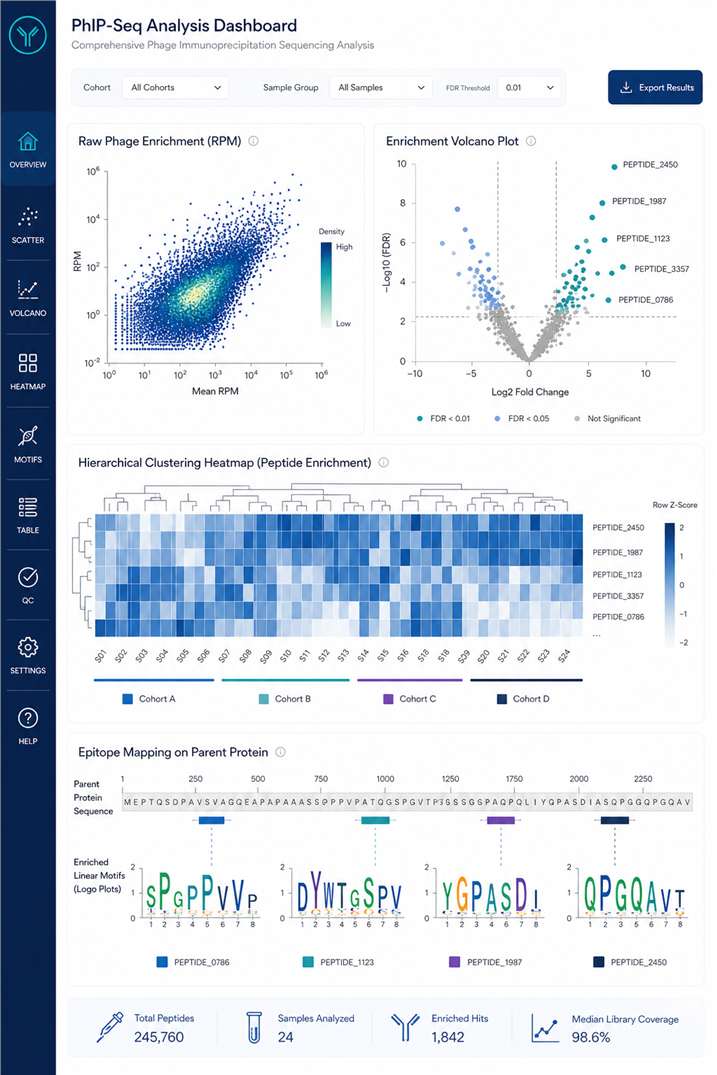
We don't just deliver FASTQ files; we provide a synthesis-ready data package that translates billions of reads into biological narratives for biomarker discovery.

description

Raw Data & Alignment Metrics

Cleaned FASTQ files, read-count matrices, and mapping quality reports.

database

Statistical Hit-Calling

Negative Binomial and Poisson distribution models isolate true antigen binding from stochastic phage stickiness.

hub

Motif Discovery (MEME/GLAM2)

Reverse-engineering of the minimal 7-15 amino acid binding motifs from enriched peptide clusters.

bar_chart

Epitope Localization

Re-aligning enriched peptides to their parent protein sequences to map functional binding domains.

analytics

Research Cohort Analytics

PCA, Hierarchical Clustering Heatmaps, and Volcano plots for stratifying patients and extracting predictive biomarker signatures.

Broad Applications in Translational Immunology

travel_explore

Autoimmunity Biomarkers

Unbiased screening for novel autoantibodies in Multiple Sclerosis, SLE, and idiopathic conditions for translational studies.

monitor_heart

irAEs Biomarker Research

Retrospective profiling of patients undergoing Immune Checkpoint Inhibitor (ICI) therapy to identify autoantibody signatures correlated with toxicities.

coronavirus

Epidemiological VirScan

Large-scale monitoring of viral exposure and retrospective analysis of vaccine-induced immune imprinting across populations.

rule

Antibody Off-Target Analysis

Evaluating the systemic cross-reactivity of engineered therapeutic mAbs against the full human peptidome during preclinical safety assessments.

eco

Allergenomics

Mapping specific IgE/IgG binding patterns across thousands of environmental and dietary allergens for R&D purposes.

Sample Requirements and Micro-Volume Processing

Sample Type Minimum Volume Preparation & Shipping Guidelines
Serum / Plasma 2 – 5 µL
  • - Standard collection; EDTA or Heparin compatible.
  • - Dry Ice; 1.5 mL low-bind tubes.
Cerebrospinal Fluid (CSF) 5 – 10 µL
  • - Must be free of visible blood; Protein > 0.01 mg/mL.
  • - Dry Ice; Immediate freezing recommended.
Purified IgG 100 µg/mL
  • - Minimum 50 µL total volume; MS-compatible buffer.
  • - Dry Ice or Blue Ice.
Synovial / Aqueous Humor 5 – 10 µL
  • - Centrifuged to remove cellular debris.
  • - Avoid freeze-thaw cycles. Dry Ice.

Note: For large-scale cohorts (>1,000 samples), we provide full logistical support, barcoded traceability, and cross-plate normalization to mitigate batch effects during retrospective analysis.

Translational Research Benchmark

Predicting immune-related adverse events (irAEs) via Proteome-Wide Profiling

Cohort

200+ Samples

Library

Human Proteome

Platform

Automated IP

Output

7-aa Motifs

Scientific Objective & Challenge

Immune checkpoint inhibitors (ICIs) have radically transformed oncology, yet a significant proportion of patients experience severe immune-related adverse events (irAEs) such as myocarditis. The underlying mechanisms remained poorly understood, and traditional targeted immunoassays failed to identify reliable pre-treatment predictors. Researchers sought to uncover the underlying autoantibody profiles by retroactively screening pre-treatment sera from a large patient cohort (200+ samples).

PhIP-Seq Experimental Design

  • Utilized a comprehensive 90-mer Human Peptidome library with a 45-amino acid overlap.
  • Ensured robust coverage of linear and local secondary epitopes across the entire proteome.
  • Implemented automated robotic immunoprecipitation to ensure standardized stringency, followed by deep NGS sequencing.

Transformative Discoveries

  • Pre-treatment Detection: Unbiased screening identified trace-level, pre-existing autoantibodies invisible to standard arrays.
  • Target Localization: Specific motifs on tissue-restricted proteins correlated with localized toxicities (e.g., myocarditis).
  • Resolution: Bioinformatics narrowed binding sites to precise 7-amino acid minimal motifs.

Research Impact

Prediction precision of severe irAEs prior to ICI therapy

> 85% Specificity

The deployment of PhIP-Seq provided the structural resolution necessary to move beyond candidate-gene guesswork. It established a robust biomarker discovery framework, demonstrating that high-throughput profiling of the autoantibody repertoire can uncover critical mechanisms driving immunotoxicities, paving the way for future validation studies in oncology.

Scientific Reference

Shrock, E., et al. (2023). Germline-encoded amino acid–binding motifs drive immunotoxicities. Science. PMC10874550.

Frequently Asked Questions

How do you handle the "Phage Stickiness" problem in raw data?expand_more
Non-specific binding is the primary challenge in PhIP-Seq. We combat this via a multi-tier approach: 1) Utilizing automated, high-stringency magnetic bead washing; 2) Integrating multiple "Mock-IP" (no-sample) controls in every 96-well plate; 3) Applying advanced statistical models (Negative Binomial distribution) that account for the overdispersion of background clones, thereby mathematically stripping the noise during Hit-Calling.
Why is the Gini Coefficient critical for library quality?expand_more
The Gini coefficient is a mathematical measure of inequality. In a phage library, if a few clones are hyper-abundant, they will consume almost all the sequencing reads, masking the detection of antibodies binding to less abundant clones. We strictly maintain a Gini coefficient below 0.2 to ensure high uniformity, granting every peptide a fair chance of detection and maximizing sensitivity for low-titer autoantibodies in research samples.
How do you control for Batch Effects in cohorts exceeding 1,000 samples?expand_more
Manual processing inevitably introduces "operator drift." We prevent this by relying entirely on automated liquid handlers. Furthermore, for massive retrospective cohorts, we utilize a Cross-Plate Normalization strategy. We include identical bridging samples (common positive controls) on every physical plate, allowing our bioinformatics team to calibrate enrichment scores and ensure that samples processed weeks apart remain statistically comparable for research purposes.
Does PhIP-Seq detect complex conformational epitopes?expand_more
PhIP-Seq primarily utilizes linear peptides (typically 56-mer to 90-mer). While our overlapping tiling design is exceptionally powerful for mapping linear and local secondary motifs, its capacity to detect complex conformational epitopes that depend on long-range 3D protein folding is limited. For full conformational mapping, we recommend integrating our structural biology or Cryo-EM research services.

Research Use Only

Disclaimer: All services and products described herein are for Research Use Only (RUO) and are strictly not intended for use in clinical diagnostic procedures or medical decision-making.

Online Inquiry
Online Inquiry