Single Molecule Protein Sequencing Hero Banner
Precision Proteomics

Single Molecule Protein Sequencing Service

Bridge the sensitivity gap in clinical proteomics. Our platform moves beyond bulk average measurements to identify ultra-low abundance proteins, rare structural variants, and complex modification patterns molecule-by-molecule.

By leveraging digital single-molecule readouts, we provide a high-resolution complement to traditional discovery assays, enabling the detection of targets that fall below the traditional analytical noise floor.

Single-Molecule Sensitivity Proteoform Mapping PTM-Associated Evidence Limited Sample Efficiency

Technical Positioning

The Digital Discovery Engine

biotech

Resolution

Digital counting of individual protein-derived peptides.

Sensitivity

Rescue rare targets below the conventional MS noise floor.

Context

Resolve molecular heterogeneity without reassembly guesswork.

Optimization

Engineered for precious clinical specimens and micro-volumes.

Overview & Fit

Capabilities

Platform & Process

Advantages & Apps

Sample & Deliverables

FAQ

What Is Single Molecule Protein Sequencing?

Single molecule protein sequencing identifies and decodes individual protein molecules in parallelized arrays. Moving beyond mass-to-charge fragmentation, this technology employs real-time kinetic sensing and semiconductor readouts to iteratively decode primary structures.

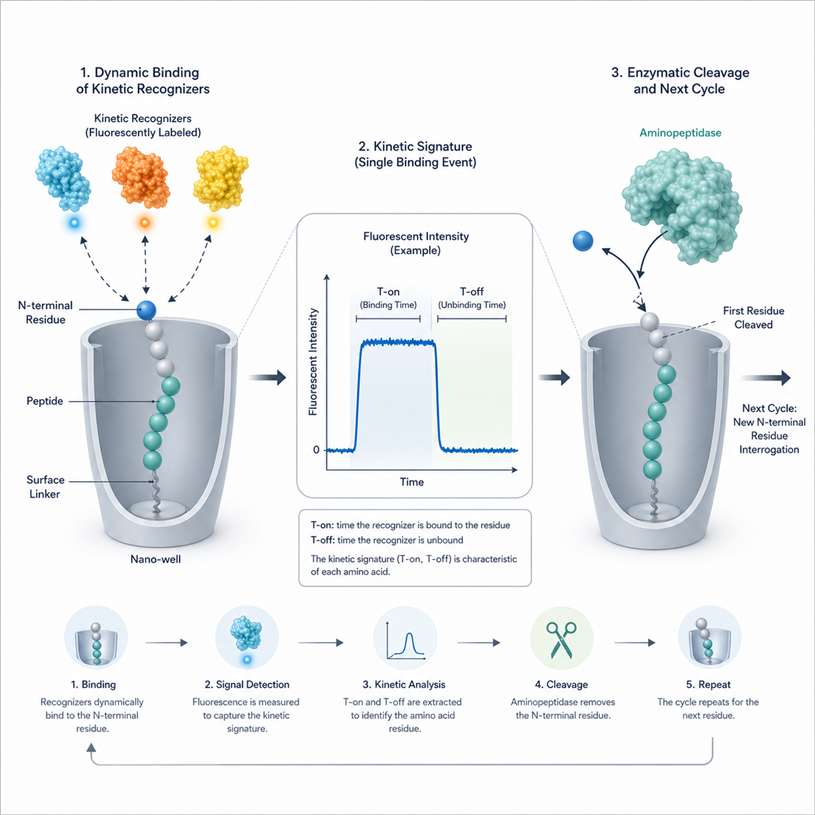
Utilizing advanced single-molecule fluorescence sequencing, dye-labeled recognition proteins bind dynamically to terminal amino acids. Each binding event produces unique kinetic signatures (residence times and fluorescence lifetimes) that differentiate structurally similar residues with high precision.

Bridging the Sensitivity Gap: While global mass spectrometry discovery is powerful, low-abundance biomarkers are often masked by high-background proteins. This platform serves as a strategic complement, rescuing rare targets and providing modification-associated evidence from volume-limited specimens.
Technical diagram of single molecule protein sequencing mechanism

When to Use Single Molecule Protein Sequencing

Consider utilizing this specialized single-molecule service when biological complexity exceeds the detection limits of conventional instrumentation:

Research Scenario Analytical Need The Strategic Advantage
Below Detection Limits Target proteins undetectable by high-resolution MS. Digital counting identifies targets below the traditional noise floor.
Sample Scarcity Precious specimens like needle aspirates or biobank entries. Optimized to maximize data recovery from highly limited clinical inputs.
Rare Variant Mapping Requirement to resolve specific protein diversity. Enables direct molecular mapping of isoforms and structural variants.
Orthogonal Validation Independent evidence for critical discovery findings. Provides single-molecule kinetic fingerprints as definitive evidence.

Our Single Molecule Protein Sequencing Capabilities

We provide a focused suite of delivery services designed to translate raw kinetic data into actionable molecular evidence.

data_thresholding

Digital Target Counting

Quantifying rare targets in complex mixtures by translating kinetic events into digital single-molecule counts.

account_tree

Proteoform Profiling

High-resolution mapping of variants and splice isoforms at the single-molecule level without reassembly guesswork.

hub

Modification Mapping

Providing site-specific PTM evidence, including phosphorylation and glycosylation contexts, directly from single molecules.

verified

Sequence Verification

Investigating trace-level variations and sequence impurities in exploratory biologics and engineered antibodies.

How Single Molecule Protein Sequencing Works

Our workflow integrates industrialized single-molecule detection with probabilistic data models to ensure robust peptide identification from complex clinical research matrices.

01

Sample Prep

Peptides are optimized for sensor stability and loaded onto semiconductor chips containing millions of nanowells.

02

Immobilization

Peptide molecules are anchored within individual reaction chambers for simultaneous parallel observation.

03

Kinetic Sensing

Dye-labeled recognizers bind terminal residues; unique kinetic fingerprints (on/off rates) distinguish structurally similar amino acids.

04

Iterative Cleavage

Controlled aminopeptidases cleave the terminal residue to expose the next amino acid for identification.

05

Probabilistic Alignment

Digital signals are processed via probabilistic models (HMM) to handle incomplete cleavage and ensure robust sequence alignment.

Technical Specifications & Performance Metrics

The following parameters define the performance envelope of our high-resolution single-molecule analytical platform:

Analytical Parameter Target Specification
Detection Sensitivity Single-molecule resolution; detects low picogram to nanogram level protein inputs.
Effective Dynamic Range Captures digital counts across 5 to 6 orders of magnitude for broad target coverage.
Operational Throughput Millions of parallelized nanowell sequencing reactions per individual chip run.
Read Length Capability Typically 10-20 amino acids per peptide, optimized for variant-specific identification.
Data Integrity (FDR) Rigorous control with peptide identification False Discovery Rate (FDR) typically ≤ 1%.
Assay Reproducibility Consistent molecular fingerprints with inter-run assay CVs typically < 15%.
Delivery Formats Digital count matrices (CSV), alignment probability files, and expert analytical PDF reports.

Technological Platform for Single Molecule Sequencing

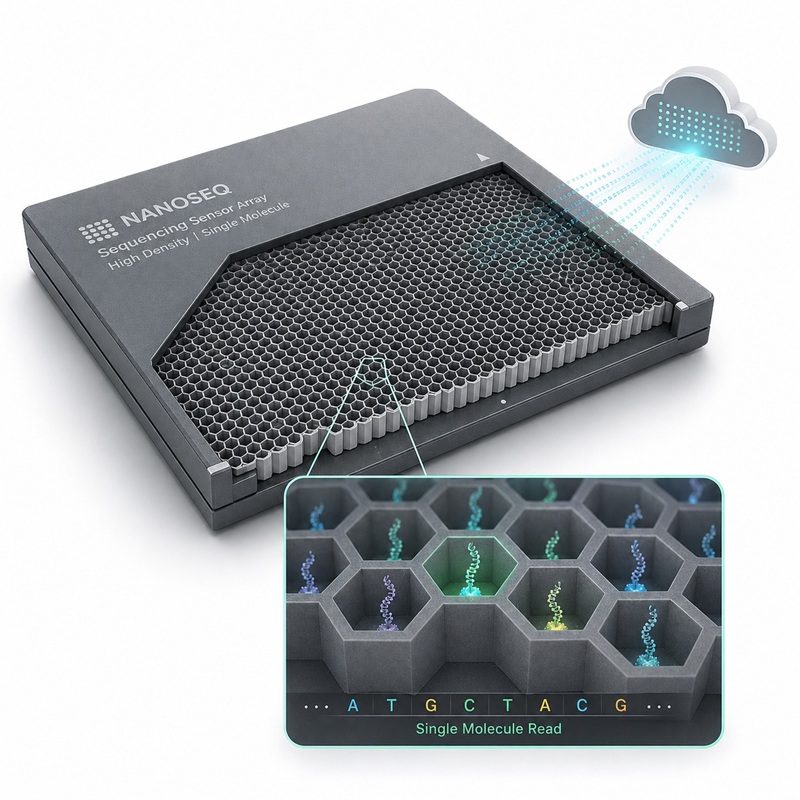
High-density semiconductor sequencing sensor chip array
memory

High-Density Sensor Chips

Leveraging advanced semiconductor chips featuring millions of nanowells for the simultaneous observation of individual peptide molecules.

sensors

Kinetic Recognizers

Engineered proteins that accurately identify residues in real-time, differentiating even structurally similar amino acids through binding rate measurement.

science

Precision Cleavage Enzymes

Highly controlled aminopeptidases ensure iterative removal of N-terminal residues without compromising the integrity of the remaining sequence.

data_thresholding

HMM-Based Bioinformatics

Probabilistic data processing handles missing signals and incomplete cycles to enable robust sequence mapping against reference proteomes.

Technology Considerations and Project Fit

Understanding technical boundaries is essential for success with high-resolution single-molecule technology.

Is it a replacement for Mass Spectrometry?

No. This technology is a highly targeted complementary tool intended for investigation of specific low-abundance targets that fall below the mass spectrometry detection floor.

Is it suitable for all sample types?

Feasibility depends heavily on target concentration and sample complexity. Highly heterogeneous raw clinical samples typically require upfront depletion or enrichment.

Can it sequence intact, full-length proteins?

Currently, the technology is optimized to sequence individual protein-derived peptides or selected molecules governed by kinetic stability during the iterative process.

Can it completely resolve all PTMs?

It provides robust modification-associated sequence evidence, but resolution of densely modified regions (like complex glycosylation) still requires careful assessment.

Single Molecule Protein Sequencing vs. Mass Spectrometry vs. Edman Sequencing

To assist in determining the appropriate analytical strategy, we outline the fundamental differences between leading techniques:

Feature Mass Spectrometry Edman Sequencing Single Molecule Protein Sequencing
Technical Strength Mature, global discovery panel. Reliable N-terminal residue ID. Digital single-molecule readout.
Best For Broad protein discovery and ID. Purified proteins and peptides. Low-abundance targets and proteoforms.
PTM Resolution Excellent but context-limited. Limited compatibility. Direct modification-associated evidence.

Advantages of Single-Molecule-Level Protein Analysis

troubleshoot

Single-Molecule Sensitivity

By counting individual molecules, we bypass signal requirements of ensembles, enabling detection at extremely low titers.

water_drop

Maximized Efficiency

The platform is specifically optimized for precious or limited samples, maximizing data recovery where volume is a constraint.

join_inner

Preserved Evidence

Direct interrogation provides a clearer understanding of structural variants without reassembly errors.

Applications of Single Molecule Protein Sequencing

Transforming translational research where molecular diversity and sample scarcity dictate project outcomes:

biotech

Oncology & Liquid Biopsy

Tracking trace mutant proteins from limited biofluids to identify exploratory markers that evade bulk detection.

psychology

Neurodegeneration

Resolving complex Tau or Amyloid proteoforms in precious cerebrospinal fluid (CSF) specimens.

coronavirus

Immunology Research

Mapping rare cytokine variants and signaling proteins that drive inflammatory responses molecule-by-molecule.

science

Exploratory Biologics

Characterizing trace-level sequence impurities and host cell proteins in research-stage therapeutic batches.

Sample Requirements and Feasibility Assessment

We maintain a flexible intake approach to accommodate limited research specimens. Project feasibility is assessed based on target molecular weight and overall concentration.

Sample Format Minimum Requirement Strategic Application
Purified Proteins High purity (>90%) preferred. Inputs from low picogram to nanogram levels.
Peptide Fractions Targeted peptide pools. Optimized to reduce background interference.
Exploratory Biologics Research-stage therapeutics. Ideal for trace variation mapping.
Precious Biofluids Serum, CSF, or rare fluids. Focus on micro-volume compatibility.

Ready to evaluate if single-molecule sequencing can resolve your analytical roadblocks?

Schedule a customized feasibility assessment with our technical specialists today.

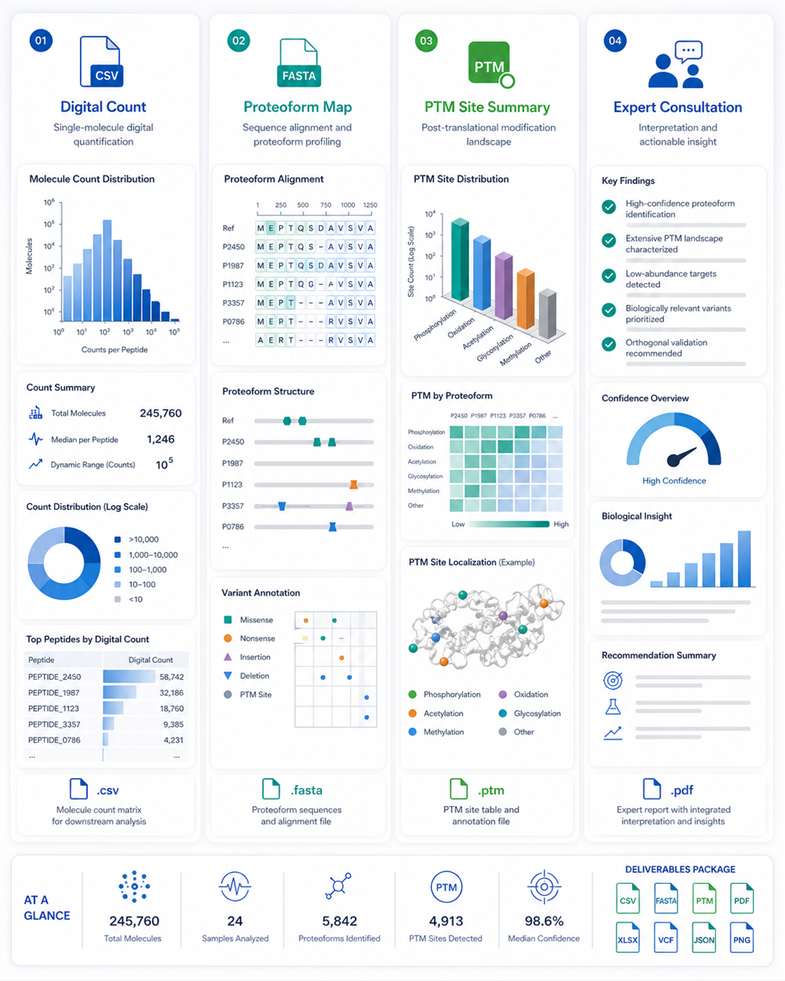
Technical report dashboard representing sequencing deliverables

Deliverables of Single Molecule Protein Sequencing

Comprehensive deliverables designed to support interpretation and advanced scientific decision-making.

description

Detailed Methodology Report

Exhaustive methodology detailing digital counting outcomes and variant alignments.

database

Digital Readout Matrix

Raw digital counting evidence for identified peptides provided in CSV format.

hub

PTM & Variant Summary

Summary of modification-associated sequence evidence and structural isoforms.

analytics

Probabilistic Alignments

Alignment probability files formatted for standard bioinformatics pipelines.

psychology

Strategy Review

Post-analysis consultation to discuss findings and guide subsequent research steps.

Frequently Asked Questions

What is the read length for single-molecule analysis?expand_more
Currently, the technology sequences individual peptides or selected molecules. Typical read lengths range from 10 to 20 amino acids, governed by the kinetic stability of the molecule during cleavage.
How is it different from mass spectrometry?expand_more
While mass spectrometry measures bulk populations, this technology digitally counts individual molecules. This offers a distinct advantage for detecting rare variants and ultra-low abundance targets below conventional detection limits.
Can it resolve post-translational modifications?expand_more
Yes. Unique kinetic binding signatures can differentiate between modified and unmodified amino acids, providing direct modification-associated sequence evidence on a molecule-by-molecule basis.
Is this technology suitable for clinical diagnostics?expand_more
No. This service is intended strictly for exploratory research, biomarker discovery, and early-stage protein characterization.

Disclaimer: All services and products described herein are for Research Use Only (RUO) and are not intended for use in clinical diagnostic procedures, patient management, or medical decision-making.

Online Inquiry
Online Inquiry