
Clinical Proteomics Pipeline: From Biomarker Discovery to Clinical Validation
Most biomarker studies fail between discovery and clinical application — not because the biology was wrong, but because the pipeline had gaps. A protein found significant in a discovery cohort of 20 samples disappears when tested in 200. A candidate identified by DDA can't be reliably quantified in the validation cohort because the acquisition method changed between phases. A machine learning model trained on one dataset overfits and fails in an independent set.
Clinical proteomics requires a single, integrated pipeline — not three separate experiments stitched together. DIA acquisition generates a complete digital record of every sample's proteome, enabling retrospective re-analysis as hypotheses evolve. PRM assays are designed from the same spectral library used for DIA discovery, ensuring method continuity from discovery to verification. Machine learning models are trained with nested cross-validation to prevent overfitting, and validated in truly independent cohorts — the same standard applied in clinical trial design. For biomarker candidates requiring absolute quantification, our targeted proteomics assays with heavy-labeled peptide standards provide the highest quantitative precision.
Content Guide
- Discovery to Validation Pipeline
- Clinical Sample Types
- Therapeutic Areas
- Bioinformatics & ML
- Starting Your Study
- Deliverables
Discovery, Verification, and Validation — One Clinical Proteomics Pipeline
| Phase | Method | What You Get | Typical Scale |
|---|---|---|---|
| Discovery | DIA on timsTOF or Orbitrap | Unbiased quantification of 1,000–9,000+ proteins per sample. Complete digital proteome archive for retrospective re-analysis. | 20–500 samples per group |
| Verification | PRM (parallel reaction monitoring) | Targeted quantification of 50–200 candidate biomarkers with absolute or relative quantification. Heavy-labeled peptide standards optional. | 100–1,000+ independent samples |
| Validation | Machine learning + independent cohort | LASSO/random forest panel selection, cross-validated AUC, calibration curves, decision curve analysis. Biomarker panel locked before testing on held-out data. | 100–500+ samples (not used in discovery) |
This is not a pick-and-choose menu — it's a single pipeline designed so that data flows cleanly from one phase to the next. The spectral library built during DIA discovery becomes the reference for PRM assay design. The same QC standards, the same normalization methods, the same bioinformatics platform carry through all three phases, eliminating the batch effects and method discontinuities that kill biomarker programs at the transition points.
Clinical Proteomics Sample Types
Each sample type requires a dedicated extraction and digestion protocol. Select your matrix for details.

Blood / Plasma / Serum
1,000+ proteins without depletion. Plasma and serum proteomics for biomarker screening and cohort studies.

FFPE Tissue
9,000+ proteins from archival blocks. FFPE quantitative proteomics for retrospective clinical cohorts.

Urine
Non-invasive biomarker source for kidney, urological, and systemic diseases. Urine proteomics with standardized normalization protocols.

Cerebrospinal Fluid (CSF)
Direct window into CNS proteome. CSF proteomics optimized for low protein concentration.

Fresh-Frozen Tissue
Highest proteome depth — 9,000+ proteins. For prospective studies where sample collection can be standardized.

Other Biofluids
Saliva, sweat, tears, nasal secretions, and fecal samples — each with matrix-specific protocols available on request.
Clinical Proteomics Applications in Oncology, Cardiovascular, Neuroscience, and More
Clinical proteomics is disease-agnostic — the same DIA+PRM pipeline adapts to your biological question, regardless of therapeutic area.

Oncology
Tumor tissue proteomics for molecular subtyping, drug resistance mechanisms, and immunotherapy response prediction. Serum biomarker panels for early cancer detection and recurrence monitoring.

Cardiovascular & Metabolic
Plasma proteomics for heart failure risk stratification, atherosclerosis biomarker panels, and metabolic syndrome characterization.

Neuroscience
CSF and plasma proteomics for neurodegenerative disease biomarkers — Alzheimer's, Parkinson's, multiple sclerosis. Blood-based panels for early detection.

Immunology & Inflammation
Serum and tissue proteomics for autoimmune disease characterization, inflammatory biomarker panels, and treatment response monitoring.

Infectious Disease
Plasma proteomics for host response profiling, severity prediction, and vaccine efficacy biomarkers. Pathogen proteomics for antigen discovery.

Rare & Genetic Diseases
Proteomics for functional validation of genetic variants, biomarker discovery from limited samples, and patient stratification for clinical trials.
Starting Your Clinical Proteomics Study
Every clinical proteomics project begins with a conversation — not a purchase order. Here is what to prepare before contacting us, and what happens next.
What to Prepare
- Sample type and count: how many samples, what matrix, what collection protocol was used
- Clinical metadata: group assignments, outcomes, covariates (age, sex, medication, etc.)
- Biological question: diagnosis? prognosis? treatment response? mechanism?
- Prior data: existing genomics, transcriptomics, or biochemical assays on the same cohort
What We Evaluate
- Sample quality: we recommend a pilot run on 5–10 representative samples if provenance is uncertain (e.g., biobank specimens)
- Statistical power: based on expected effect sizes and cohort size, we estimate detectable fold-changes at your desired FDR
- Pipeline fit: which phases (discovery only, discovery+verification, full pipeline) match your study stage and budget
What You Receive
- Study design document: detailed experimental plan with sample randomization, batch design, QC strategy, and statistical analysis plan
- Timeline and milestones: phased delivery schedule with checkpoints for go/no-go decisions between pipeline stages
- Cost estimate: itemized per phase, so you can stage your study — discovery first, verification only for promising leads
Bioinformatics and Machine Learning for Clinical Proteomics
The proteomics data you receive is an input to decision-making — not the decision itself. Our bioinformatics transforms protein quantification matrices into clinically actionable results.
| Analysis | What It Provides | When to Use It |
|---|---|---|
| Differential Expression | Moderated t-test / ANOVA with multiple testing correction (Benjamini-Hochberg). Volcano plots, heatmaps, PCA. | Any two-group or multi-group comparison. Foundation for all downstream analysis. |
| Pathway & Network | GO, KEGG, Reactome enrichment. PPI networks with cluster identification. Kinase-substrate enrichment for phosphoproteomics. | Translating protein lists into biological mechanisms. Essential for publication and grant applications. |
| Survival Analysis | Kaplan-Meier curves stratified by protein expression. Cox proportional hazards regression with clinical covariate adjustment. | Cohort studies with follow-up data. Identifying proteins associated with patient outcomes. |
| Biomarker Panel Development | LASSO / elastic net / random forest feature selection. Nested cross-validation, calibration curves, decision curve analysis. | Building multi-marker diagnostic or prognostic panels. Requires independent training and validation sets. |
| Molecular Subtyping | Consensus clustering, NMF, UMAP/t-SNE visualization. Subtype-specific pathway enrichment and survival analysis. | Discovering proteome-defined patient subgroups with distinct biology or outcomes. |
| Multi-Omics Integration | MOFA, correlation networks across proteomics + transcriptomics/metabolomics. Combined biomarker panels. | Studies with matched multi-omics data from the same samples. |
- Every analysis includes full statistical documentation — test used, correction method, effect sizes, confidence intervals
- Machine learning models are delivered with cross-validation metrics, calibration plots, and decision curve analysis — not just AUC
- For multi-center studies, site is included as a covariate in all models to identify and adjust for collection site effects
Clinical Proteomics Deliverables
What you receive at each phase of the pipeline.
Discovery Phase
- Protein quantification matrix (N samples × M proteins)
- QC report: sample clustering, CV distributions, outlier detection
- Differential expression analysis with full statistics
- Pathway enrichment and network analysis
- Raw DIA data files (.d or .raw)

Verification Phase
- PRM quantification of selected candidates
- Transition quality scores and interference assessment
- Absolute quantification with heavy peptide standards (optional)
- ROC analysis for individual and combined biomarkers

Validation Phase
- Machine learning model (LASSO, random forest, or ensemble)
- Cross-validated AUC, calibration curves, decision curve analysis
- Final locked biomarker panel with coefficients
- Independent validation cohort results
Clinical Proteomics Frequently Asked Questions
Basic research proteomics answers biological questions — what pathways are activated, how does protein expression change with treatment. Clinical proteomics answers translational questions — can these proteins diagnose disease, predict outcomes, or guide treatment decisions.
The technical difference is in study design and statistical rigor. Clinical proteomics requires pre-registered analysis plans, independent discovery and validation cohorts, adjustment for clinical covariates (age, sex, medication), and model evaluation metrics that reflect clinical utility — not just statistical significance. The mass spectrometry is the same. The study design is what makes it clinical.
Case Study: Blood Proteomics Predicts Parkinson's Disease 7 Years Before Symptoms
Discovery
MS proteomics on PD vs control plasma
Verification
Targeted MRM on 164 individuals
Validation
54 pre-motor iRBD patients
Result
79% identified · 7 years before onset
Background
Parkinson's disease is diagnosed when motor symptoms appear — tremor, rigidity, bradykinesia. By that point, 60–80% of dopaminergic neurons in the substantia nigra are already lost, and disease-modifying therapies have little tissue left to protect. The clinical need is clear: a blood-based test that identifies at-risk individuals years before motor onset, enabling enrollment in preventive trials during the window when neuroprotection is still possible. Non-motor symptoms — loss of smell, REM sleep behavior disorder — can precede motor symptoms by a decade, but most patients never receive a neurological workup during this prodromal phase.
Study Design & Samples
A three-phase clinical proteomics pipeline was applied across three independent cohorts. The discovery cohort comprised 10 drug-naïve Parkinson's patients and 10 matched healthy controls. The verification cohort expanded to 164 individuals: 99 newly diagnosed PD patients, 36 healthy controls, and 29 patients with other neurological disorders — testing whether the biomarkers were specific to Parkinson's or reflected general neurodegeneration. The prospective validation cohort consisted of 54 patients with isolated REM sleep behavior disorder (iRBD), a condition where approximately 80% of patients eventually convert to Parkinson's or Lewy body dementia. Baseline blood samples were collected years before any motor symptoms emerged, and patients were followed longitudinally for conversion.
Technical Methods
Discovery phase: Label-free MS-based proteomics on plasma from PD patients vs controls identified differentially expressed proteins. Pathway analysis mapped candidates to inflammatory, ER stress, and WNT signaling pathways. Verification phase: A targeted MRM-MS assay was developed for the most promising candidates and applied to the 164-patient independent cohort. This tested both diagnostic accuracy (PD vs healthy) and disease specificity (PD vs other neurological disorders). Validation phase: A locked support vector machine (SVM) classifier incorporating 8 proteins (GRN, MASP2, HSPA5/BiP, PTGDS, ICAM1, C3, DKK3, SERPING1) was applied to baseline samples from the iRBD cohort — with no re-tuning after seeing validation results.
Key Findings
| Result | Performance | Significance |
|---|---|---|
| PD vs healthy discrimination | 100% specificity at 100% sensitivity | Zero false positives in the verification cohort — essential for population screening |
| Disease specificity | Panel distinguishes PD from other neurological disorders | Biomarkers reflect PD-specific pathology, not general neurodegeneration |
| Pre-motor prediction (iRBD) | 79% correctly classified, up to 7.3 years before motor onset | Molecular changes are detectable years before clinical diagnosis |
| Biological pathways | Inflammation, ER stress, WNT signaling | Panel proteins map to druggable pathways — not just a diagnostic tool, but a target discovery resource |
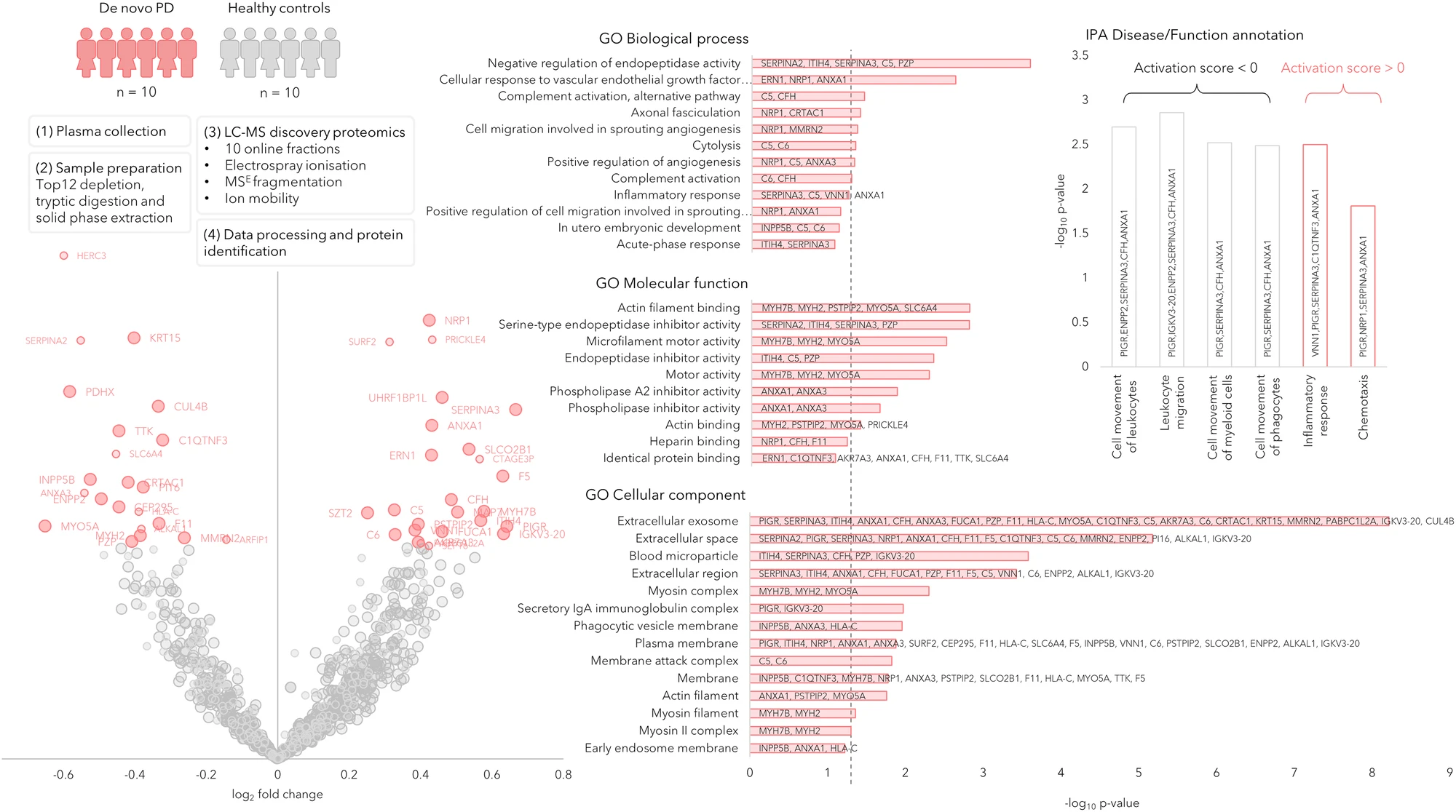
Discovery phase: MS proteomics identified differentially expressed plasma proteins between Parkinson's patients and healthy controls — revealing inflammatory, ER stress, and complement pathway activation.
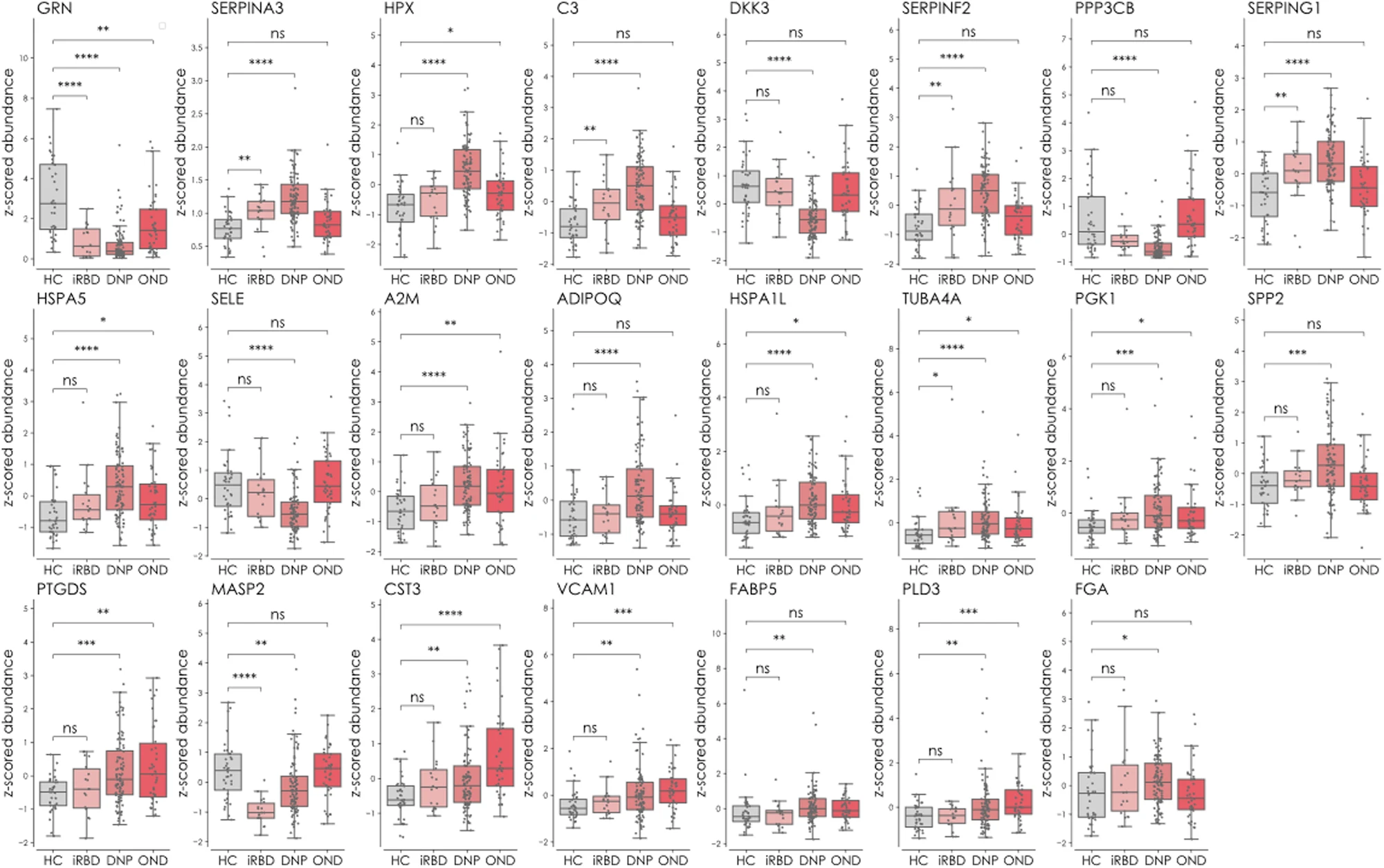
Validation phase: A locked 8-protein SVM classifier correctly identified 79% of pre-motor iRBD patients who would convert to PD — up to 7.3 years before motor symptom onset.
What This Means for Clinical Proteomics Studies
- Clinical proteomics detects disease before clinical diagnosis. The 8-protein panel identified molecular signals of neurodegeneration up to 7.3 years before motor symptoms. No existing clinical test or imaging modality matches this lead time — a transformative capability for any disease where early intervention changes outcomes.
- Three-phase pipeline eliminates the most common source of biomarker failure. Discovery (18 patients) → verification (164 independent samples across multiple disease groups) → prospective validation (54 pre-motor patients with longitudinal follow-up). Each phase used completely separate cohorts. The model was locked before validation — no re-tuning. This is the standard your biomarker program should meet.
- The same pipeline adapts to any therapeutic area. Whether your target is cancer, neurodegeneration, cardiovascular disease, or autoimmune conditions, the clinical proteomics pipeline — MS discovery, targeted verification, ML validation — is disease-agnostic. The proteins and pathways change. The three-phase design and statistical rigor don't.
Reference: Hällqvist J, Bartl M, Dakna M, et al. Plasma proteomics identify biomarkers predicting Parkinson's disease up to 7 years before symptom onset. Nature Communications. 2024;15:4759. doi:10.1038/s41467-024-48961-3