Get Your Custom Quote

Online Inquiry

High-Precision IP-MS Absolute Quantification Service for Target Validation

Accelerate drug discovery with our IP-MS absolute quantification service. Overcome Western Blot limits, validate low-abundance targets, and secure publication-ready data.

Compliance & Usage Statement: Creative Proteomics provides high-precision quantitative proteomics services bridging discovery and validation. All data, reports, and analytical services discussed herein are strictly for Research Use Only (RUO) and are not intended for use in human or animal clinical diagnostics, GMP manufacturing, or therapeutic applications.

Overview Advantages Service Packages Comparison Workflow Requirements Case Study Demo FAQ

CORE SERVICE

Overview: Bridging the Gap in Target Validation

When qualitative interaction mapping is no longer sufficient for high-impact publications or critical go/no-go drug discovery decisions, precise quantification is required. Our IP-MS absolute quantification service for target validation provides a robust, highly sensitive analytical solution that bridges the gap between basic discovery and rigorous clinical translation.

By combining the high specificity of immunoprecipitation (IP) enrichment with the unparalleled quantitative accuracy of targeted mass spectrometry (PRM/MRM), we enable researchers to determine the absolute concentration of low-abundance target proteins and endogenous complexes down to the fmol/mg level. Designed specifically for academic principal investigators, biotech R&D scientists, and pharmaceutical pipelines, this one-stop service delivers publication-ready, actionable data matrices that overcome the inherent limitations of traditional Western Blotting, ensuring your mechanism of action (MoA) studies are backed by incontrovertible evidence.

  • Absolute fmol/mg Concentration
  • Overcome Western Blot Limits
  • Endogenous Complex Focus
  • Strict LOQ/LOD Validation

Why Choose Creative Proteomics for Target Validation

For high-stakes MoA research, sample loss, non-specific binding, and data ambiguity are critical roadblocks. Creative Proteomics brings extensive experience in specialized proteomics, addressing the unique pain points of top-tier academic labs and mid-to-large biopharma organizations.

  • Overcoming Western Blot Limitations: Eliminate reliance on semi-quantitative, antibody-dependent optical density. We provide true absolute quantification across a wide dynamic range, ideal for targets that fail standard detection methods due to low abundance or poor antibody availability for blotting.
  • High-Sensitivity Instrument Fleet: All analyses are conducted on cutting-edge, high-resolution platforms, including Orbitrap, timsTOF, and Sciex systems, maximizing the limit of quantitation (LOQ) for trace endogenous proteins.
  • Gold-Standard Calibration: We utilize heavy isotope-labeled internal standards (such as AQUA peptides) spiked directly into your samples, correcting for matrix effects, ion suppression, and sample loss during complex IP protocols.
  • Endogenous Complex Focus: Specialized protocols designed to preserve transient and weak protein-protein interactions (PPIs) in their native cellular states, bypassing the artificial aggregation often seen in overexpression models and delivering high-confidence target validation for drug discovery.
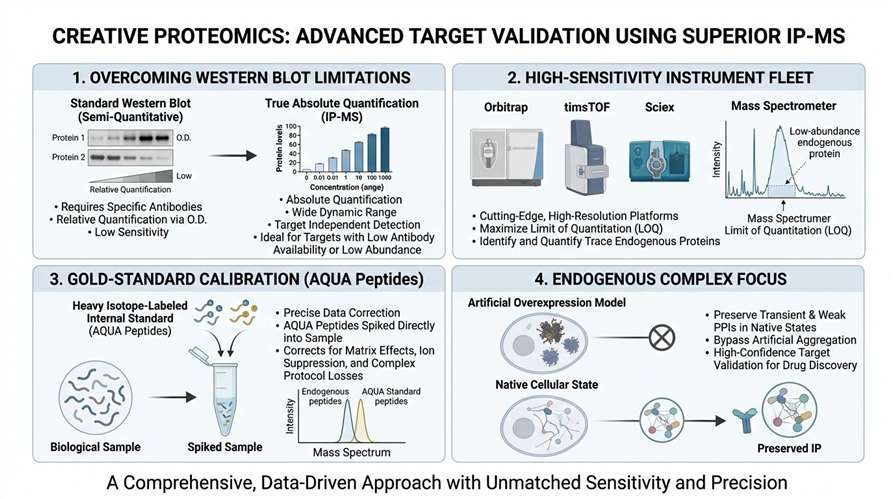
Advantages of IP-MS for target validation.

Comprehensive IP-MS Service Packages

Depending on your research phase and specific molecular questions, Creative Proteomics offers a suite of tailored immunoprecipitation and mass spectrometry services. You can seamlessly integrate absolute quantification with broader profiling strategies across various stages of pre-clinical development.

Co-IP Service

For broad-spectrum identification of interacting protein partners within complex biological mixtures. This service is ideal for the initial discovery phase, allowing researchers to map unknown interactomes before moving into targeted validation. We optimize buffer stringency to maintain delicate protein-protein interfaces.

Learn More

SILAC-based CoIP-MS

Utilizing stable isotope labeling by amino acids in cell culture (SILAC) for precise relative quantification of interactome dynamics. This package is highly effective for observing how protein complexes assemble or disassemble in real-time when exposed to specific drug candidates or physiological stimuli across different experimental conditions.

Learn More

Amyloid-β IP-MS

A specialized analytical workflow tailored specifically for neurodegenerative disease research. This service enables the precise measurement of Amyloid-β isoforms and their clearance rates, providing critical data for advanced Alzheimer's disease diagnostics model validation and the evaluation of therapeutic monoclonal antibodies.

Learn More

Technology Comparison: IP-MS vs. Standard WB/Co-IP

Selecting the right analytical platform is critical for the evaluation phase of your project. The table below outlines why quantitative proteomics is becoming the gold standard for drug MoA validation compared to legacy techniques.

Feature / Capability Traditional Western Blot Standard Qualitative Co-IP IP-MS Absolute Quantification
Data Output Type Semi-quantitative (Optical density) Qualitative (Identification only) Absolute concentration (e.g., fmol/mg)
Multiplexing Capacity Low (Typically 1-3 targets per blot) High (Hundreds of targets) High (Simultaneous multi-target quantification)
Sensitivity & LOQ Antibody-dependent, variable, prone to saturation Moderate to High Ultra-high (Sub-nanogram level precision)
Specificity Validation Prone to non-specific band cross-reactivity High (Mass-to-charge ratio) Unmatched (Precursor & fragment ion transitions)
Isotope Internal Standards Not applicable Rarely utilized Standard practice (AQUA peptides)
Ideal Application Routine lab checks, preliminary screening Initial discovery of interactors Drug discovery, MoA validation, Top-tier journals

Advanced IP-MS Workflow & Rigorous QC

Our targeted proteomics service follows a highly standardized, globally recognized workflow. We enforce rigorous quality control at every phase to ensure your data meets the evaluation criteria of both elite academic journals and pharmaceutical sourcing managers.

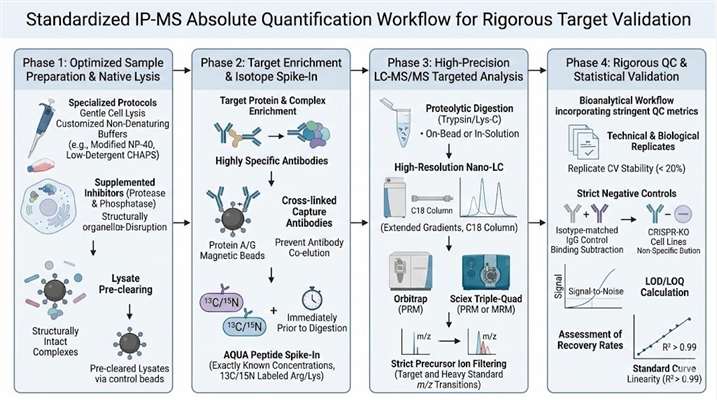
IP-MS absolute quantification workflow from immunoprecipitation to targeted mass spectrometry data analysis

Standardized IP-MS absolute quantification workflow for rigorous target validation.

Phase 1: Optimized Sample Preparation & Native Lysis: Handling challenging matrices requires specialized protocols. We perform gentle cell lysis using customized, non-denaturing buffers (such as modified NP-40 or low-detergent CHAPS) supplemented with broad-spectrum protease and phosphatase inhibitors. This crucial step ensures that endogenous protein complexes remain structurally intact while minimizing organelle disruption that could introduce background noise. The lysates are then carefully pre-cleared using control agarose or magnetic beads to eliminate non-specific binding elements prior to the primary immunoprecipitation.

Phase 2: Target Enrichment & Isotope Spike-In: Target proteins and their associated complexes are enriched using highly specific, validated antibodies. To prevent antibody co-elution—which can severely suppress target peptide ionization in the mass spectrometer—we chemically cross-link the capture antibodies to Protein A/G magnetic beads. To guarantee absolute quantitative accuracy, synthetic heavy-isotope labeled standard peptides (AQUA peptides incorporating 13C/15N-labeled arginine or lysine) are spiked directly into the bead matrix at exactly known concentrations immediately prior to digestion.

Phase 3: High-Precision LC-MS/MS Targeted Analysis: The enriched protein complexes undergo either on-bead or in-solution proteolytic digestion (typically using Trypsin/Lys-C for optimal cleavage efficiency). The resulting peptide mixtures are separated via high-resolution nano-liquid chromatography (nano-LC) utilizing extended gradients on C18 analytical columns to maximize peak resolution. The eluate is analyzed using Parallel Reaction Monitoring (PRM) on Orbitrap platforms or Multiple Reaction Monitoring (MRM) on Sciex triple-quadrupole systems. This targeted acquisition mode strictly filters out background precursor ions, isolating and fragmenting only the specific mass-to-charge (m/z) transitions of your target peptide and its corresponding heavy-isotope internal standard.

Phase 4: Rigorous Quality Control (QC) & Statistical Validation: We do not rely on assumptions. Our bioanalytical workflow incorporates stringent QC metrics to ensure data validity, including: Evaluation of technical and biological replicates to ensure Coefficient of Variation (CV) stability remains well below the industry standard of 20%. Implementation of strict negative controls (such as isotype-matched IgG controls or CRISPR-knockout cell lines) to quantitatively subtract residual non-specific binding from the final interactome calculations. Precise calculation of the Limit of Detection (LOD) and Limit of Quantitation (LOQ) based on signal-to-noise ratios. Assessment of peptide recovery rates and standard curve linearity (requiring an R² > 0.99 for all targeted MRM/PRM assays).

Sample Requirements for IP-MS Absolute Quantification

To achieve the highest analytical sensitivity, proper sample collection and preservation are mandatory. Please refer to the general guidelines below. If your matrix is highly complex or limited in volume, please consult our technical team.

Sample Type Recommended Minimum Amount Storage & Shipping Conditions Notes
Cell Lysates / Pellets 10^7 cells or 2 - 5 mg total protein -80°C, ship on dry ice Avoid strong denaturing buffers (e.g., high SDS) if endogenous complexes must be maintained.
Animal/Human Tissue 50 - 100 mg -80°C, ship on dry ice Flash-freeze immediately upon harvesting to prevent protein degradation.
Biofluids (Plasma/Serum) 200 - 500 µL -80°C, ship on dry ice Protease inhibitor cocktails are highly recommended during sample collection.
Pre-Enriched IP Eluates Dependent on target abundance -80°C, ship on dry ice Contact us to verify compatibility of your elution buffer with downstream LC-MS.

CASE STUDY

Case Study: Quantifying Novel Pharmacodynamic Biomarkers

Background

Validating the mechanism of action for novel therapeutics frequently requires monitoring subtle changes in low-abundance target pathways. Targeted mass spectrometry provides the analytical depth necessary to quantify these pharmacodynamic shifts precisely, offering a level of detail unmatched by traditional assays. Researchers required a robust, highly sensitive method to measure the pharmacodynamic effects of ATM kinase inhibition. Traditional immunological assays lacked the specificity and quantitative rigor required for evaluating these complex signaling networks and could not distinguish between closely related protein isoforms.

Methods

The study leveraged targeted mass spectrometry (MRM/PRM) integrated with stable isotope dilution techniques. Cell lysates were subjected to targeted immunoprecipitation, followed by the addition of heavy isotope internal standards. This approach allowed for the precise isolation, fragmentation, and measurement of specific peptide fragments associated with the targeted biomarkers across different kinase inhibitor treatment conditions.

Results

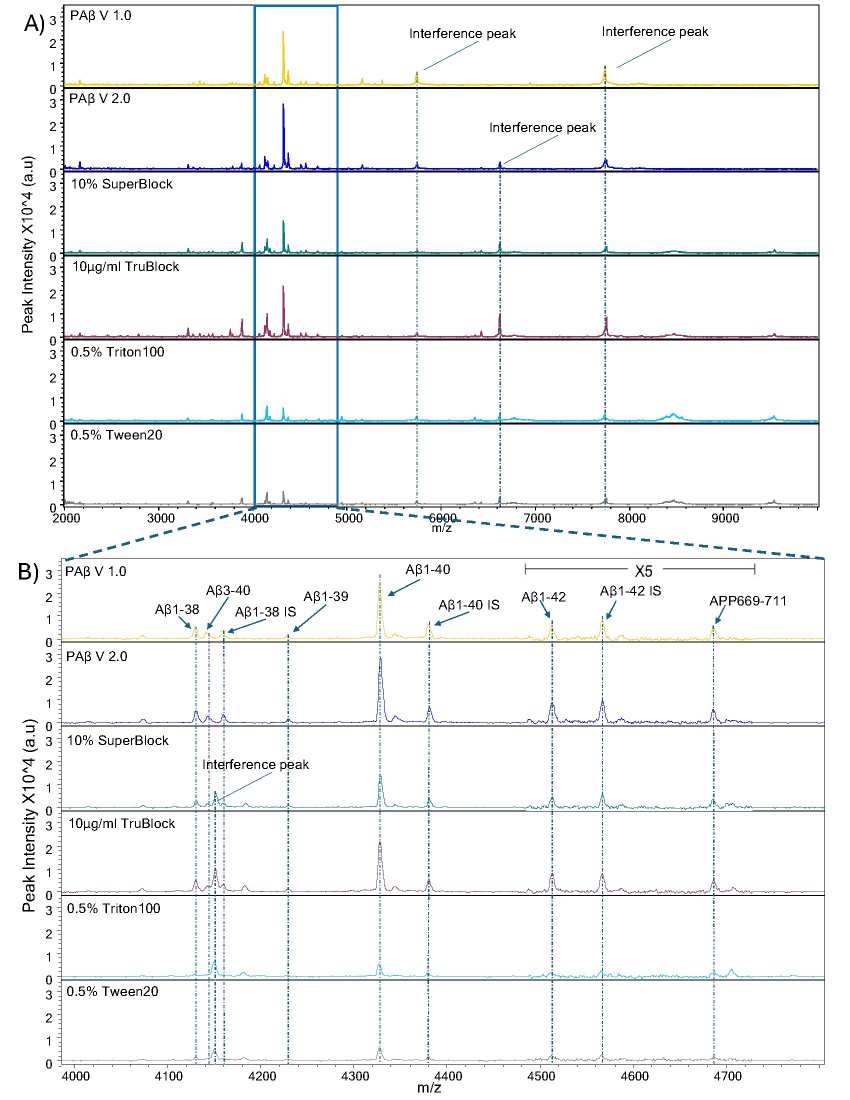
The methodology achieved highly reproducible, absolute quantification of the selected novel pharmacodynamic biomarkers down to the fmol level. The data exhibited excellent linearity and technical CVs well within acceptable limits, establishing a direct, measurable link between the kinase inhibitor administration and target engagement at the protein level.

Case study data visualization.

Conclusion

The application of high-precision quantitative MS provided incontrovertible evidence of target modulation. This robust dataset successfully bridged the gap between basic discovery and pre-clinical validation, directly supporting and accelerating the drug discovery pipeline.

Demo Results & Actionable Deliverables

Creative Proteomics bridges the gap between raw data generation and actionable biological insight. Our Custom Bioinformatics team ensures that your high-dimensional mass spectrometry data is distilled into clear, publication-ready formats that clearly articulate your findings.

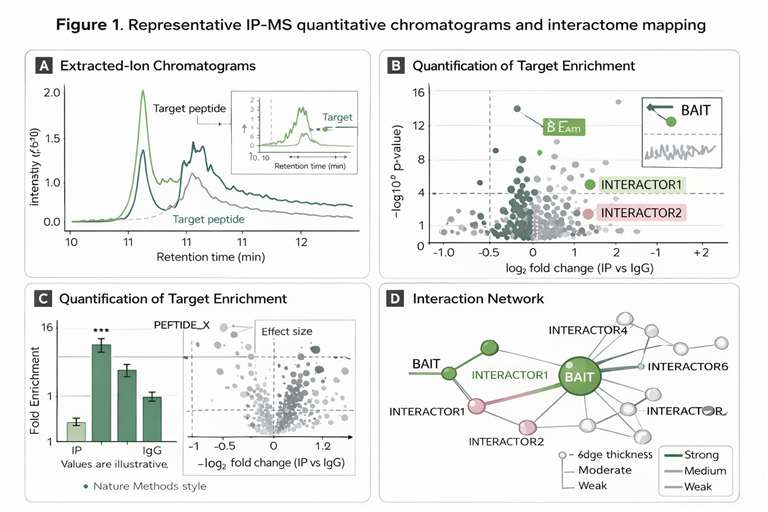
Representative IP-MS quantitative chromatograms.

Figure 1. Representative IP-MS quantitative chromatograms and interactome mapping.

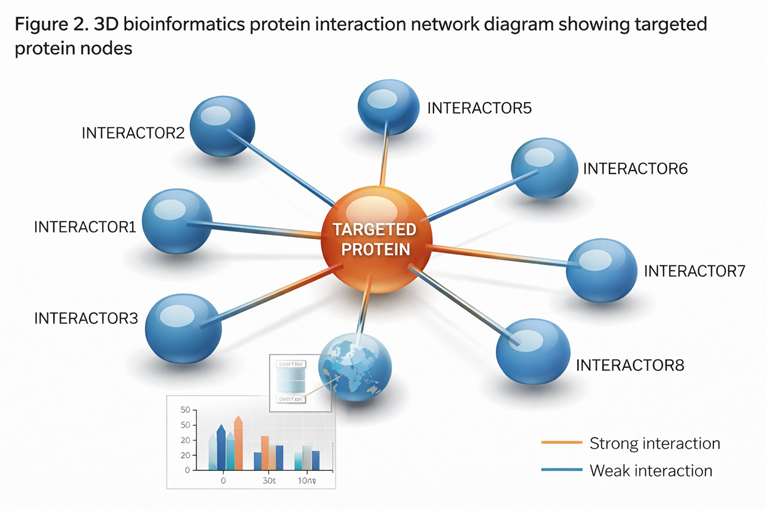
Protein interaction network demo results.

Figure 2. 3D bioinformatics protein interaction network diagram showing targeted protein nodes.

Upon project completion, clients receive a comprehensive, structured data package including:

  • Methodology Report: Detailed experimental procedures, including buffer compositions, LC gradients, and MS parameters, fully suitable for the "Materials & Methods" section of high-impact academic journals.
  • Quantitative Matrix: Formatted Excel/CSV files providing absolute protein concentrations (e.g., fmol/mg total protein or copies per cell) derived from the heavy isotope standard curves.
  • Quality Control (QC) Dossier: High-resolution chromatograms demonstrating precise peak integration, standard curve linearity (R² values), negative control base-lining, and CV values across all technical replicates.
  • Custom Bioinformatics: Where applicable, visualization of quantitative interaction networks using tools like Cytoscape, pathway enrichment analysis (KEGG/GO), and stoichiometric mapping of multi-subunit protein complexes.

Frequently Asked Questions (FAQ)

1. What is the difference between standard Co-IP and your IP-MS absolute quantification service for target validation?

Standard Co-IP followed by Data-Dependent Acquisition (DDA) MS is excellent for identifying unknown interacting partners (qualitative discovery). However, our absolute quantification service utilizes targeted MS (PRM/MRM) coupled with heavy isotope internal standards. This transitions the data from simple "presence/absence" to exact absolute concentrations, which is critical for verifying target engagement and validating drug MoA.

2. How do you handle high background noise or non-specific binding during the IP-MS workflow?

Background noise is a common challenge. We mitigate this through optimized pre-clearing steps, stringent washing buffers tailored to the target's binding affinity, and the mandatory inclusion of robust negative controls (such as isotype IgG or knockout samples). Furthermore, the targeted nature of PRM/MRM physically isolates the signal, filtering out non-specific background ions at the mass spectrometer level before detection.

3. What sample types and starting amounts are required for analyzing endogenous protein complexes?

We routinely process cell lysates, solid tissues, and biofluids. Because endogenous complexes often exist at low concentrations, we generally recommend starting with 2-5 mg of total protein (or ~10^7 cells) to ensure sufficient target enrichment. However, requirements vary based on target abundance, and our team will optimize the protocol for your specific matrix.

4. Do you use spike-in heavy isotope standards (AQUA peptides) for absolute quantification?

Yes. To achieve true absolute quantification, we synthesize and spike stable isotope-labeled standard peptides (such as AQUA peptides) directly into the sample. These act as internal calibrants, perfectly mirroring the chemical properties of the target peptide while maintaining a distinct mass difference, which corrects for matrix suppression and allows us to calculate exact fmol/mg concentrations.

5. What quality control (QC) metrics are included in the final data report?

Our comprehensive QC reports include standard curve linearity graphs (R² metrics), extracted ion chromatograms (XICs) proving correct peak picking and absence of interference, analytical recovery rates, and Coefficient of Variation (CV) calculations across replicates to verify high technical precision.

6. Is this targeted proteomics service suitable for clinical diagnostic (IVD) testing?

No. All services provided by Creative Proteomics, including this absolute quantification service, are strictly designated for Research Use Only (RUO). They are designed to support academic research, pre-clinical drug discovery, and mechanism of action studies, and must not be used for clinical diagnostics or in vitro diagnostic (IVD) procedures.

Internal Knowledge Base & Further Reading

Scientific References

  1. Targeted Mass Spectrometry Enables Quantification of Novel Pharmacodynamic Biomarkers of ATM Kinase Inhibition. https://pmc.ncbi.nlm.nih.gov/articles/PMC8345163/
  2. Label-free proteomic identification of endogenous, insulin-stimulated interaction partners of insulin receptor substrate-1. https://pmc.ncbi.nlm.nih.gov/articles/PMC3072570/

GET STARTED

Partner with the Experts in Multi-Omics

The proteome is complex, but your research journey shouldn't be. At Creative Proteomics, we combine cutting-edge technology with deep biological expertise to help you achieve your next breakthrough.

Ready to advance your research?

Request a Customized Quote