
Get Your Custom Quote

Online Inquiry

Isotope labeling combined with tandem mass spectrometry enables highly accurate and precise absolute protein quantification, ensuring reliable results across complex biological samples.

Get Your Custom Quote

Isotope-labeled mass spectrometry-based absolute quantification of multiple proteins

Unlock True Protein Concentrations: Absolute Quantification Service

Our Absolute Protein Quantification service utilizes Stable Isotope Labeling combined with Tandem Mass Spectrometry (LC-MS/MS) to determine the exact molar concentration of target proteins within complex biological matrices. Unlike relative quantification methods that only provide fold-changes, or antibody-based assays that often suffer from cross-reactivity and matrix effects, this approach employs synthetic heavy isotope-labeled internal standards to ensure superior specificity and accuracy. By directly comparing the ion intensity of endogenous peptides against these strictly quantified standards, we provide researchers with definitive data that is entirely independent of antibody availability or variability.

This transition from simple identification to precise absolute quantification is a critical leap for advancing scientific research. The service allows scientists to rigorously validate potential biomarkers by establishing the exact concentration thresholds necessary for clinical diagnostics, as well as to decipher the specific stoichiometry of protein complexes for accurate kinetic modeling and systems biology. By offering a direct, sequence-specific measurement, this technology resolves the reproducibility issues common in traditional immunoassays, providing the high-fidelity data required for metabolic engineering, pharmacokinetic studies, and the development of robust diagnostic tests.
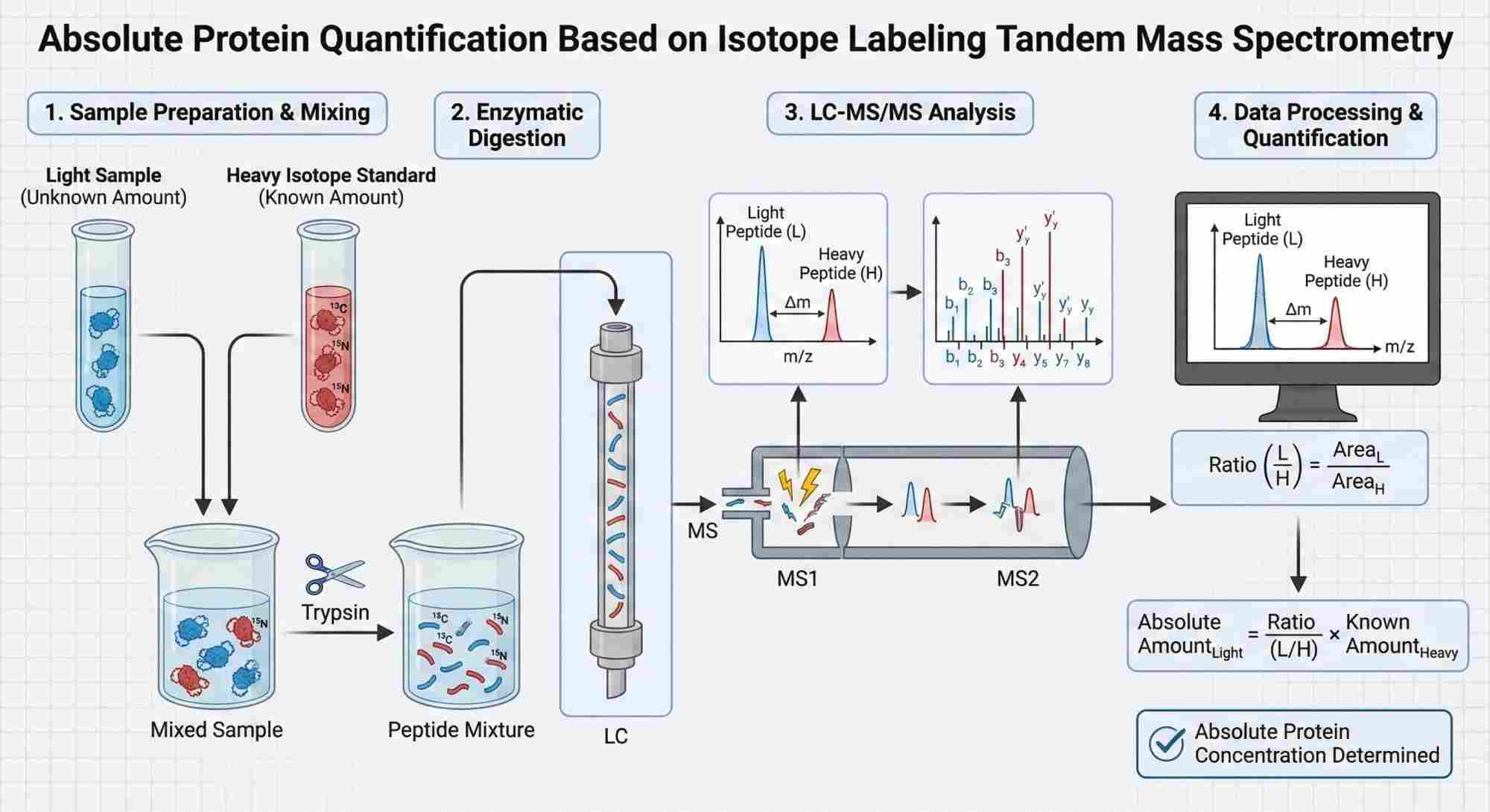
mechanism of absolute quantification

Why choose isotope-labeled tandem mass spectrometry for absolute quantification of multiple proteins?

Isotope-labeled tandem mass spectrometry (MS/MS) is a highly precise and reliable method for absolute protein quantification, offering unparalleled sensitivity, accuracy, and reproducibility. By incorporating stable isotope-labeled peptides as internal standards, this technique ensures accurate measurement of even low-abundance proteins across a broad dynamic range, without the need for external calibration curves. The high specificity of MS/MS minimizes interference from complex biological matrices, making it ideal for analyzing diverse sample types such as plasma, serum, and cerebrospinal fluid. When paired with our expert testing services, this powerful technology allows us to deliver highly reproducible, quantitative data tailored to your research needs, ensuring that your protein quantification is not only accurate but also streamlined and efficient, with professional analysis and interpretation included.

Absolute Protein Quantification at Creative Proteomics

We provide both test kits and testing services, allowing you to select the option that best fits your requirements.

Below is a detailed table listing the applicable species, analytical techniques, and applicable proteins for each service for your reference.

Service Module Target
Species
Target Scope Technology Primary Application Applicable Proteins
(View List)
CVD Biomarker Panel Human/Mouse/
Rat
Disease-Associated Targeted MRM/PRM Biomarker
Validation
View List
CHO Host Cell
Protein(CHO) Panel
CHO Cell Residual Purity
(Safety/Purity)
LC-MS/MS Biologic Drug Safety Evaluation View List
Human 270
Panel
Human Broad Metabolic & Signaling pathways High-Quality MRM Systems Biology & Pathway Analysis View List
Human 125
Panel
Human Broad Metabolic & Signaling pathways High-Quality MRM Systems Biology & Pathway Analysis View List
Human 500
Panel
Human Deep Plasma/
Serum Profiling
Flexible(MRM/PRM/DIA) Large-Cohort Screening & Biomarker Discovery View List
Mouse 375
Panel
Mouse Broad Metabolic & Signaling pathways High-Quality MRM Pre-Clinical Model Characterization View List

Advantages of Absolute Quantification Using Isotope Labeling Tandem Mass Spectrometry

Using LC-MS/MS and MRM/MS with isotopically labeled internal standards for highly accurate, reproducible protein quantification.

Identifying even low-abundance proteins in complex samples, ideal for biomarker discovery and sensitive analyzes.

Processing plasma, serum, tissues, and cell cultures to meet diverse research needs.

Measuring both high and low-abundance proteins in a single analysis, delivering comprehensive data.

Managing projects of any scale, from single protein analysis to high-throughput, large-sample studies.

Tailoring workflows to meet research objectives, including custom sample preparations and data analysis methods.

Delivering advanced data analysis and clear, actionable reports along with precise quantification.

Assisting from experiment design to data interpretation, ensuring smooth project progression.

Protecting your research and intellectual property through secure data handling.

FAQs

What is the fundamental difference between the output of your service and standard "discovery" proteomics?

Standard discovery proteomics (or "shotgun" proteomics) provides relative quantification (e.g., "Sample A has a 2.5-fold increase in Protein X compared to Sample B"). Our absolute quantification service utilizes external standards to provide a specific molar or mass concentration (e.g., 25 ng/mL). This data is necessary for kinetic modeling, biomarker validation, and determining stoichiometry.

What methods do you use for absolute protein quantification?

We deliver absolute protein quantification using isotope-labeled peptides and liquid chromatography-mass spectrometry (LC-MS). Understanding that every project is unique, we tailor our methodology—selecting from LC-MS/MS, PRM, or DIA techniques—to meet your specific goals. Our analysis is powered by industry-leading instrumentation, including the Thermo Orbitrap Astral, and Agilent 1260 AB SCIEX API6500+.

What types of samples can be analyzed?

We can analyze a wide range of sample types, including biological fluids (e.g., plasma, serum), tissues, cell cultures, and more. We handle both complex and straightforward samples, ensuring accurate quantification regardless of sample complexity.

What is the role of isotopically labeled standards in absolute quantification?

Isotopically labeled standards, also known as internal standards, are used to account for sample variability and instrument fluctuations. These labeled peptides or proteins mimic the target analyte but have a different isotope mass, allowing for more accurate quantification by compensating for any potential analytical variations.

What is the limit of detection (LOD) for your protein quantification service?

The limit of detection (LOD) varies depending on the protein and sample type. However, using LC-MS/MS and MRM/MS, we can achieve detection levels as low as femtomolar concentrations, allowing for the quantification of even low-abundance proteins in complex biological samples.

Can you quantify post-translational modifications (PTMs) using this method?

Yes, our LC-MS/MS and MRM/MS techniques can quantify proteins with specific post-translational modifications (PTMs) such as phosphorylation, glycosylation, and acetylation. This provides deeper insights into protein function and regulation, which is critical for understanding cellular processes and disease mechanisms.

How do you ensure the reproducibility of protein quantification results?

Reproducibility is ensured through the use of multiple technical replicates, stringent sample preparation protocols, and stable isotopic labeling. Additionally, our advanced analytical platforms undergo regular calibration and maintenance to guarantee consistent performance.

What kind of data analysis tools do you use for protein quantification?

We use advanced software tools for data processing and analysis, including proprietary algorithms for protein identification, quantification, and statistical analysis. Tools like Skyline or OpenMS are often employed for MRM/MS analysis, providing accurate and reproducible quantification results with clear, interpretable outputs.

For research purposes only, not intended for clinical diagnosis, treatment, or individual health assessments.

Tell Us About Your Project