Get Your Custom Quote

Online Inquiry

Targeted PTM Quantification Service

Site-specific, multiplexed quantification of protein post-translational modifications by targeted LC-MS/MS. Our platform delivers precise, quantitative measurement of phosphorylation, acetylation, ubiquitination, methylation, glycosylation, SUMOylation, and other PTMs using PRM/MRM workflows with PTM-specific enrichment strategies and stable isotope-labeled internal standards — enabling confident biological interpretation of PTM dynamics in complex biological matrices.

Research Use Only (RUO) Notice: All services and data provided are strictly for non-clinical research purposes. Our analytical results are not intended for clinical diagnosis, patient management, or therapeutic decision-making.

Services Technologies Demo Case Study FAQ Related Services

CORE SERVICE

Targeted PTM Quantification for Site-Specific Modification Analysis

Post-translational modifications regulate virtually every aspect of protein function — from signalling cascade activation to protein stability, localisation, and protein–protein interactions. Yet quantifying these modifications at specific amino acid residues across multiple biological conditions remains a significant analytical challenge. Our Targeted PTM Quantification service addresses this challenge by combining targeted LC-MS/MS acquisition (PRM on Orbitrap/QqTOF platforms, MRM on triple quadrupole platforms) with PTM-specific enrichment strategies and stable isotope-labeled internal standards, delivering site-specific, quantitative data on PTM occupancy and dynamics. Whether your research focuses on phosphorylation-driven signalling, histone PTM crosstalk in epigenetics, or ubiquitination dynamics in protein degradation pathways, we provide custom assay development and cohort-scale quantification with defined analytical performance metrics.

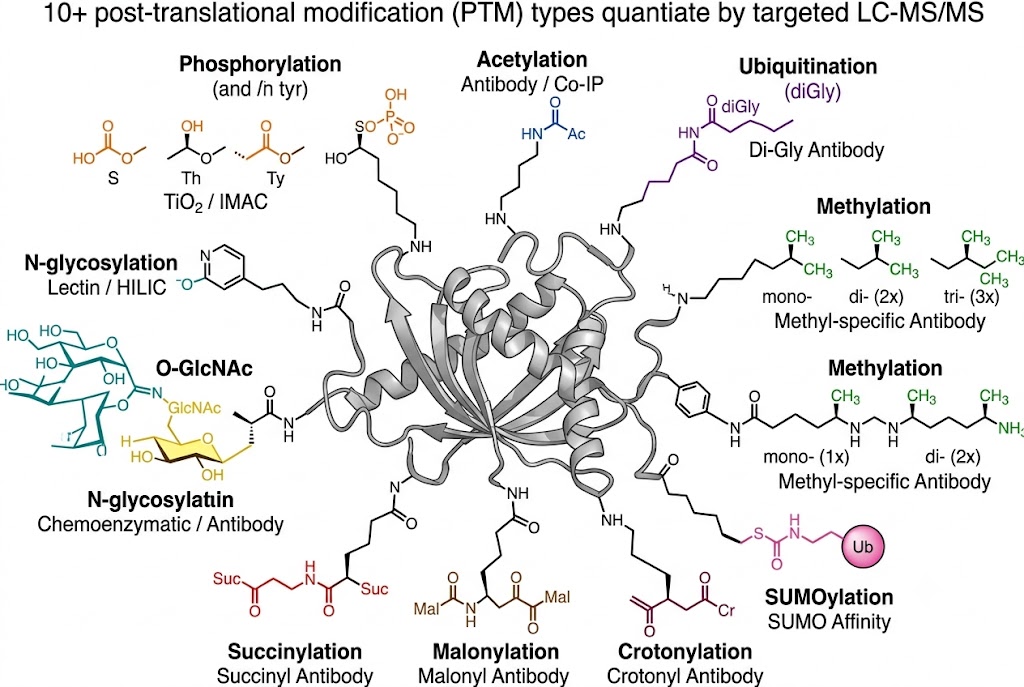
  • Multi-PTM Coverage: Quantify 10+ PTM types including phosphorylation (pSer, pThr, pTyr), acetylation, ubiquitination (diGly remnant), methylation (mono-/di-/tri-methyl), glycosylation (N-/O-linked), SUMOylation, succinylation, malonylation, crotonylation, and others — using PTM-optimised enrichment and LC-MS/MS acquisition strategies.
  • Site-Specific Resolution with Quantitative Accuracy: High-resolution Orbitrap and QqTOF MS platforms resolve adjacent modification sites with confident localisation, while stable isotope-labeled AQUA/SIS peptide internal standards enable absolute quantification with defined LOD, LOQ, linearity, and inter-batch CV metrics.
  • Flexible Enrichment & Workflow Design: We design PTM enrichment strategies matched to your modification of interest and sample type — including IMAC, TiO2, antibody-based enrichment, chemical derivatisation, and lectin capture — ensuring optimal modification coverage and quantification accuracy.
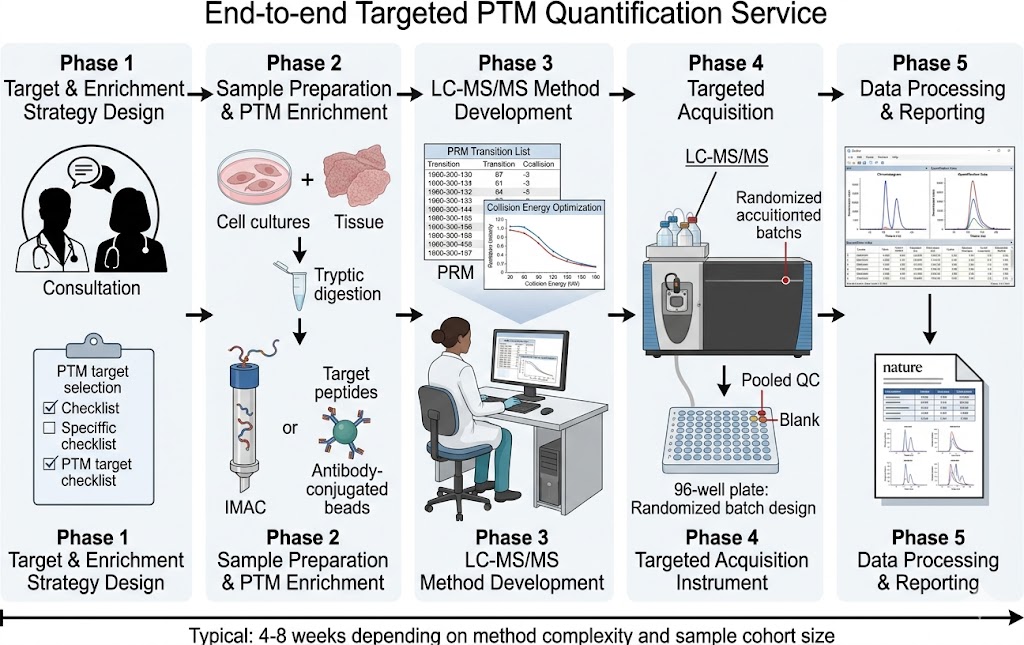
Targeted PTM quantification workflow diagram showing PRM/MRM LC-MS/MS pipeline with PTM enrichment steps

Targeted PTM quantification workflow: from PTM enrichment through PRM/MRM acquisition to site-specific quantitative reporting.

Understanding Targeted PTM Quantification

Post-translational modifications expand the functional proteome far beyond the genome-encoded proteome, with over 200 distinct PTM types modulating protein activity, localisation, stability, and interactions. Unlike global PTM discovery approaches that prioritise breadth of identification, targeted PTM quantification focuses on measuring pre-selected modification sites with optimal analytical performance — delivering the sensitivity, reproducibility, and quantitative accuracy needed for hypothesis-driven research. This approach is particularly valuable when testing specific signalling hypotheses, validating candidate PTM biomarkers, or monitoring PTM dynamics in response to pharmacological intervention.

The core technical challenge lies in the sub-stoichiometric nature of most PTMs — a modified peptide may constitute less than 1% of its unmodified counterpart. Our platform addresses this through three pillars: PTM-specific enrichment that selectively isolates modified peptides, targeted MS acquisition (PRM/MRM) for low-abundance detection, and stable isotope-labeled internal standards that correct for enrichment efficiency and instrument drift. For researchers beginning with broader PTM surveys, our Deep Proteome Profiling service provides high-coverage discovery data from which targeted candidates can be selected for downstream validation.

Overview of 10+ PTM types quantified by targeted LC-MS/MS including phosphorylation, acetylation, ubiquitination, methylation, and glycosylation

Multi-PTM quantification landscape: 10+ modification types addressable with optimised enrichment and acquisition strategies.

PTM Types We Quantify

Our targeted PTM quantification platform covers a broad spectrum of modifications, each with optimised enrichment and acquisition workflows. For each PTM type we provide custom method development including transition selection, collision energy tuning, and internal standard synthesis, with assay performance documented in a detailed report.

Phosphorylation

Sites: pSer, pThr, pTyr  |  Enrichment: IMAC, TiO2
PRM on Orbitrap with CID/HCD or EAD fragmentation. Signalling pathway analysis, kinase inhibitor studies, phospho-biomarker validation.

Acetylation

Sites: K-ac  |  Enrichment: Anti-acetyllysine antibody
MRM/PRM quantification of site-specific acetylation occupancy in histones, transcription factors, and metabolic enzymes.

Ubiquitination

Method: diGly remnant  |  Enrichment: K-ε-GG antibody
Targeted quantification of ubiquitin remnant peptides for ubiquitin-proteasome system dynamics and degradation pathway studies.

Methylation

Sites: K-me1/me2/me3, R-me  |  Enrichment: Pan-methyl antibody
Site-specific quantification of methylation marks in histones and non-histone proteins for epigenetic and gene regulation research.

Glycosylation

Types: N-glycan, O-GalNAc, O-GlcNAc  |  Enrichment: Lectin capture, HILIC
Targeted glycopeptide quantification by PRM for cell signalling, immune regulation, and biotherapeutic characterisation.

SUMOylation

Method: SUMO remnant  |  Enrichment: SUMO remnant antibody
Targeted quantification of SUMOylated peptide signatures for studying protein localisation, stability, and transcription regulation.

Additional PTMs: Succinylation, malonylation, crotonylation, β-hydroxybutyrylation, and others — with enrichment and MS methods developed on a per-project basis. Where absolute quantification at the protein level is the goal, our Precision Protein Quantification platform provides complementary targeted workflows using unmodified peptide surrogates.

Targeted Acquisition: PRM and MRM Platforms

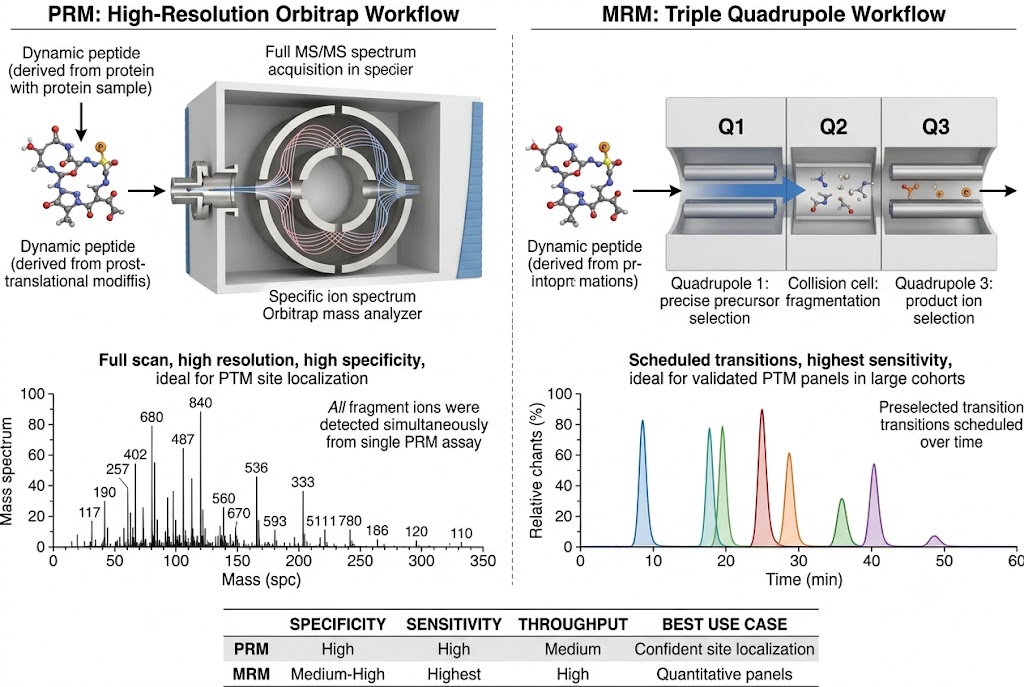
Our targeted PTM quantification platform offers two complementary LC-MS/MS acquisition strategies. Parallel Reaction Monitoring (PRM) on high-resolution Orbitrap (Q Exactive HF-X, Orbitrap Fusion Lumos) and QqTOF (ZenoTOF 7600) instruments captures full MS/MS fragment ion spectra for each target, providing maximum specificity for confident PTM site localisation — ideal for method development and multi-PTM projects where modification assignment confidence is critical.

Multiple Reaction Monitoring (MRM/SRM) on triple quadrupole platforms (AB Sciex 6500+) uses scheduled precursor-to-product ion transitions to deliver the highest sensitivity for known modified peptide targets, making it the method of choice for large cohort studies and validated PTM assay panels requiring consistent throughput across hundreds of samples.

The appropriate platform is selected based on project goals: PRM for discovery-to-targeted transition and high-specificity requirements, MRM for established panels at maximum throughput. Both strategies incorporate stable isotope-labeled internal standards and batch-randomised QC designs.

Side-by-side comparison of PRM on high-resolution Orbitrap and MRM on triple quadrupole mass spectrometers for PTM quantification

PRM (high-resolution full spectrum) vs MRM (scheduled transition) for targeted PTM quantification — platform selection by project requirements.

Technologies & Workflow

Parallel Reaction Monitoring (PRM) on High-Resolution MS

Full MS/MS fragment ion acquisition on Orbitrap and QqTOF platforms (Q Exactive HF-X, Orbitrap Fusion Lumos, ZenoTOF 7600) provides high-specificity PTM quantification. EAD fragmentation preserves labile modifications including phosphorylation and acetylation while maintaining confident site localisation.

Multiple Reaction Monitoring (MRM/SRM) on Triple Quadrupole

Scheduled MRM acquisition on triple quadrupole platforms (AB Sciex 6500+) delivers the highest sensitivity for known PTM peptide transitions, ideal for large cohort studies and validated assay panels requiring consistent throughput.

PTM-Specific Enrichment & Internal Standard Strategies

Custom-designed enrichment protocols (IMAC, TiO2, antibody-based, chemical derivatisation, lectin) are paired with stable isotope-labeled AQUA or SIS peptides matching modified sequences, enabling absolute quantification with enrichment-normalised accuracy.

Workflow Overview

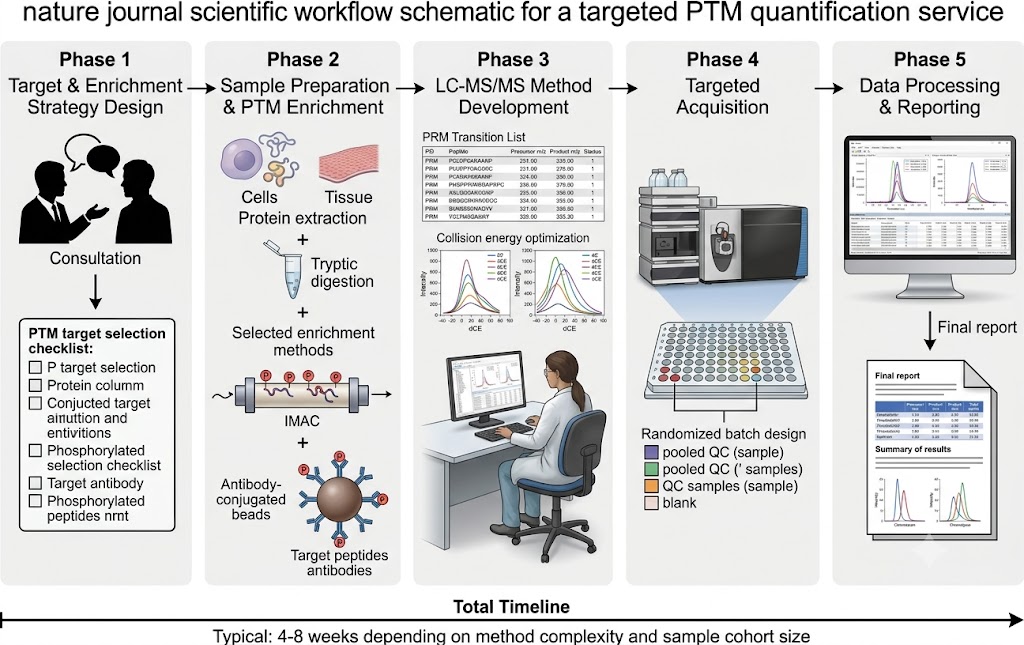
Step 1 — Target & Enrichment Strategy Design: Our team reviews your PTM targets, sample type, and quantification requirements to design the optimal enrichment and acquisition strategy, including transition/scheduling planning for PRM or MRM methods.

Step 2 — Sample Preparation & PTM Enrichment: Proteins are extracted, quantified, and digested using optimised protocols. PTM-specific enrichment is performed using the selected method (IMAC, TiO2, antibody beads, or chemical derivatisation) with appropriate quality controls.

Step 3 — LC-MS/MS Method Development: PRM or MRM methods are developed with optimised retention time scheduling, isolation window assignment, collision energy parameters, and internal standard spiking concentrations. Method performance is evaluated through test runs.

Step 4 — Targeted Acquisition: Samples are acquired in randomised batch designs with periodic QC injections (pooled QC, blank, internal standard monitoring). PRM data are collected at 35,000–120,000 resolution (Orbitrap) or with Zeno trap activation (QqTOF); MRM data are collected with scheduled transition monitoring.

Step 5 — Data Processing & Reporting: Targeted extraction of PTM peptide signals, peak integration, internal standard normalisation, and quantitative calculation using Skyline or equivalent software. Deliverables include processed quantification tables, peak quality metrics, CV assessment, and an assay performance report.

Sample Requirements & Submission Guidelines

Sample Type Recommended Input Notes
Cell lysate (adherent/suspension) 500 μg – 2 mg total protein Sufficient for 1–2 enrichment replicates; low-input options available (≥100 μg)
Tissue (fresh frozen or FFPE) 10–50 mg wet weight FFPE requires additional deparaffinisation and protein extraction steps
Plasma / Serum 100–500 μL High-abundance protein depletion recommended for phosphoproteomics
CSF 200–500 μL Low protein concentration; may require pooling or TCA precipitation
Immunoprecipitation eluate 1–10 μg total protein Minimal input workflow available; please contact for feasibility assessment
Cell surface / subcellular fraction 100–500 μg protein Nuclear, membrane, or mitochondrial fractions enrich compartment-specific PTM signals

Please contact us for feasibility assessment and input optimisation for non-standard or limited sample types. For samples requiring antibody-based enrichment prior to PTM analysis, our Immunoaffinity-LC-MS/MS Quantification service provides complementary workflows.

Representative Data & Workflow Examples

Below are representative examples from our targeted PTM quantification workflows, demonstrating assay linearity, multi-PTM coverage, and site-specific quantification across sample types.

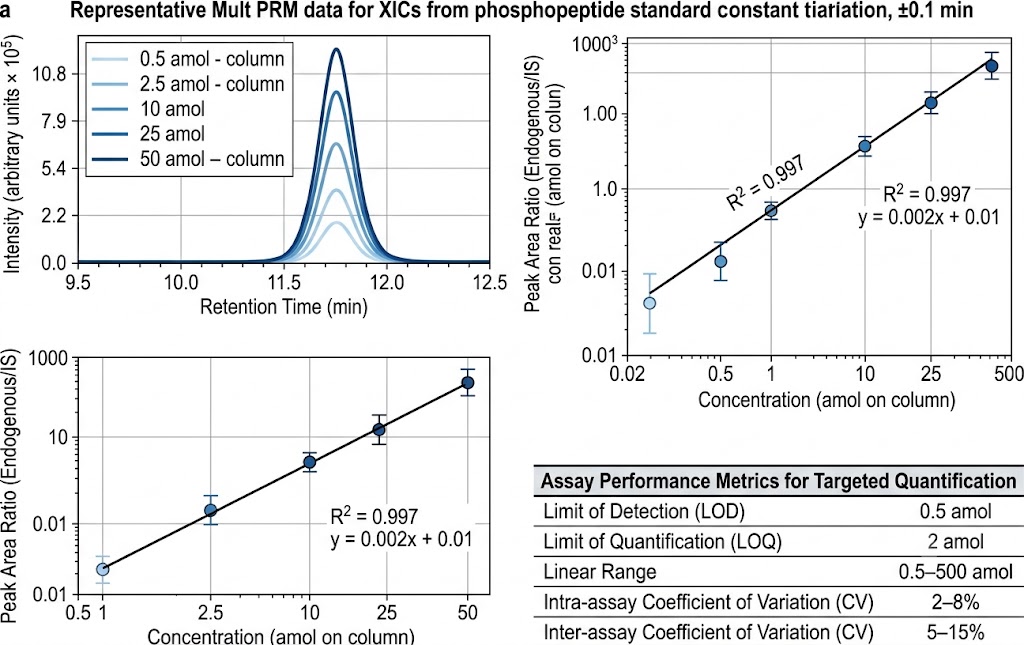
PRM extracted ion chromatograms showing phosphopeptide quantification across a titration series with linear response

Representative PRM extracted ion chromatograms showing site-specific quantification of phosphopeptides across a titration series with linear response and LOD determination.

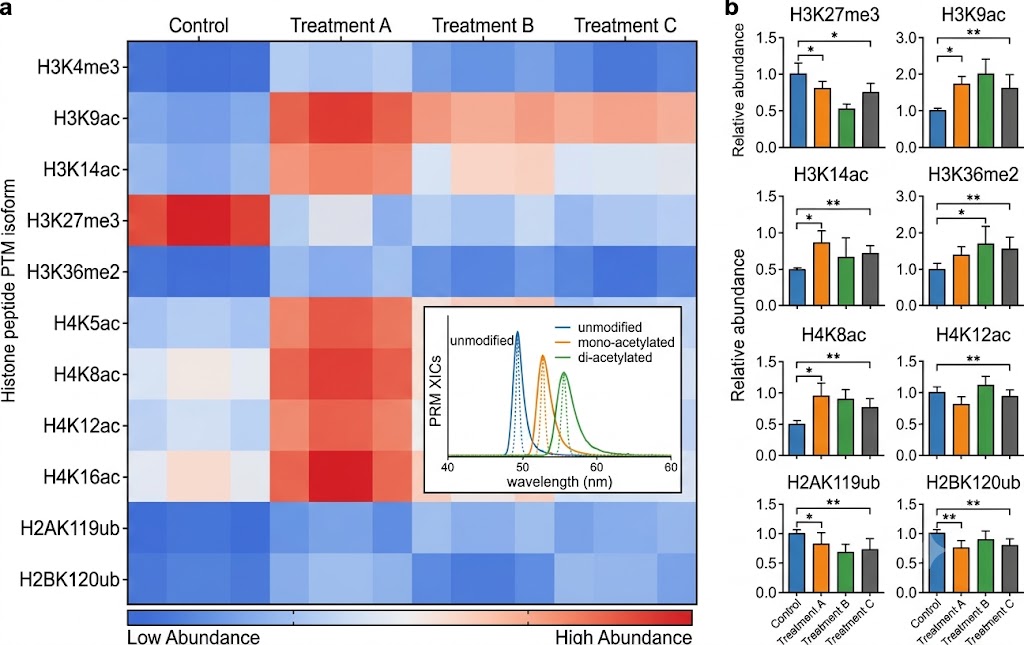
Multiplexed quantification of acetylated and methylated histone peptides from a single PRM acquisition

Multiplexed quantification of acetylated and methylated histone peptides from a single PRM acquisition, illustrating combinatorial histone PTM mark analysis.

Workflow schematic from target selection through enrichment, LC-MS/MS acquisition, and data processing for targeted PTM quantification

Integrated PTM quantification workflow: from target selection and enrichment strategy design through LC-MS/MS acquisition to quantitative data reporting.

CASE STUDY

Targeted MRM Quantification of Histone H3 Lysine 14 Acetylation Stoichiometry in Human Macrophages

Macur et al. 2023 | Clin Proteomics | CC BY 4.0

Background & Purpose

Histone post-translational modifications play a central role in regulating chromatin structure and gene expression, yet quantifying site-specific acetylation stoichiometry in primary human cells remains technically challenging. Macur et al. developed and validated a targeted LC-MS/MS multiple reaction monitoring (MRM) assay for the absolute quantification of histone H3 lysine 14 acetylation (H3K14Ac) stoichiometry, with application to investigating the combined effects of HIV-1 infection and methamphetamine (Meth) exposure in human monocyte-derived macrophages (hMDMs) from six donors.

Methods

Histones were isolated from hMDM nuclei and subjected to propionylation before and after trypsin digestion to block lysine residues, enabling differentiation of endogenous acetylation from chemical derivatisation. Targeted MRM acquisition was performed on a triple quadrupole LC-MS/MS system monitoring three transitions per peptide for both the acetylated (K[Poy]STGGK[1Ac]APR) and unmodified (K[Poy]STGGK[Poy]APR) forms of histone H3(9-17). Stable isotope-labeled (SIL) heavy peptide standards (13C/15N-labeled C-terminal arginine) were spiked at known concentrations before analysis, enabling absolute quantification with enrichment-normalised accuracy. The experimental workflow is shown in Figure 2 from the study.

Results Overview

The MRM assay demonstrated robust analytical performance with a linear range of 0.5-2500 fmol/µL, lower limit of detection (LLOD) of 0.106 fmol/µL for the unmodified peptide and 0.204 fmol/µL for the acetylated peptide, and consistent linearity (R² > 0.99) across the calibration range. The assay successfully quantified H3K14Ac stoichiometry across three experimental conditions — CIC (control-infected-control), CIM (control-infected-Meth), and MIM (Meth-infected-Meth) — revealing substantial inter-donor variability and differential stoichiometry changes in response to HIV infection and Meth exposure. Figure 3 presents the stoichiometry data for all six individual donors across conditions, demonstrating the assay's capacity to detect biologically relevant changes in PTM occupancy within a physiologically relevant primary cell model.

Experimental workflow for targeted MRM quantification of histone H3K14 acetylation in human macrophages

Experimental workflow for targeted MRM quantification of H3K14Ac: histone isolation, propionylation, tryptic digestion, LC-MS/MS MRM acquisition with SIL internal standards, and stoichiometry calculation. (CC BY 4.0)

H3K14Ac stoichiometry percentages across CIC, CIM, and MIM conditions from six donors

H3K14Ac stoichiometry across three experimental conditions from six individual donors — demonstrating inter-donor variability and differential response to HIV/Meth exposure. (CC BY 4.0)

Histone H3 PTM map from resting human monocyte-derived macrophages

Qualitative PTM map of histone H3 from resting hMDM, providing the foundation for selecting H3K14 acetylation as a quantitative target. (CC BY 4.0)

Conclusion

This study demonstrates the successful application of targeted MRM-based absolute quantification to measure site-specific histone PTM stoichiometry in primary human cells, achieving LLOD at sub-fmol levels and a linear dynamic range spanning over three orders of magnitude. The inter-donor variability observed (CV across donors ranging 15-35% depending on condition) underscores the importance of robust quantitative methodology when assessing PTM dynamics in heterogeneous primary cell populations. The assay design — incorporating propionylation chemistry for histone peptide analysis, SIL internal standard normalisation, and scheduled MRM acquisition — provides a directly transferable workflow for quantifying other histone PTM marks in a wide range of research contexts, including epigenetic regulation, infectious disease, and substance exposure studies.

Frequently Asked Questions

Q1: Which PTM types can you quantify by targeted LC-MS/MS?

We provide targeted quantification for 10+ PTM types including phosphorylation (pSer, pThr, pTyr), acetylation, ubiquitination (diGly remnant), methylation (mono-/di-/tri-methyl), N- and O-linked glycosylation, SUMOylation, succinylation, malonylation, crotonylation, and others. Each PTM type uses a custom enrichment and acquisition strategy optimised for its specific chemical properties and abundance.

Q2: What are the typical LOD and LOQ for phosphopeptide quantification?

Assay performance depends on enrichment efficiency, peptide ionisation properties, and sample matrix. Typical phosphopeptide LODs range from 0.5–5 amol on column with PRM on Orbitrap platforms, with linear dynamic range spanning 3–4 orders of magnitude. LOQ is determined empirically for each target peptide during method development. For detailed performance expectations, consult published benchmarks such as the 2–7% CV range reported by Bons et al. for EAD-PRM quantification.

Q3: Can you quantify phosphorylation and acetylation in the same project?

Yes. We offer integrated multi-PTM workflows where samples are split after digestion, with parallel enrichment streams for each modification type. This approach maximises data yield from limited sample while ensuring each PTM type receives the optimal enrichment strategy.

Q4: Do you provide stable isotope-labeled internal standards for PTM peptides?

We design and synthesise stable isotope-labeled AQUA or SIS peptides matching the modified peptide sequence of each target, incorporating the modification of interest. These internal standards are spiked at known concentrations before enrichment, enabling enrichment-normalised absolute quantification with defined accuracy.

Q5: What sample types have you processed for targeted PTM quantification?

We have extensive experience with cell lysate (adherent, suspension, primary cells), tissue (fresh frozen, FFPE, PDX), plasma/serum, CSF, immunoprecipitation eluates, and subcellular fractions (nuclear, membrane, mitochondrial). Please contact us to discuss sample-specific feasibility and input requirements.

References

  1. Bons J, Hunter CL, Chupalov R, Causon J, Antonoplis A, Rose JP, MacLean B, Schilling B. Localization and Quantification of Post-Translational Modifications of Proteins Using Electron Activated Dissociation Fragmentation on a Fast-Acquisition Time-of-Flight Mass Spectrometer. J Am Soc Mass Spectrom. 2023;34(10):2199-2210.
  2. Dakup P, Gritsenko MA, Piehowski PD, Zhao R, Rodland KD, Qian WJ, Shi T, Jacobs JM. Targeted Quantification of Protein Phosphorylation and Its Contributions towards Mathematical Modeling of Signaling Pathways. Molecules. 2023;28(3):1143.
  3. Macur K, Schissel A, Yu F, Lei S, Morsey B, Fox HS, Ciborowski P. Change of histone H3 lysine 14 acetylation stoichiometry in human monocyte derived macrophages as determined by MS-based absolute targeted quantitative proteomic approach: HIV infection and methamphetamine exposure. Clin Proteomics. 2023;20:48.

GET STARTED

Ready to Quantify Your PTM Targets?

Contact our proteomics team to discuss your project requirements. We will design a custom targeted PTM quantification strategy matched to your modification type, sample matrix, and quantitative goals.

Get a Custom Quote for Your Targeted PTM Quantification Project

Request a Customized Quote