Why Multiplex PTM Immunoassays for Biomarker Validation and Drug Development
Multiplex immunoassay platforms occupy a critical position in the PTM analysis workflow — bridging the gap between MS-based discovery (which identifies thousands of modification sites with broad coverage) and clinical application (which requires robust, high-throughput, analytically validated methods for measuring specific modifications across large populations). For pharmaceutical and biotechnology research programs, multiplex PTM immunoassays offer decisive advantages in throughput, reproducibility, and regulatory compatibility.
High-Throughput PTM Screening for Large-Scale Studies
Modern drug development and biomarker discovery programs routinely involve hundreds to thousands of biospecimens collected across multiple time points, dose groups, and clinical sites. MS-based PTM analysis, while providing exceptional depth, faces practical limitations in sample throughput and per-sample cost for studies of this scale. Multiplex immunoassays address this gap directly: Luminex bead-based assays can quantitate up to 50 PTM targets simultaneously in a single 25 µL sample, in 96- or 384-well plate formats, enabling a single operator to generate thousands of PTM data points per day. This throughput makes multiplex immunoassays the method of choice for large-cohort biomarker validation, clinical trial sample analysis, and population-based epigenetic studies.
Regulatory-Compliant Analytical Validation
For pharmaceutical programs where PTM biomarkers are used for patient stratification, pharmacodynamic assessment, or surrogate endpoint measurement, analytical validation according to regulatory guidelines is essential. Immunoassay platforms have a well-established regulatory track record, with validated methods, reference standards, quality control protocols, and acceptance criteria that can be aligned with ICH M10 and other bioanalytical method validation guidelines. Our immunoassay services include comprehensive analytical validation — assessing sensitivity, specificity, precision, accuracy, linearity, matrix effects, and stability — to generate data suitable for regulatory submissions. For broader PTM discovery and early-stage profiling, our Global PTM Profiling Service provides complementary MS-based discovery capabilities.
Quantitative PTM Detection in Complex Biological Matrices
Unlike MS-based approaches that may require extensive sample preparation and enrichment for PTM detection, immunoassays can directly quantitate modified proteins in complex biological matrices including plasma, serum, CSF, tissue lysates, and cell culture supernatants. This capability is particularly valuable for measuring circulating PTM-modified proteins as blood-based biomarkers, assessing target engagement through phosphoprotein signaling analysis in tumor biopsies, and monitoring epigenetic drug effects on histone modifications in peripheral blood mononuclear cells. Our Ultra-Sensitive Modified Protein Detection service extends detection sensitivity to low-abundance PTM targets using proximity-based amplification technologies for applications where standard immunoassay sensitivity is insufficient.
Our Multiplex PTM Immunoassay Platform
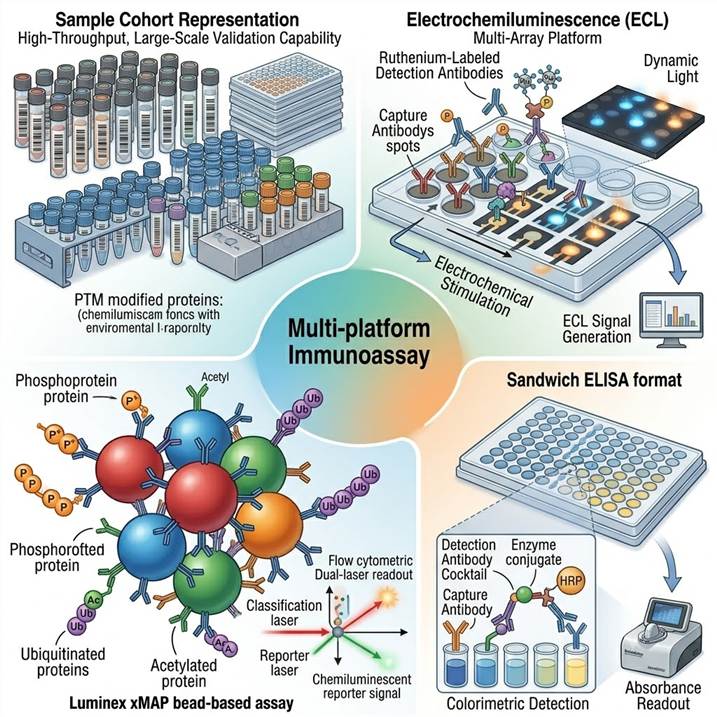
Our multiplex PTM immunoassay platform integrates three complementary detection technologies, each selected for its specific advantages in addressing different research questions, sample types, and throughput requirements. All platforms operate under standardized quality management protocols to ensure data comparability across projects and time points.
Integrated PTM-Focused Assay Development
Each PTM immunoassay project begins with a thorough assessment of the specific modification targets, expected concentration ranges, sample matrix characteristics, and required assay performance characteristics. Our team has extensive experience developing and validating immunoassays for phosphoprotein targets (including phospho-ERK, phospho-Akt, phospho-STAT, and other signaling node proteins), histone modifications (H3K9ac, H3K27ac, H3K4me3, H3K27me3, and others), and modified protein biomarkers across multiple disease areas. For challenging PTM targets where standard antibody pairs may not be available, our Bioorthogonal PTM Labeling Services can provide alternative detection strategies using chemical probe-based approaches.
Multi-Platform Technology Suite
The ability to deploy multiple immunoassay platforms within a single service organization provides unique advantages for PTM biomarker programs that progress through different development stages. Early-stage discovery screening can use high-plex Luminex panels for broad PTM target coverage, mid-stage validation can use focused ECL panels for improved sensitivity in specific matrices, and late-stage clinical testing can use qualified ELISA assays with established regulatory compliance documentation. Our Histone Modification Antibody Array provides complementary membrane-based antibody array detection for focused epigenetic studies, while for broader PTM discovery and integration, our PTM Bioinformatics Analysis services enable multi-platform data fusion and biological interpretation.
Available PTM Immunoassay Platforms
Our PTM immunoassay platform suite offers three complementary technology formats, each with distinct advantages for different phases of PTM biomarker research and drug development.
Luminex xMAP Bead-Based Multiplex Assays
- Technology: Magnetic bead-based multiplex immunoassay using color-coded bead populations, each coupled to a specific PTM capture antibody, with flow cytometric or dual-laser imaging readout. Up to 50-plex detection per well with 25–50 µL sample volume.
- PTM Applications: Multiplex phosphoprotein signaling mapping (phospho-ERK, phospho-Akt, phospho-STAT3, phospho-p38, phospho-JNK, phospho-NF-κB), cytokine and growth factor detection in signaling studies, and multi-analyte PTM biomarker panels for clinical sample screening.
- Throughput: Up to 384 samples per plate, with automated liquid handling for high-throughput batch processing.
- Sensitivity: Typical limit of detection in the low pg/mL range, with broad dynamic range (3–4 logs).
Electrochemiluminescence (ECL) Multiplex Assays
- Technology: ECL-based detection using ruthenium-labeled detection antibodies on patterned multi-array electrode plates, with electrochemical stimulation generating light signals at each electrode spot. Up to 10-plex detection per well with 25–50 µL sample volume.
- PTM Applications: Ultrasensitive phosphoprotein quantification in complex matrices (tissue lysates, CSF), phosphorylation site-specific signaling analysis for drug target engagement studies, and histone modification detection in clinical samples where matrix interference may affect other assay formats.
- Throughput: 96-well plate format compatible with standard plate handling equipment.
- Sensitivity: Typical limit of detection in the low pg/mL to fg/mL range, with superior performance in complex biological matrices due to the ECL signal generation mechanism.
Enzyme-Linked Immunosorbent Assay (ELISA)
- Technology: Traditional and enhanced sandwich ELISA formats using colorimetric, fluorescent, or chemiluminescent detection. Single-plex (traditional ELISA) and low-plex (multi-analyte ELISA) formats available.
- PTM Applications: Quantitative single-target PTM measurement for orthogonal validation of multiplex findings, high-sensitivity detection of specific phosphoproteins and modified biomarkers, and regulatory-compliant assay formats for clinical biomarker analysis.
- Throughput: 96-well plate format, standard ELISA workflow with plate readers.
- Sensitivity: Dependent on assay format, with chemiluminescent ELISA achieving low pg/mL detection limits for many PTM targets.
For drug development programs requiring integrated PTM analysis from discovery through clinical validation, our PTMs in Drug Discovery and Development services provide end-to-end support spanning MS-based discovery, immunoassay-based validation, and bioanalytical method qualification.
Workflow: From Study Design to PTM Immunoassay Data
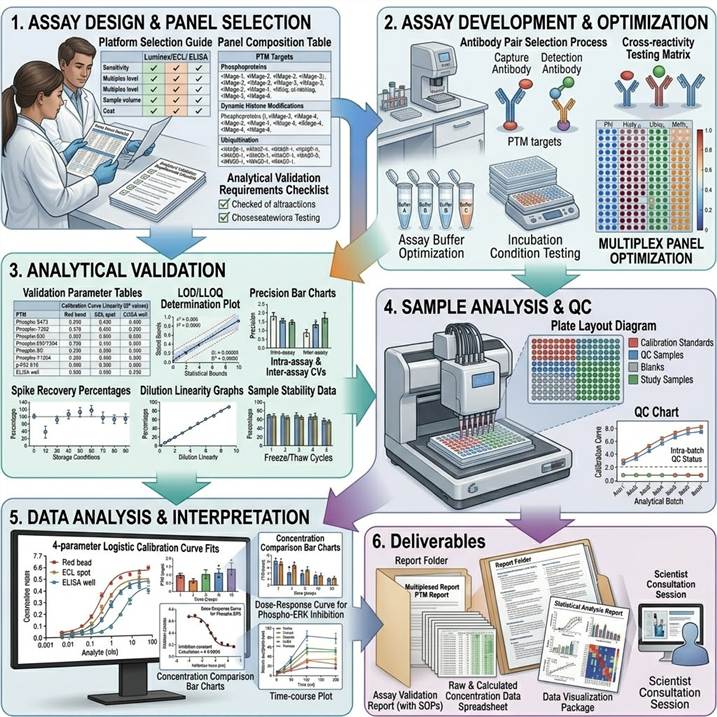
Step 1: Assay Design and Panel Selection
We collaborate with you to design the optimal PTM immunoassay strategy based on your research goals, target modifications, sample matrix, and required throughput. Platform selection (Luminex, ECL, or ELISA), panel composition, and analytical validation requirements are defined during this phase.
Step 2: Assay Development and Optimization
PTM-specific immunoassays are developed and optimized for each target, including antibody pair selection (capture and detection), assay buffer optimization, incubation conditions, and signal detection parameters. For multiplex panels, cross-reactivity and interference testing ensures target specificity.
Step 3: Analytical Validation
Assay performance is characterized according to established bioanalytical method validation guidelines: calibration curve linearity and range, limit of detection and quantification, precision (intra- and inter-assay), accuracy (spike recovery), matrix effect assessment, dilution linearity, and sample stability.
Step 4: Sample Analysis and Batch QC
Study samples are analyzed in batch format with appropriate quality control samples (calibration standards, QC low/mid/high, blank, and matrix controls) on each plate. Acceptance criteria are applied to each analytical run, with re-analysis triggered for failed QC criteria.
Step 5: Data Analysis and Interpretation
Raw signal data are processed using platform-specific software with appropriate curve-fitting algorithms (4-parameter logistic, 5-parameter logistic). PTM target concentrations are calculated, and statistical analysis is performed for group comparisons, dose-response relationships, and temporal trends.
Step 6: Deliverables and Reporting
Complete immunoassay study report including: assay validation summary, plate layout and run details, raw and calculated concentration data, quality control performance, statistical analysis results, and individual value plots with group comparisons.
Why Choose Our Multiplex PTM Immunoassay Service
Multi-Platform Expertise Under One Roof
Unlike service providers that specialize in a single immunoassay technology, our platform suite spans Luminex xMAP, ECL, and ELISA — allowing us to deploy the optimal technology for each specific research question and program stage. This multi-platform capability ensures continuity as your PTM biomarker program progresses from discovery through validation to clinical application.
PTM-Specific Assay Experience
Our team has extensive experience developing immunoassays specifically for post-translational modification targets — including phosphorylation site-specific assays, histone modification quantification, and modified protein biomarker detection. This PTM-focused expertise is distinct from general immunoassay service providers and ensures appropriate assay design for modification-specific detection.
Analytical Validation Aligned with Regulatory Expectations
For pharmaceutical programs, our immunoassay services include analytical validation parameters that align with bioanalytical method validation guidelines, supporting data acceptability for regulatory submissions. Validation documentation includes method development reports, full validation reports, and sample analysis reports with complete audit trails.
Integrated PTM Discovery-to-Validation Pipeline
Our immunoassay platform is integrated within a comprehensive PTM analysis ecosystem spanning MS-based discovery (Global PTM Profiling), antibody array screening, and bioinformatics integration (PTM Bioinformatics Analysis). This integration means that MS-based PTM discovery findings can be seamlessly transitioned to immunoassay-based validation within a single service organization, preserving data continuity and accelerating the discovery-to-validation timeline.
Case Study: Multi-Platform Validation of a 10-Plex Luminex Bead-Based Immunoassay for Bladder Cancer Risk Stratification
In a 2024 study published in the Journal of Translational Medicine (BMC), Furuya et al. validated the Oncuria 10-plex bead-based urinalysis immunoassay across three different Luminex xMAP instrumentation platforms, demonstrating the robustness and reproducibility of multiplex immunoassay technology for clinical biomarker applications.
Background: Bladder cancer is the tenth most common cancer worldwide, and current diagnostic methods (cystoscopy, cytology) have significant limitations in invasiveness, cost, and sensitivity. Non-invasive urine-based biomarker assays could transform bladder cancer detection and surveillance, but require robust analytical validation across instrumentation platforms to ensure clinical reliability.
Approach: The study validated a 10-plex magnetic bead-based immunoassay (Oncuria panel) quantifying ten protein biomarkers — ANG, ApoE, CA9, IL-8, MMP-9, MMP-10, A1AT, PAI-1, SDC1, and VEGF-A — in urine specimens. Critically, the same assay was validated on three different Luminex xMAP instrumentation platforms — MagPix, Luminex 200, and FlexMap 3D — to assess cross-platform reproducibility. Analytical validation included assessment of calibration curve performance, sensitivity (LOD/LLOQ), precision (intra-assay and inter-assay CV), spike recovery, dilution linearity, and sample stability across all three platforms.
Key Findings:
- The 10-plex Oncuria assay demonstrated robust analytical performance across all three Luminex platforms, with inter-platform variability typically below 5% for most analytes, confirming the transferability and reproducibility of multiplex bead-based immunoassays across different instrument configurations
- The assay achieved high diagnostic accuracy for de novo bladder cancer detection with an AUC of 0.95, 93% sensitivity, and 93% specificity, demonstrating clinical utility of the multiplex immunoassay panel
- Individual analytes showed varying performance across platforms but maintained consistent diagnostic classification, with ANG, MMP-9, and PAI-1 emerging as the strongest individual contributors to the multiplex panel's diagnostic performance
- Analytical validation parameters including spike recovery (85–115% for most analytes), dilution linearity (R² > 0.95 across platforms), and precision (inter-assay CV < 15% for all analytes) met established bioanalytical method acceptance criteria
- The study demonstrated that multiplex Luminex bead-based immunoassays can be successfully transferred between different Luminex instrumentation platforms without requiring re-validation of the entire assay — a critical practical consideration for multi-site clinical studies and laboratory transitions
Significance: This study provided a comprehensive validation framework for multiplex bead-based immunoassay technology in clinical biomarker applications, demonstrating that Luminex xMAP platforms deliver the analytical robustness, cross-platform reproducibility, and clinical accuracy required for diagnostic assay deployment. The validation strategy — assessing analytical performance across multiple instrumentation platforms, sample types, and clinical contexts — establishes a template for immunoassay validation applicable to PTM biomarker panels in drug development and clinical research.
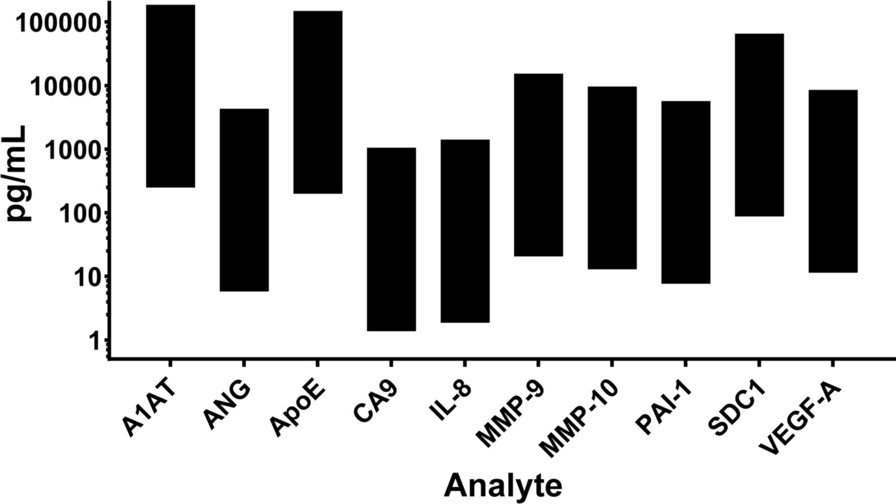
Figure 1 from Furuya et al. (2024). Multi-platform validation of the Oncuria 10-plex Luminex bead-based immunoassay for bladder cancer risk stratification. (CC BY 4.0)
Representative Multiplex PTM Immunoassay Results
Our multiplex PTM immunoassay platform delivers comprehensive data packages designed to support regulatory-compliant biomarker reporting and publication-quality visualization of PTM quantification results across study cohorts.
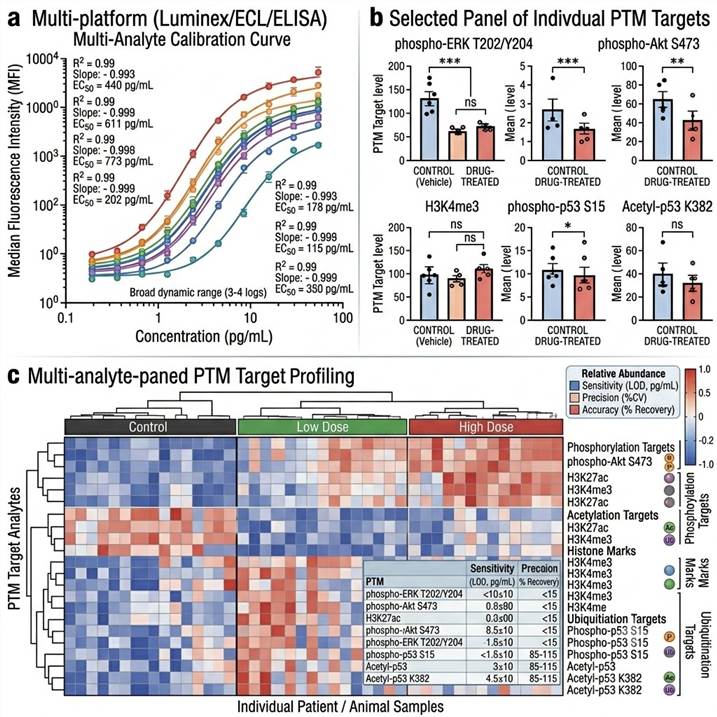
Representative data outputs from our Multiplex PTM Immunoassay platform. Left: Calibration curves and assay performance. Center: Quantitative PTM target comparison across groups. Right: Multi-analyte heat map of PTM biomarker patterns.
Key deliverables included in every multiplex PTM immunoassay project:
- Assay validation report — Full analytical validation documentation including calibration curve performance, sensitivity, precision, accuracy, matrix effects, and stability data for each assay
- Raw and calculated concentration data — Individual sample results with calibration curve fits, QC performance, and batch acceptance criteria documentation
- Data visualization — Publication-quality calibration curves, concentration bar charts, group comparison plots, and multi-analyte heat maps
- Statistical analysis — Group comparisons, dose-response analysis, time-course analysis, and correlation analysis between PTM targets as appropriate for study design
- Method documentation — Detailed standard operating procedures, assay protocols, and validation documentation suitable for regulatory submission support
Related Services
Our multiplex PTM immunoassay platform is part of a comprehensive PTM analysis service portfolio spanning antibody-based, immunoassay, and MS-based detection platforms for integrated PTM research from discovery through clinical application.
- Phospho-Signaling Antibody Array — Membrane-based antibody array for targeted phospho-kinase signaling pathway analysis and activation profiling across multiple signaling networks
- Multi-PTM Crosstalk Profiling — Integration of multiple PTM datasets for comprehensive analysis of modification crosstalk, competition, and coordinated regulation in biological systems
- PTMs in Biological Research — Integrated PTM analysis solutions for basic biology research, from signaling studies to functional characterization
- PTMs in Disease Research — Disease-focused PTM analysis services for cancer, neurodegenerative, metabolic, and inflammatory disease research programs
- DNA/RNA Modification Immunoassay Services — Immunoassay-based detection of DNA and RNA modifications including m6A, m5C, and oxidative DNA damage markers
- Kinase Activity Profiling Service — Functional kinase activity profiling using multiplex immunoassay-based detection of kinase substrate phosphorylation
FAQs
What are the key differences between Luminex, ECL, and ELISA platforms for PTM detection?
Luminex xMAP bead-based assays offer the highest multiplexing capacity (up to 50-plex per well) with moderate sensitivity (pg/mL), ideal for broad PTM screening and high-throughput studies. ECL assays provide superior sensitivity (fg/mL) with moderate multiplexing (up to 10-plex), excellent for complex matrix samples and low-abundance PTM targets. ELISA delivers the lowest multiplexing but offers the most extensive validation history and regulatory acceptance for clinical applications.
What types of PTMs can be detected using multiplex immunoassays?
Multiplex immunoassays can detect a wide range of PTMs where modification-specific antibodies are available, including protein phosphorylation (phospho-tyrosine, phospho-serine/threonine, site-specific phospho-antibodies), histone modifications (acetylation, methylation, phosphorylation at specific residues), acetylation on non-histone proteins, ubiquitination, and SUMOylation. Custom assay development can extend detection to additional PTM types as needed.
How much sample is required for multiplex PTM immunoassay analysis?
Sample requirements vary by platform and multiplex level. For Luminex xMAP assays, 25–50 µL of sample per well supports up to 50-plex detection. For ECL assays, 25–50 µL per well supports up to 10-plex detection. For ELISA, 50–100 µL per well supports single-target detection. For limited sample volumes, we recommend the Luminex or ECL platforms which maximize data yield per unit of sample.
How do you ensure antibody specificity for PTM detection in multiplex immunoassays?
Antibody specificity for PTM detection is rigorously evaluated during assay development through peptide competition assays to confirm modification-specific recognition, cross-reactivity testing against related modification states and sequence contexts, matrix interference assessment, and correlation with orthogonal methods (western blot, MS) where applicable. For multiplex panels, all pairwise antibody combinations are tested for cross-reactivity.
Can multiplex PTM immunoassays be used for quantitative comparison across large sample cohorts?
Yes — quantitative comparison across large cohorts is a primary application. All platforms support multi-sample comparison with appropriate normalization and QC strategies. For large multi-batch studies, we implement a systematic QC framework including calibration curve consistency monitoring, bridge sample controls for inter-batch normalization, and batch acceptance criteria based on predefined QC sample performance.
What analytical validation parameters are included in your immunoassay services?
Our immunoassay services include comprehensive analytical validation aligned with bioanalytical method validation guidelines: calibration curve linearity and range (including lower limit of quantification), precision (intra-assay and inter-assay), accuracy (spike recovery), matrix effect assessment (matrix comparison, dilution linearity), sample stability (freeze-thaw, bench-top, long-term storage), and method robustness testing.
How do I select between Luminex, ECL, and ELISA for my PTM detection project?
Selection depends on your specific requirements. Choose Luminex for broad PTM screening and high-plex studies where maximum target coverage per sample is needed. Choose ECL for ultrasensitive detection in complex matrices (CSF, tissue lysates) or when low-abundance PTM targets must be quantified. Choose ELISA for orthogonal validation, regulatory-compliant single-target analysis, or when well-validated commercial ELISA kits are available for your targets of interest.
Can multiplex immunoassay results be integrated with MS-based PTM discovery data?
Yes — integration of immunoassay-based PTM quantification with MS-based PTM discovery data is a key strength of our integrated PTM analysis platform. MS discovery data guides the selection of high-priority PTM targets for immunoassay validation, while immunoassay results provide orthogonal confirmation and quantitative measurement across larger cohorts. Our bioinformatics services can perform cross-platform data integration for comprehensive multi-technology PTM analysis.
References
- Furuya H, Sakatani T, Tanaka S, Murakami K, Waldron RT, Hogrefe W, Rosser CJ. Bladder cancer risk stratification with the Oncuria 10-plex bead-based urinalysis assay using three different Luminex xMAP instrumentation platforms. Journal of Translational Medicine. 2024;22:8.
- He Y, Jiang M, Liang Z, Luo Z, Qin J, Shen Y, Gu Y, Ma X, Wang H, Li X, Shi Y, Chen Y, Pu K, Li J. Lab-in-a-Tip: a multiplex immunoassay platform based on a self-assembled barcoded protein array. Nature Communications. 2025;16:59390.
- Alves J, Schwinn M, Machleidt T, Goueli SA, Cali JJ, Zegzouti H. Monitoring phosphorylation and acetylation of CRISPR-mediated HiBiT-tagged endogenous proteins. Scientific Reports. 2024;14:2138.
For research use only. Not for use in diagnostic procedures.