Why Integrated Redox PTM Proteomics Matters
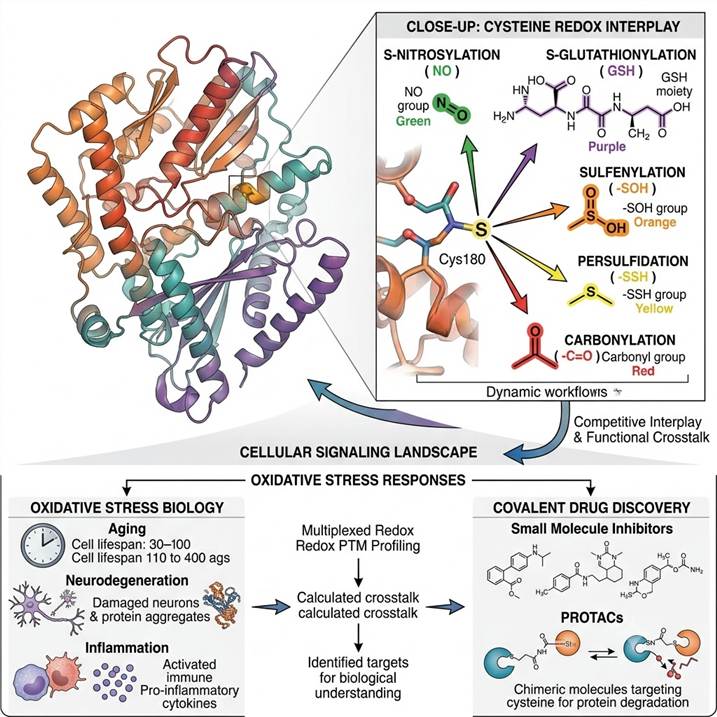
Cysteine is the most redox-sensitive amino acid in the proteome, and its thiol side chain can exist in multiple functionally distinct oxidation states. The collective landscape of these oxidative modifications — often termed the redox proteome or "redoxome" — represents a sophisticated regulatory network that governs diverse biological processes and is central to both oxidative stress pathology and covalent drug action.
The Redox Code and Cellular Signaling
Reactive oxygen species (ROS) and reactive nitrogen species (RNS) are not merely damaging byproducts of metabolism — they are essential signaling molecules that exert their effects through selective oxidation of protein cysteine residues. Each cysteine redox state carries distinct chemical properties and biological consequences: sulfenylation (-SOH) serves as a sensor of oxidative stress and a precursor to further modifications; S-nitrosylation (-SNO) mediates nitric oxide signaling in cardiovascular and neuronal systems; S-glutathionylation (-SSG) protects cysteines from irreversible oxidation while modulating enzyme activity; persulfidation (-SSH) mediates hydrogen sulfide signaling with emerging roles in aging and longevity regulation. The dynamic interplay between these modifications — their competition for the same cysteine residues, their differential reversibility, and their context-dependent functional effects — constitutes the "redox code" that translates environmental and metabolic cues into cellular responses.
Oxidative Stress and Disease Mechanisms
Dysregulation of cysteine redox homeostasis is a hallmark of aging and is implicated in the pathogenesis of cardiovascular disease, neurodegeneration, diabetes, cancer, and inflammatory disorders. Chronic oxidative stress shifts the balance of cysteine modifications toward irreversible oxidation states, leading to protein dysfunction, aggregation, and loss of proteostatic control. Integrated redox PTM profiling provides a quantitative readout of these disease-relevant changes, enabling the identification of redox-sensitive protein targets, biomarker discovery, and mechanistic understanding of oxidative stress pathology.
Relevance to Covalent Drug Discovery
Cysteine reactivity is the foundation of modern covalent drug development, and the same chemoproteomic methods used to profile endogenous redox modifications are directly applicable to mapping the target engagement and selectivity of covalent inhibitors, electrophilic fragments, and targeted protein degraders. Understanding the basal redox state of a cysteine — its susceptibility to S-nitrosylation, S-glutathionylation, or other modifications — provides critical context for predicting its ligandability, evaluating its druggability, and interpreting the functional consequences of its engagement by therapeutic compounds.
Our Integrated Redox PTM Platform
Our integrated platform deploys a complementary suite of chemoselective enrichment strategies, quantitative mass spectrometry methods, and computational analysis tools designed to capture the full spectrum of cysteine redox modifications from a single biological system. We recommend a multi-parameter approach whenever possible, as the simultaneous measurement of multiple redox states provides the integrated view necessary to understand redox signaling networks rather than isolated modification events.
Chemoselective Enrichment Strategies
Each cysteine redox modification requires a specific enrichment strategy tailored to its unique chemistry. For S-nitrosylation, we deploy the biotin-switch method and its derivatives, in which S-nitrosylated cysteines are selectively reduced, labeled with biotin affinity tags, and enriched for LC-MS/MS analysis. For S-glutathionylation, we use specific glutaredoxin-based reduction or antibody-based enrichment that preserves the mixed disulfide bond. For persulfidation, we offer both tag-switch and dimedone-switch methods optimized for this labile modification. For the combined analysis of multiple redox states, we employ sequential enrichment strategies that partition the sample into aliquots processed in parallel with modification-specific workflows, enabling direct comparison of modification profiles within the same biological context.
Quantitative Mass Spectrometry
All enriched redox-modified peptides are analyzed on high-resolution Orbitrap platforms with optimized HCD fragmentation parameters tailored to each modification type. For quantitative comparisons across conditions, we offer both label-free quantification — based on normalized spectral abundance factors and extracted ion chromatogram comparison — and TMT-based multiplexed quantification enabling up to 16 samples to be compared simultaneously. For targeted validation of specific redox-modified sites, we also deploy PRM (parallel reaction monitoring) assays with heavy isotope-labeled internal standards.
Integrated Data Analysis
Raw MS data are processed through modification-specific search pipelines with custom parameters for each redox PTM. The integration of data across multiple modification types enables pathway-level analysis that reveals the interplay between different cysteine redox states — for example, identifying cysteines that are substrates for both S-nitrosylation and S-glutathionylation and are therefore nodes of redox signaling crosstalk. Our bioinformatics platform provides functional enrichment, network analysis, and structural context for each identified redox-modified site, connecting cysteine-level modifications to systems-level biology.
Covered Redox & Cysteine PTM Services
Our integrated platform comprises the following specialized services, each optimized for a specific cysteine redox modification or functional state. These services can be deployed individually or in combination for comprehensive redox proteome characterization.
Redox State and Thiol Status
- Free Thiol Groups Quantification — Quantitative measurement of reduced cysteine thiol (-SH) availability, providing the baseline redox state from which all oxidative modifications depart and the reference point for calculating modification occupancy
- Cysteine-Redoxome Proteomics — Global profiling of the cysteine oxidation landscape, simultaneously capturing multiple oxidation states for an integrated view of the cellular redoxome
- Disulfide Bond Analysis — Mapping of intra- and intermolecular disulfide bridge formation, isomerization patterns, and cysteine pairing in proteins under native and oxidative conditions
Oxidative Cysteine Modifications
- S-Nitrosylation Analysis — Detection and site-specific mapping of protein S-nitrosylation, the principal mechanism of nitric oxide-based redox signaling in cardiovascular, neuronal, and immune systems
- S-Glutathionylation Analysis — Profiling of protein S-glutathionylation, a protective and regulatory modification that links cellular redox status to glutathione homeostasis under oxidative stress
- Carbonylation Analysis — Detection and quantification of protein carbonylation, a hallmark of oxidative damage associated with aging, neurodegeneration, and metabolic disease
- Oxidation Analysis — Comprehensive profiling of oxidative PTMs including sulfenylation (-SOH), sulfinylation (-SO₂H), and sulfonylation (-SO₃H), covering the full oxidation cascade of cysteine residues
Specialized Cysteine PTMs and Emerging Modifications
- Cysteinylation Analysis — Detection of cysteine-cysteine conjugation and cysteinylated proteins, a modification linking free cysteine levels to protein redox state
- Persulfidation / S-Sulfhydration Analysis — Detection and site mapping of cysteine persulfidation, the molecular mechanism of hydrogen sulfide (H₂S) signaling with emerging roles in cardiovascular protection, neuroprotection, and longevity regulation
- Reactive Cysteine Profiling — Chemoproteomic mapping of cysteine reactivity and ligandability using isoTOP-ABPP and IAA-alkyne probe labeling, bridging redox biology to covalent drug discovery and target engagement assessment
Workflow: Integrated Redox PTM Analysis Pipeline
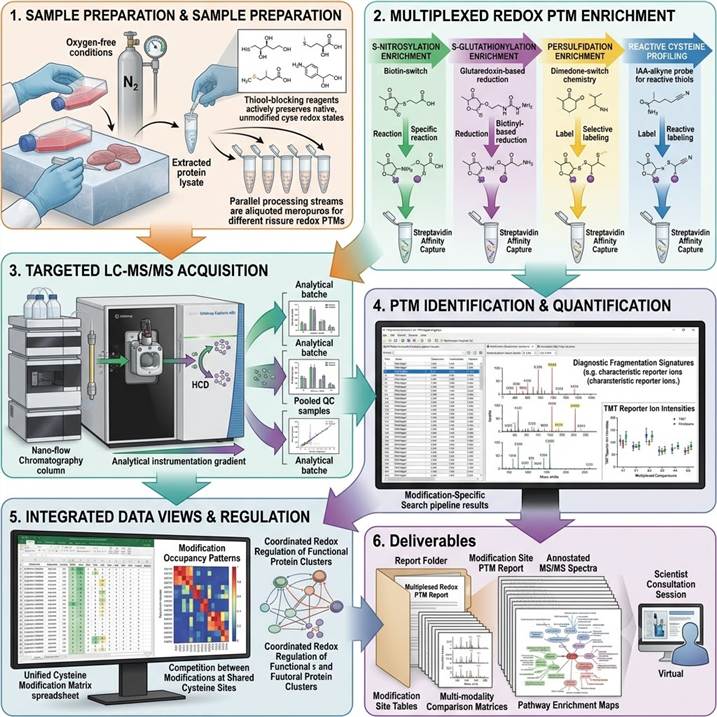
Step 1: Experimental Design and Sample Preparation
We collaborate with you to design the optimal redox PTM profiling strategy based on your biological question, sample type, and desired modification coverage. Samples are processed under conditions that preserve the native redox state: samples are snap-frozen, processed in oxygen-free environments where needed, and freshly prepared alkylating and reducing agents are used to block free thiols and prevent artifactual oxidation during processing.
Step 2: Modification-Specific Enrichment
Aliquoted sample fractions are processed in parallel with modification-specific enrichment workflows: biotin-switch for S-nitrosylation, glutaredoxin reduction for S-glutathionylation, dimedone-switch for persulfidation, IAA-alkyne labeling for reactive cysteine profiling, and DNPH derivatization for carbonylation. Each enrichment strategy is validated with appropriate positive and negative controls to ensure modification specificity.
Step 3: LC-MS/MS Acquisition
Enriched redox-modified peptides are analyzed on high-resolution Orbitrap or timsTOF platforms using optimized LC gradients and HCD fragmentation parameters tailored to each modification type. For integrated multi-modality comparisons, samples are analyzed in a single batch to minimize technical variation, with pooled quality control samples injected at regular intervals for performance monitoring.
Step 4: Identification and Quantification
Raw MS data are processed through modification-specific search pipelines with custom PTM definitions. Each redox modification is identified by its characteristic mass shift and validated by diagnostic fragmentation signatures. Quantification is performed using label-free or TMT-based methods, with normalization against internal standards and total protein content to ensure cross-sample comparability.
Step 5: Multi-Modality Data Integration
Data from individual redox PTM channels are integrated into a unified cysteine modification matrix, where each cysteine site is annotated with its modification status across all measured redox states. This integrated view reveals modification occupancy, competition between different redox PTMs at the same cysteine, and coordinated regulation of functionally related cysteine clusters. Statistical analysis identifies redox-modified sites and pathways significantly altered between conditions.
Step 6: Deliverables and Interpretation
Integrated redox PTM report containing: modification site tables for each redox PTM analyzed, annotated MS/MS spectra, multi-modality comparison matrices showing modification interplay, pathway enrichment analysis of redox-modified proteins, structural context mapping of modified cysteine sites, and a scientist consultation session for biological interpretation and follow-up experimental planning.
Why Choose Our Integrated Redox PTM Proteomics Platform
Comprehensive Multi-PTM Coverage
Our platform covers the full spectrum of cysteine redox modifications — from well-characterized modifications like S-nitrosylation and S-glutathionylation to emerging modifications like persulfidation and carbonylation — all available from a single service provider. This integrated approach eliminates the need to coordinate across multiple vendors or platforms and ensures that multi-modality data are generated with consistent quality standards and comparable quantification frameworks.
Integrated Data Analysis and Biological Context
Unlike service providers that deliver isolated modification lists, our platform provides integrated multi-modality data analysis that reveals the interplay between different redox PTMs. We deliver pathway-level biological interpretation, structural mapping of modified cysteine residues, and contextualization within the broader signaling and disease networks relevant to your research.
Dual Oxidative Stress and Drug Discovery Expertise
Our team brings combined expertise in both redox biology and chemoproteomic drug discovery — a rare combination that allows us to contextualize cysteine modification data within both oxidative stress mechanisms and covalent drug development paradigms. Whether you are investigating the redox basis of disease or profiling the cysteine engagement landscape of a therapeutic candidate, our platform delivers actionable data matched to your specific program needs.
Cross-Species and Multi-Matrix Compatibility
Our enrichment and analysis methods are validated across mammalian tissues and cells, plant samples, microbial systems, and clinical specimens including tumor biopsies, plasma, and subcellular fractions. This broad compatibility ensures that integrated redox PTM profiling is accessible for your specific biological system regardless of sample type.
Case Study: Low-Input Redoxomics for Multi-Parameter Cysteine Redox Profiling in Gut Oxidative Stress
In a 2025 study published in Signal Transduction and Targeted Therapy (Nature), Xiao et al. developed a low-input redoxomics pipeline that simultaneously profiles five distinct cysteine redox states from minimal sample input, demonstrating the power of integrated redox PTM analysis for understanding oxidative stress biology in complex physiological systems.
Background: While individual redox PTM profiling methods existed, no integrated platform could simultaneously measure multiple cysteine redox states from the limited sample amounts typically available from physiologically relevant models — particularly primate tissues and clinical biopsy specimens. This analytical gap prevented the systematic characterization of redox regulation in aging and disease contexts where sample availability is constrained.
Approach: The team developed a low-input redoxomics pipeline requiring only approximately 60 µg of total peptides to simultaneously profile five distinct cysteine redox states: free thiol (-SH), total cysteine oxidation, sulfenic acid (-SOH), S-nitrosylation (-SNO), and S-glutathionylation (-SSG). The method combines sequential blocking and reduction strategies with TMT isobaric labeling and high-resolution LC-MS/MS, enabling multiplexed quantification across multiple redox states from a single sample. The pipeline was applied to profile the cysteine redoxome in ascending and descending colon tissues from young (3–4 years), middle-aged (9–10 years), and aged (15–16 years) cynomolgus monkeys, quantifying 14,811 cysteine residues on 5,057 proteins.
Key Findings:
- S-glutathionylation was identified as the modification most strongly associated with gut aging, with age-dependent increases in SSG occupancy at specific cysteine sites
- Sulfenylated and S-glutathionylated proteins were enriched in cell adhesion categories, while S-nitrosylated proteins were predominantly involved in immune function — revealing modification-specific functional specialization
- Cysteine oxidation exhibited a bimodal distribution with peaks at approximately 32% and 86% oxidation that both increased with age, suggesting two distinct classes of redox-sensitive cysteines with differential susceptibility
- The descending colon showed greater age-related oxidative stress than the ascending colon, revealing regional differences in redox regulation along the gastrointestinal tract
- Metabolites including fumarate, allantoin, N-acetyl alanine, and indolelactic acid were identified as endogenous suppressors of oxidative stress, with fumarate treatment validated in a DSS-induced colitis model
- Calorie restriction in aged mice reversed many age-associated oxidative stress markers and reshaped the cysteine redoxome toward a younger profile
Significance: This study demonstrated that integrated multi-parameter redox PTM profiling from low-input samples is not only technically feasible but biologically transformative — revealing modification-specific functional specialization, regional redox heterogeneity, and metabolite-redox connections that would be invisible to single-modification approaches. The low-input redoxomics pipeline validated in this study establishes a template for integrated redox PTM analysis that is directly applicable to clinical and translational research settings.
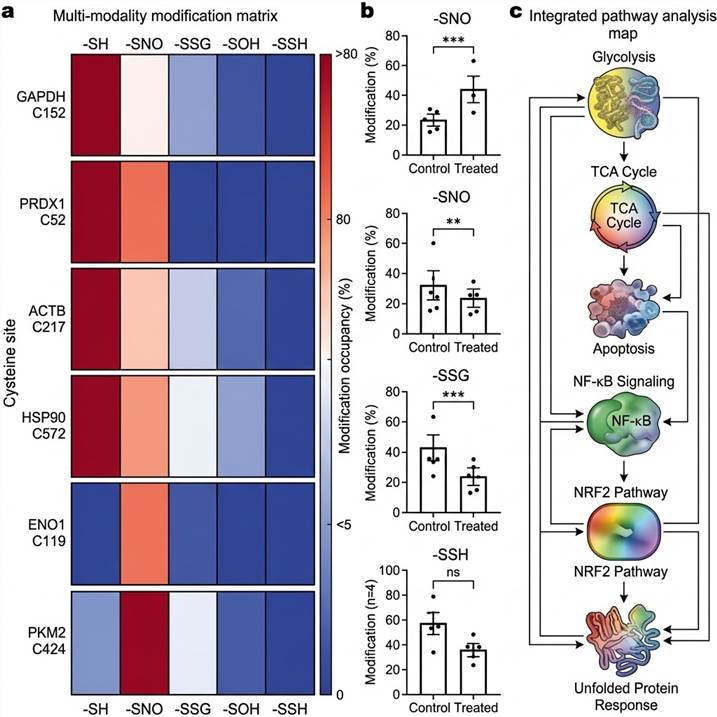
Figure 1 from Xiao et al. (2025). Low-input redoxomics workflow for simultaneous multi-parameter cysteine redox profiling and age-dependent redoxome remodeling in primate gut tissues. (CC BY 4.0)
Representative Integrated Redox PTM Profiling Results
Our integrated redox PTM platform delivers comprehensive data packages that enable both modification-specific analysis and cross-modality integration for systems-level understanding of redox regulation.
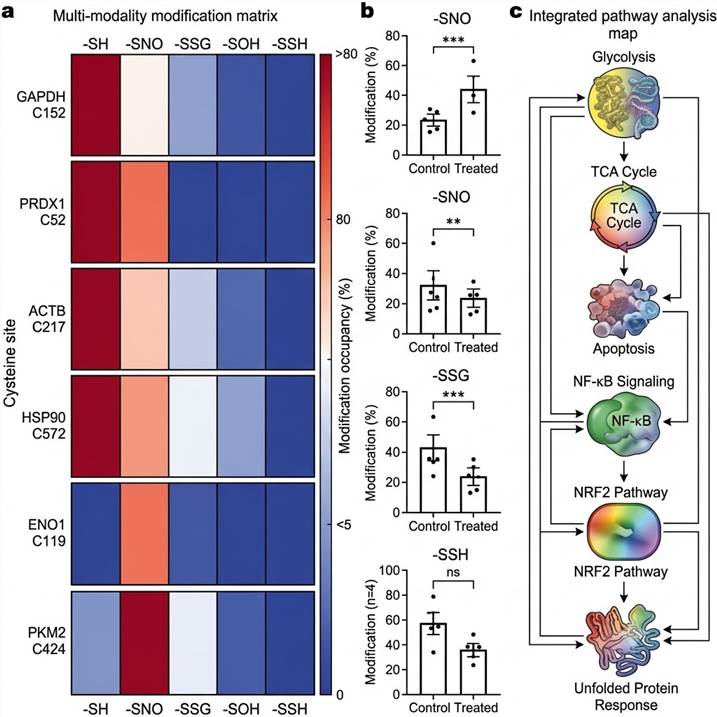
Representative data outputs from our integrated redox PTM platform. Multi-modality modification matrix, quantitative comparison across conditions, annotated spectra, and integrated pathway analysis.
Key deliverables included in every integrated redox PTM project:
- Modification-specific site tables — For each redox PTM analyzed: protein ID, modified cysteine position, peptide sequence, identification confidence, and quantification values with statistical significance
- Integrated multi-modality matrix — Combined dataset showing the modification status of each identified cysteine across all measured redox states, enabling direct comparison of modification occupancy and interplay
- Annotated MS/MS spectra — Fragmentation spectra for each identified redox-modified peptide with diagnostic ions and modification-specific fragmentation signatures
- Quantitative comparison reports — For each modification type, the differential abundance between conditions with statistical analysis and effect size estimation
- Pathway and functional enrichment analysis — Biological process, molecular function, and pathway enrichment for proteins modified by each redox PTM, with integrated multi-modality pathway maps showing coordinated redox regulation
Related Services
Our redox PTM platform interfaces with broader PTM analysis and drug discovery service lines, enabling comprehensive integration of cysteine redox data with other functional and therapeutic analyses.
- Reactive Cysteine Target Engagement Assay — Targeted quantitative assays for monitoring engagement of specific cysteine residues by covalent inhibitors, bridging redox profiling to drug development
- Covalent Drug Reactive Cysteine PTM Profiling — Integrated profiling of cysteine PTMs in the context of covalent drug treatment, linking endogenous redox state to drug-target interactions
- PTMs in Drug Discovery and Development — Broader PTM analysis platform supporting drug development programs from target identification through lead optimization
- PTM Bioinformatics Analysis — Advanced computational analysis for redox PTM datasets including pathway mapping, network analysis, and structural modeling of modified cysteine residues
- Multi-PTM Crosstalk Profiling — Analysis of interplay between different PTM types beyond redox modifications, including phosphorylation, acetylation, and ubiquitination crosstalk with cysteine redox states
FAQs
What is redox PTM proteomics?
Redox PTM proteomics is the comprehensive analysis of oxidative post-translational modifications on protein cysteine residues. These modifications — including S-nitrosylation, S-glutathionylation, sulfenylation, persulfidation, and carbonylation — collectively regulate cellular redox signaling, oxidative stress responses, and are central to both disease mechanisms and covalent drug action.
How many cysteine redox states can you analyze simultaneously?
In our integrated multi-parameter platform, we can simultaneously analyze up to five cysteine states: free thiol (-SH), S-nitrosylation (-SNO), S-glutathionylation (-SSG), sulfenic acid (-SOH), and persulfidation (-SSH). Additional modifications including carbonylation, sulfinylation, and sulfonylation can be added depending on your specific research questions. The optimal modification panel is designed in consultation with our scientific team based on your biological system and experimental goals.
What is the minimum sample amount required for integrated redox PTM analysis?
For comprehensive multi-modality profiling, we recommend 200–500 µg of total protein per sample (which enables parallel enrichment for multiple redox states). For focused analysis of a single redox modification, 50–100 µg of total protein is sufficient. Our low-input workflows, validated in published studies, can profile multiple redox states from as little as 60 µg of total peptides per sample. Specific requirements depend on sample type and modification complexity.
How do you distinguish between different cysteine modifications that have the same mass shift?
Differentiation of cysteine modifications with identical or overlapping mass shifts (e.g., persulfidation +32 Da versus sulfenylation +16 Da × 2 oxygens) relies on two complementary strategies: chemoselective enrichment chemistry that specifically targets each modification type at the sample preparation stage, and diagnostic fragmentation signatures during LC-MS/MS analysis that provide unambiguous identification of each modification based on characteristic neutral losses and fragment ions.
How do you prevent artifactual oxidation during sample processing?
Artifactual oxidation is the central challenge in redox proteomics. We employ multiple strategies to preserve native redox states: sample processing under oxygen-free (nitrogen or argon) atmosphere where possible, inclusion of rapid thiol-blocking reagents during lysis to prevent post-lysis oxidation, use of metal chelators to inhibit Fenton chemistry, processing at 4°C to slow oxidation kinetics, and inclusion of isotope-labeled internal standards to monitor and correct for artifactual oxidation during processing.
Can redox PTM profiling be combined with covalent drug target engagement studies?
Yes — this is one of the most powerful applications of our integrated platform. By profiling the basal redox state of cysteine residues before and after treatment with a covalent compound, we can determine how endogenous redox modifications affect drug-target engagement, identify cysteines whose modification status is altered by drug treatment, and distinguish drug-induced oxidative stress from direct target engagement. This integrated approach provides uniquely valuable data for covalent drug discovery programs.
What types of biological samples are compatible with redox PTM analysis?
Redox PTM profiling is compatible with a wide range of sample types including cultured mammalian cells, snap-frozen tissues (brain, heart, liver, kidney, colon, muscle, and others), tumor biopsies and clinical specimens, blood-derived samples (plasma, serum, PBMCs), plant tissues, microbial cell pellets, and subcellular fractions (mitochondria, cytosol, membrane, nuclear). For each sample type, we optimize processing conditions to preserve native redox state while maximizing protein extraction efficiency.
How do I select which redox modifications to profile for my experiment?
Selection depends on your biological question and target pathways. For broad oxidative stress assessment, we recommend a core panel of S-nitrosylation, S-glutathionylation, and free thiol status. For focused hydrogen sulfide biology, add persulfidation analysis. For covalent drug discovery programs, include reactive cysteine profiling. For aging and neurodegeneration studies, carbonylation is a valuable addition. We provide complimentary scientific consultation to design the optimal redox PTM panel for your specific research goals.
References
- Xiao X, Hu M, Gao L, Yuan H, Chong B, et al. Low-input redoxomics facilitates global identification of metabolic regulators of oxidative stress in the gut. Signal Transduction and Targeted Therapy. 2025;10:8.
- Percio A, Cicchinelli M, Masci D, Summo M, Urbani A, Greco V. Oxidative Cysteine Post Translational Modifications Drive the Redox Code Underlying Neurodegeneration and Amyotrophic Lateral Sclerosis. Antioxidants. 2024;13(8):883.
- Butterfield DA, Boyd-Kimball D, Reed TT, Sultana R, Cai J, Pierce WM. Using Redox Proteomics to Gain New Insights into Neurodegenerative Disease and Protein Modification. Antioxidants. 2024;13(1):127.
For research use only. Not for use in diagnostic procedures.