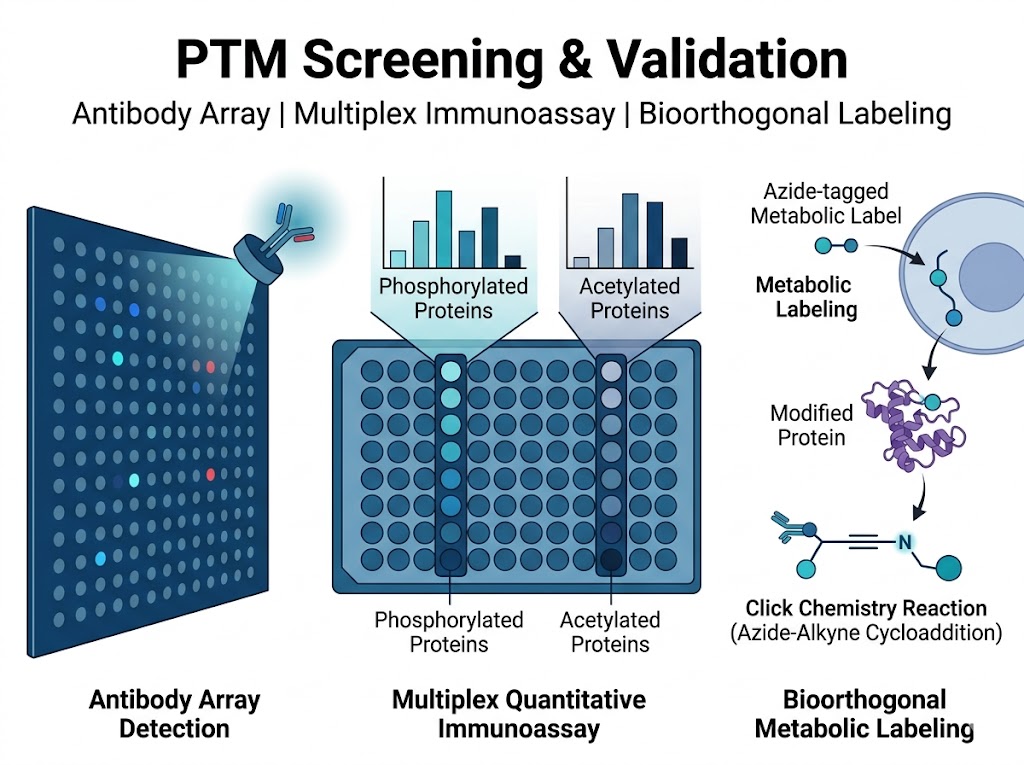
Why PTM Screening & Validation — From Discovery Hits to Confirmed Modifications
Mass spectrometry-based PTM discovery produces candidate lists of modified proteins and sites, each assigned a localization probability score. But localization probability is not proof. False positives arise from in-source fragmentation, chemical artifacts introduced during sample preparation, and peptides carrying modifications that produce isobaric fragment ions. Even at a strict 1% FDR, a 10,000-site dataset may contain 100 false discoveries — and the true sites still require orthogonal confirmation before functional interpretation.
Validation also addresses a different question than discovery. Discovery asks "what modifications are present?" Validation asks "is this specific modification truly present at this specific residue, and how does its abundance change across conditions?" Our three complementary approaches address validation at different throughput and resolution levels.
Antibody-based validation uses modification-specific antibodies to confirm the presence of a PTM at a target protein, recognizing not just the mass shift but the structural context of the modified residue. Bioorthogonal labeling uses chemical reporters that are metabolically incorporated into specific modification types, enabling pulse-chase kinetics and enrichment strategies that antibody-independent methods cannot achieve.
PTM Antibody Array Profiling — Multiplex Screening Across Modification Types
When you have a panel of candidate PTM targets and need to prioritize which sites to pursue, antibody arrays provide the highest throughput per experiment. Our PTM Antibody Array platform uses pre-spotted antibodies on membrane or slide formats, each recognizing a specific modified epitope. A single array can simultaneously detect 10–200+ modification-specific signals from a protein lysate.
Key capabilities: Simultaneous screening of multiple modification types (acetylation, methylation, phosphorylation, ubiquitination) from one sample. Chemiluminescence or fluorescence readout with quantitative densitometry. Sample requirement: 50–200 μg total protein per array. Compatible with cell lysates, tissue extracts, and immunoprecipitated samples.
Two dedicated sub-services provide targeted coverage:
• Histone Modification Antibody Array Service — Focused histone marks: H3K4me3, H3K9ac, H3K27me3, H3K36me3, H4K16ac, H4K20me3, and 20+ additional histone PTM targets. Designed for epigenetic drug screening and chromatin biology.
• Phospho-Signaling Antibody Array Service — Targets key phosphorylation sites in AKT/mTOR, ERK, STAT3, p53, NF-κB, JNK, and 30+ additional phospho-epitopes across MAPK, JAK-STAT, and PI3K-Akt pathways.
For broader coverage, visit our comprehensive PTM Antibody Array Profiling page.
Multiplex PTM Immunoassays — Quantitative Modified Protein Detection in Complex Matrices
When throughput requirements are lower but quantitative precision is critical, multiplex immunoassays provide the most reliable detection across multiple samples. Unlike arrays designed for single-sample screening, immunoassays enable quantitative comparison of modification levels across dozens to hundreds of samples — essential for clinical cohort studies, dose-response experiments, and time-course analyses.
Platform options: Luminex xMAP-based assays (up to 50-plex per well, 3–4 orders dynamic range, 25–50 μL sample). MSD electrochemiluminescence (up to 10-plex, sub-pg/mL sensitivity, preferred for serum/plasma). Custom sandwich ELISA (single- or low-plex, gold standard for regulatory biomarker qualification).
• Ultra-Sensitive Modified Protein Detection Service — fg/mL sensitivity using proximity-based amplification (SIMOA, Erenna). Enables PTM biomarker detection in serum, plasma, and CSF without enrichment pre-treatment.
For full detail on all multiplex formats, visit our Multiplex PTM Immunoassays page.
Bioorthogonal PTM Labeling Services — Chemical Tagging for Site-Specific Modification Tracking
When the question is not "is this modification present?" but "how does this modification change over time?" — bioorthogonal labeling provides the kinetic dimension that antibody-based methods cannot. By incorporating chemical reporters (azide- or alkyne-modified metabolic precursors) into specific modification types, we enable pulse-chase labeling, enrichment of newly synthesized modified proteins, and tracking of modification turnover rates.
Available strategies: Azidohomoalanine (AHA) labeling for newly synthesized proteins. Alkyne-modified sugar precursors (Ac4ManNAz for sialylation, Ac4GalNAz for O-GlcNAc) for glycan-specific PTM tracking. Click chemistry enrichment via copper-catalyzed or copper-free azide-alkyne cycloaddition for selective capture. Pulse-chase kinetics for modification half-life and turnover measurement.
Bioorthogonal labeling is particularly valuable when antibody-based methods are unavailable (novel or rare PTMs) or when modification dynamics need to be distinguished from changes in total protein abundance. By combining metabolic labeling with affinity enrichment and MS readout, this approach provides the most direct evidence that a modification is dynamically regulated.
Learn more on our Bioorthogonal PTM Labeling Services page.
How to Choose the Right PTM Validation Strategy — A Decision Framework
| Criterion |
Antibody Array |
Multiplex Immunoassay |
Bioorthogonal Labeling |
| Best for |
Multi-target screening |
Precise quantification |
Dynamic tracking |
| Throughput |
10–200 targets/array |
1–50 targets/plate |
1–10 targets/experiment |
| Sample per run |
50–200 μg protein |
25–100 μL; 10–50 μg |
100–500 μg protein |
| Quant. precision |
Semi-quantitative |
Fully quantitative |
Semi-quantitative (MS) |
| Modif. specificity |
High (validated Abs) |
Highest (sandwich) |
Chemical reporter type |
| Turnaround |
2–3 weeks |
3–4 weeks |
4–6 weeks |
| Best stage |
Screening |
Validation / cohort |
Mechanism / dynamics |
Recommended workflow: Discovery MS → Antibody Array (broad screen to confirm modification class) → Multiplex Immunoassay (precise quantification across conditions) → Bioorthogonal Labeling (dynamics and turnover). Not every project needs all three — the table above helps identify which approach matches your current experimental question.
Applications — Epigenetic Drug Screening, Biomarker Validation & Signaling Pathway Mapping
Epigenetic drug screening. Evaluate compound effects on histone modification landscapes: HDAC inhibitor effects on H3/H4 acetylation, EZH2 inhibitor effects on H3K27me3, BET bromodomain inhibitor effects on H3K9ac and H4K5ac. Our antibody array platform provides direct chromatin state readouts across dose ranges and treatment durations.
Biomarker validation. Confirm and quantify phospho-protein biomarkers in clinical sample cohorts. Multiplex immunoassays enable simultaneous measurement of 5–30 phospho-biomarkers across 100+ patient samples with clinical research-grade reproducibility. Phospho-ERK, phospho-AKT, phospho-STAT3, and phospho-p53 are among the most frequently requested panels.
Signaling pathway mapping. Map kinase activation cascades in response to stimuli or inhibitors. Phospho-antibody arrays provide a comprehensive view of pathway activation states, identifying which nodes are phosphorylated and to what extent under each condition.
Target engagement studies. Confirm that a drug candidate engages its intended target and produces the expected PTM changes. Bioorthogonal labeling with pulse-chase kinetics provides the most direct evidence of target engagement by measuring modification turnover in drug-treated vs. control samples.
For a broader discovery-first approach, our Global PTM Profiling Service provides the upstream discovery data that feeds into targeted validation workflows.
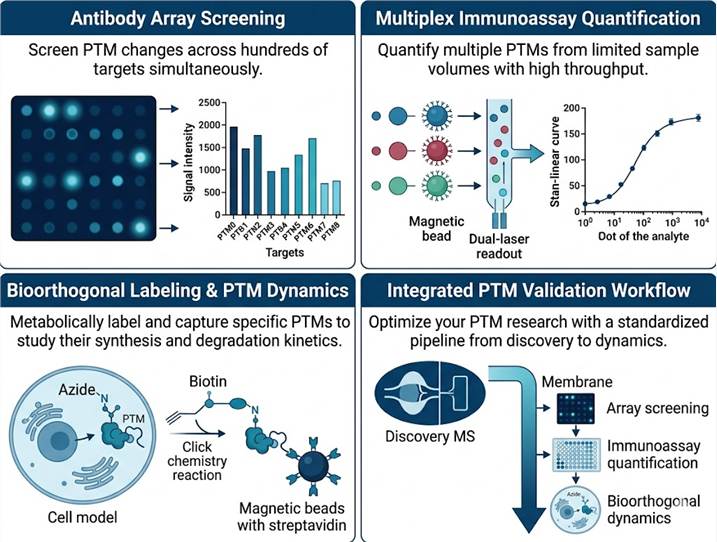
Frequently Asked Questions About PTM Screening & Validation
Q: When should I use antibody array vs. multiplex immunoassay vs. bioorthogonal labeling?
A: Use antibody arrays to screen many targets (10–200) from limited samples. Use multiplex immunoassays for precise quantification across many samples. Use bioorthogonal labeling to track modification dynamics or when antibodies are unavailable.
Q: Can you validate PTMs discovered from our own MS data?
A: Yes. Provide your list of candidate modified proteins and modification sites, and we will design a targeted validation strategy. For well-characterized PTMs, antibody arrays or immunoassays are configured. For novel modifications, bioorthogonal labeling may be more appropriate.
Q: How many samples can be analyzed in one antibody array experiment?
A: Most formats process one sample per array. For a 20-antibody array, 20 samples can be processed in parallel. We recommend an initial screen of 3–5 representative samples per condition, followed by immunoassay quantification across all samples for top candidates.
Q: What is the minimum detection limit for multiplex immunoassays?
A: Luminex-based assays: 1–10 pg/mL. MSD electrochemiluminescence: sub-pg/mL. SIMOA platform: fg/mL sensitivity for ultra-low abundance targets.
Q: How specific are PTM antibodies? Can pan-acetyl-lysine antibodies distinguish acetylation from butyrylation?
A: This depends on the antibody. We validate each PTM antibody lot against a panel of competitor modification peptides. Pan-acetyl-lysine antibodies may show some cross-reactivity with butyrylation. Modification-specific antibodies (e.g., acetyl-H3K9 vs. butyryl-H3K9) are generally highly specific.
Q: Can bioorthogonal labeling be combined with mass spectrometry?
A: Yes. Click chemistry enrichment of bioorthogonally labeled proteins followed by MS analysis enables identification of proteins carrying modifications synthesized during the labeling window, providing a temporal dimension that standard PTM enrichment cannot achieve.
References
- Choudhary C, Mann M. Decoding signalling networks by mass spectrometry-based proteomics. Nature Reviews Molecular Cell Biology. 2010;11(6):427-439. doi:10.1038/nrm2900
- Olsen JV, Mann M. Status of large-scale analysis of post-translational modifications by mass spectrometry. Molecular & Cellular Proteomics. 2013;12(12):3444-3452. doi:10.1074/mcp.O113.034181
- Zhao Y, Jensen ON. Modification-specific proteomics: strategies for characterization of post-translational modifications using enrichment techniques. Proteomics. 2009;9(20):4632-4641. doi:10.1002/pmic.200900398
- Huang H, Sabari BR, Garcia BA, Allis CD, Zhao Y. SnapShot: histone modifications. Cell. 2014;159(2):458-458.e1. doi:10.1016/j.cell.2014.09.037
*This service is provided for research use only (RUO). It is not intended for clinical diagnostic or therapeutic applications.