Integrated PTM Enzyme Activity Profiling — One Provider, Every Major Enzyme Class
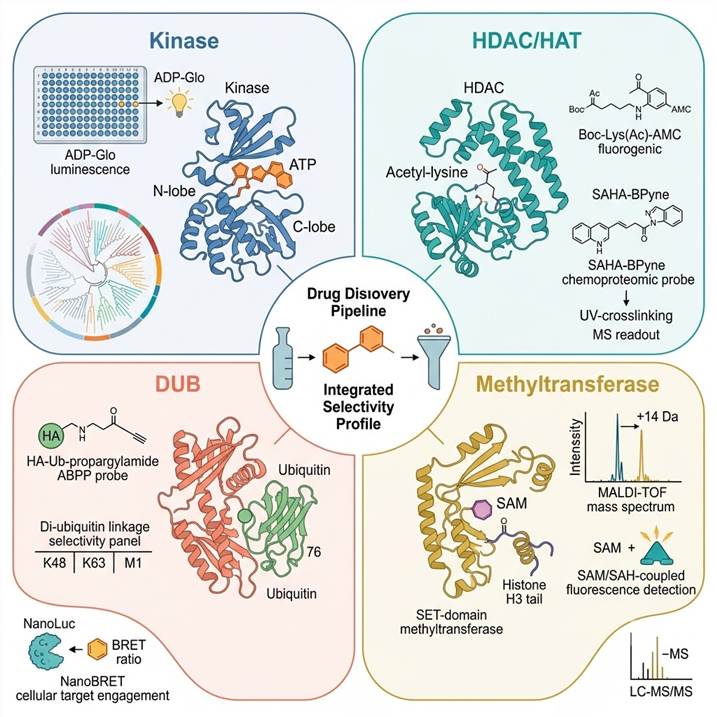
Drug discovery programs targeting PTM enzymes — kinases, deubiquitinases, deacetylases, acetyltransferases, methyltransferases — share a common bottleneck: selectivity profiling across the target enzyme family is technically demanding, platform-dependent, and typically fragmented across multiple vendors. Each enzyme class requires distinct assay chemistry, detection technology, and sample preparation. Our integrated platform solves this fragmentation by consolidating activity-based screening across all major PTM enzyme classes under one provider, one quality system, and one data analysis framework. We combine biochemical activity assays (fluorescence, luminescence, MALDI-TOF), chemoproteomic target engagement profiling (MIBs/kinobeads, ABPP), and cellular pathway analysis (phosphoproteomics, histone acetylation LC-MS/MS, ubiquitin chain profiling) to deliver quantitative, cross-comparable selectivity data from biochemical potency through cellular pharmacology. For kinase-specific profiling, our Kinase Activity & Selectivity Profiling provides MIBs kinome profiling across 300+ kinases with dose-resolved Kd. For epigenetic enzyme programs, our HDAC/HAT Activity Assays cover all zinc-dependent HDAC isoforms and major HAT families with fluorogenic and chemoproteomic readouts. For ubiquitin-pathway targets, our DUB and Ubiquitin Enzyme Activity Assays provide ABPP-based inhibitor profiling across 50+ DUBs with linkage-specific activity quantification.
Find Your Solution: Target Class → Screening Strategy
| Your Target Class |
Recommended Screening Platform |
Key Techniques & Readouts |
| Protein kinases — inhibitor selectivity profiling and lead optimization |
MIBs/kinobeads chemoproteomics + ADP-Glo biochemical panel |
300+ kinases dose-resolved apparent Kd (TMT LC-MS/MS), 100+ recombinant kinase IC₅₀ panel (Z′ > 0.7), NanoBRET intracellular target engagement, phosphoproteomics kinase activity inference (KSEA/INKA) |
| Histone deacetylases (HDACs) — isoform-selective inhibitor discovery |
Fluorogenic HDAC panel + chemoproteomic ABPP (SAHA-BPyne) |
Class I/IIb/IV HDAC isoform IC₅₀ (Boc-Lys(Ac)-AMC), UV-crosslinking ABPP with quantitative LC-MS/MS for native HDAC complex target engagement, histone acetylation LC-MS/MS (30+ marks) for cellular PD |
| Histone acetyltransferases (HATs/KATs) — p300, PCAF, MYST family |
Fluorescence + MALDI-TOF HAT activity assays |
Acetyl-CoA consumption fluorescence (384-well), label-free MALDI-TOF peptide acetylation (+42 Da shift), histone substrate peptides, IC₅₀ determination |
| Deubiquitinases (DUBs) — covalent inhibitor screening and ubiquitin linkage selectivity |
ABPP covalent fragment profiling + di-ubiquitin probe assays |
HA-Ub-propargylamide ABPP probe labeling of 50+ DUBs in cell lysate (± inhibitor), TMT or label-free LC-MS/MS, di-ubiquitin linkage selectivity panel (K48, K63, M1, K11, K29, K33), enzyme kinetics (kinact/Ki) |
| Protein methyltransferases (PMTs) — G9a, EZH2, DOT1L, PRMT family |
Biochemical methyltransferase activity assays |
SAM/SAH-coupled fluorescence or antibody-based detection, histone and non-histone peptide substrates, IC₅₀ and SAM-competitive vs. substrate-competitive mechanism determination |
| Multi-target PTM inhibitor profiling — kinase + HDAC + bromodomain combinations |
Custom integrated screening across enzyme classes |
Consolidated selectivity profiling across kinase, HDAC, HAT, DUB, and methyltransferase panels from matched biological samples, multi-enzyme selectivity heat maps, cross-class selectivity scores |
Activity-Based Screening Platforms by Enzyme Class
Each PTM enzyme class demands distinct assay technology — we provide optimized platforms for every major drug target family, all integrated under one quality system.
Kinase Inhibitor Selectivity Profiling — MIBs Chemoproteomics + Biochemical Panel
Kinase inhibitor selectivity is the single most important predictor of clinical success. Our integrated platform delivers four orthogonal selectivity readouts: MIBs/kinobeads chemoproteomic kinome profiling measures inhibitor binding to 300+ endogenously expressed kinases in their native cellular context (dose-resolved apparent Kd from a single TMT LC-MS/MS experiment); biochemical ADP-Glo activity assays provide quantitative IC₅₀ against 100+ recombinant kinases (Z′ > 0.7, 10-point dose-response); NanoBRET quantifies intracellular target occupancy in live cells at physiological ATP; and phosphoproteomics-based kinase activity inference (KSEA/INKA/RoKAI) reveals functional signaling consequences. For detailed platform specifications, see our Kinase Activity & Selectivity Profiling service page.
HDAC/HAT Activity Assays — Fluorogenic, Chemoproteomic, and MS Detection
Epigenetic drug targets require isoform-level resolution. Our HDAC platform covers class I (HDAC1/2/3/8), class IIb (HDAC6/10), and class IV (HDAC11) using Boc-Lys(Ac)-AMC fluorogenic substrates with optimized conditions per isoform. Chemoproteomic ABPP with the SAHA-BPyne photoaffinity probe reveals target engagement at the native HDAC complex level (CoREST, NuRD, Sin3, NCoR/SMRT) — critical data that biochemical isoform IC₅₀ cannot provide. For HATs, fluorescence-based acetyl-CoA consumption and label-free MALDI-TOF MS detection of peptide acetylation provide complementary readouts for inhibitor characterization and SAR. Full platform details: HDAC/HAT Activity Assays.
DUB & Ubiquitin Enzyme Inhibitor Screening — ABPP + Linkage Selectivity
DUBs are high-priority targets in oncology and neurodegeneration, but achieving selectivity across the ~100-member DUB family is exceptionally challenging. Our DUB inhibitor screening platform combines activity-based protein profiling (ABPP) using HA-Ub-propargylamide and HA-Ub-vinyl sulfone probes to label active DUBs in cell lysates, competitive inhibitor profiling with TMT or label-free quantitative LC-MS/MS readout across 50+ DUBs, and di-ubiquitin linkage selectivity panels (K48, K63, M1, K11, K29, K33, K27) to characterize inhibitor linkage preference. For PROTAC and targeted protein degradation programs, we offer integrated DUB activity profiling and ubiquitin chain analysis. Details: DUB and Ubiquitin Enzyme Activity Assays. For ubiquitin chain characterization, our Ubiquitylomics Analysis services provide quantitative ubiquitin chain profiling.
Methyltransferase, Acetyltransferase & Other PTM Enzyme Assays
Protein methyltransferases (G9a, EZH2, DOT1L, PRMT1–9, SETD2, NSD1–3), acetyltransferases (p300/CBP, PCAF/GCN5, MYST family), and other PTM writer/eraser enzymes represent a rapidly growing target space for oncology and epigenetic drug discovery. We develop and validate custom biochemical activity assays for these enzyme classes — fluorescence-based (SAM/SAH-coupled, acetyl-CoA consumption), antibody-based (methyl-lysine detection), or MS-based (MALDI-TOF or LC-MS detection of reaction products) — with IC₅₀ determination, mechanism-of-inhibition characterization, and selectivity screening against related enzyme family members. For methylated peptide enrichment and analysis, our Methylation Proteomics service provides complementary global methylation profiling.
Why Choose Our PTM Enzyme Activity & Inhibitor Screening Platform
All Major PTM Enzyme Classes, One Provider
Kinase, HDAC, HAT, DUB, methyltransferase, acetyltransferase — every major druggable PTM enzyme class covered under one quality system. Eliminate multi-vendor coordination, normalize selectivity data across enzyme families, and receive integrated cross-class selectivity reports that accelerate decision-making.
Biochemical → Chemoproteomic → Cellular Translation
Biochemical IC₅₀ tells you what a compound can do to a purified enzyme. Chemoproteomic ABPP/MIBs profiling tells you what it actually does to endogenously expressed enzymes in their native complexes. Cellular pathway readouts (phosphoproteomics, histone acetylation, ubiquitin chains) confirm functional pharmacology. Three layers of selectivity data, directly comparable, from one provider.
Validated Against Industry-Reference Datasets
Our kinase profiling platforms are benchmarked against the Klaeger et al. (2017) kinobeads dataset — 243 clinical kinase inhibitors profiled against 220+ kinases, the industry-standard reference for kinase selectivity. HDAC ABPP methods are validated against well-characterized isoform-selective inhibitors (SAHA, tubastatin A, PCI-34051). DUB ABPP is benchmarked against published DUB inhibitor chemoproteomics datasets.
Custom Assay Development for Novel PTM Targets
For emerging PTM enzyme targets without established commercial assay kits, we develop and validate custom biochemical and chemoproteomic assays — substrate identification, detection chemistry optimization, assay condition optimization (Km determination, Z′ validation), and selectivity panel design. Your novel target, our assay development expertise.
Workflow: From Compound to Cross-Class Selectivity Profile
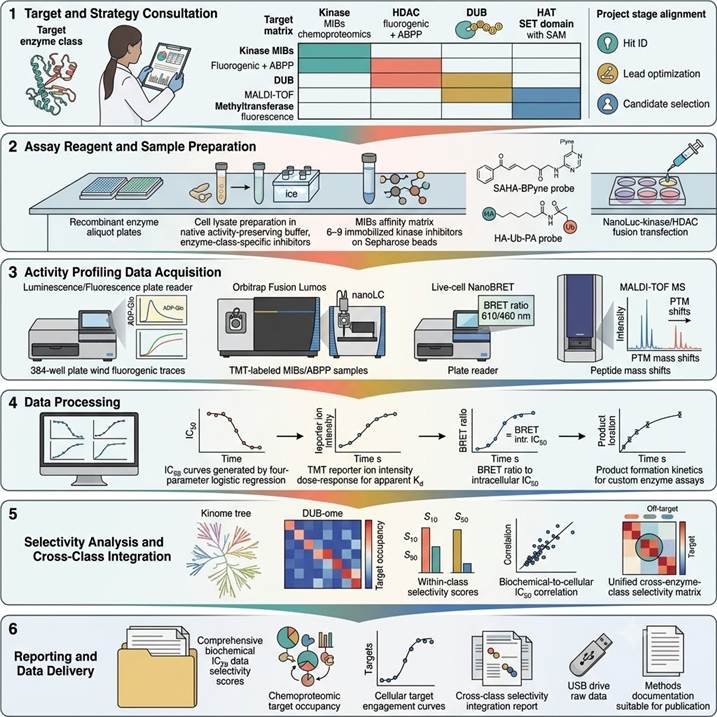
Step 1: Target & Strategy Consultation
We define the screening strategy based on your target enzyme class, project stage (hit ID, lead optimization, candidate selection), selectivity requirements, and sample availability. A detailed proposal covers enzyme panel design, assay formats, control compounds, and data analysis plan.
Step 2: Assay Reagent & Sample Preparation
Recombinant enzyme QC and panel assembly for biochemical assays. Cell lysate preparation in activity-preserving native buffers with enzyme-class-appropriate protease/phosphatase inhibitors. Probe labeling (MIBs matrix, SAHA-BPyne, HA-Ub-PA) for chemoproteomic workflows. Live-cell transfection for NanoBRET.
Step 3: Activity Profiling Data Acquisition
Biochemical: fluorescence/luminescence plate reader (384-well, kinetic or endpoint). MIBs/ABPP: probe-labeled proteins enriched, on-bead digested, TMT-labeled, nanoLC-MS/MS (Orbitrap Fusion Lumos). NanoBRET: BRET ratio (610/460 nm) in live cells. MALDI-TOF: peptide acetylation/methylation mass shift.
Step 4: Data Processing & Quantification
Biochemical: IC₅₀ by four-parameter logistic regression. Chemoproteomic: protein ID (FDR < 1%), TMT reporter ion extraction, dose-response Kd. NanoBRET: BRET ratio → intracellular IC₅₀. DUB ABPP: target occupancy (inhibitor/control ratio). Custom enzyme assays: product formation kinetics and IC₅₀.
Step 5: Selectivity Analysis & Cross-Class Integration
Within-class selectivity heat maps, selectivity scores (S₁₀, S₅₀), kinome/DUB-ome tree visualizations, biochemical-to-cellular potency correlation, pathway enrichment for cellular readouts. For multi-class programs: cross-enzyme-class selectivity matrices identifying overlapping off-targets.
Step 6: Reporting & Data Delivery
Comprehensive report: full experimental protocols, raw data files (plate reader, mzML, BRET), IC₅₀ curves with 95% CI, selectivity heat maps and kinome/DUB-ome trees, cellular target occupancy data, pathway enrichment, and publication-ready methods documentation.
Applications in Drug Discovery
Kinase Inhibitor Selectivity Profiling & Lead Optimization
For oncology, immunology, and neurodegeneration programs, kinome selectivity determines therapeutic window. We deliver the multi-dimensional selectivity data — biochemical IC₅₀ (100+ kinases), MIBs kinome Kd (300+ kinases), NanoBRET cellular occupancy — that medicinal chemists need to optimize selectivity alongside potency at every SAR iteration.
Epigenetic Inhibitor Discovery — HDAC, HAT, Methyltransferase
Epigenetic drug targets demand isoform-level selectivity across multi-member enzyme families. We provide the integrated biochemical + chemoproteomic + cellular PD readout (histone acetylation/methylation LC-MS/MS) needed to characterize isoform selectivity, confirm cellular target engagement, and establish pharmacodynamic biomarker assays for preclinical studies.
DUB Inhibitor Screening for Oncology & Neurodegeneration
DUBs are among the most challenging enzyme targets for selectivity — the ~100-member cysteine protease DUB family shares highly conserved active-site architecture. Our ABPP platform screens inhibitors against 50+ DUBs simultaneously in native proteomes, identifying selective starting points and quantifying off-target DUB engagement that would be invisible to biochemical panel assays alone.
PROTAC & Targeted Protein Degradation
PROTAC efficacy depends on ternary complex formation with E3 ligases and efficient target ubiquitination — both of which require functional activity measurement of the ubiquitin-proteasome machinery. We support degrader programs with DUB activity profiling, ubiquitin chain profiling, and integration with our Modificated Protein Degrader Proteomics services for comprehensive degrader characterization.
Resistance Mechanism & Kinome Reprogramming Analysis
Acquired resistance via kinome reprogramming or epigenetic bypass is the major cause of targeted therapy failure. Our combined MIBs kinome profiling + phosphoproteomics + histone PTM analysis workflow identifies which kinases and epigenetic enzymes are activated in drug-resistant vs. drug-sensitive cells — directly informing rational combination strategies. For phospho-signaling validation, our Phospho-Signaling Antibody Array provides parallel measurement of 100–200 kinase phosphorylation sites.
Case Study: Kinobeads Chemoproteomics Drives Selective Kinase Inhibitor Development
In a 2024 Scientific Reports study (CC BY 4.0), Yoshida et al. demonstrated the practical power of kinobeads-based chemoproteomic screening for kinase inhibitor discovery — using the same methodology that underpins our PTM enzyme activity and inhibitor screening platform to transform a non-selective starting compound into a selective inhibitor with cellular activity.
Approach: The study used TIM-063-Kinobeads — an affinity matrix of an immobilized CaMKK inhibitor on Sepharose beads — to perform chemoproteomic profiling of TIM-063 against endogenously expressed kinases in cell lysates. Quantitative LC-MS/MS identified AAK1 (adaptor-associated kinase 1) as a key off-target kinase engaged by TIM-063, with strong dose-dependent competition. Guided by this chemoproteomic selectivity data, the team optimized the compound structure to enhance AAK1 potency while reducing CaMKK and other off-target activity — yielding TIM-098a, a selective AAK1 inhibitor with IC₅₀ = 0.24 µM in biochemical assays and 0.87 µM in cellular target engagement assays, demonstrating functional inhibition of clathrin-mediated endocytosis. This study exemplifies the core value proposition of our PTM enzyme activity and inhibitor screening service: chemoproteomic profiling reveals the complete target engagement landscape of your compound, enabling data-driven optimization of potency and selectivity.
- Kinobeads chemoproteomics identified AAK1 as the key off-target of TIM-063 — information invisible to biochemical panel assays alone
- Structure-guided optimization informed by chemoproteomic selectivity data yielded TIM-098a with ~35-fold improved AAK1 potency and substantially reduced off-target activity
- Cellular target engagement and functional assays (clathrin-mediated endocytosis inhibition) confirmed that biochemical selectivity translated to cellular pharmacology
- The study validates the core chemoproteomic screening workflow — kinobeads affinity profiling → off-target identification → data-driven lead optimization → cellular validation — that we apply across kinase, HDAC, DUB, and other PTM enzyme classes
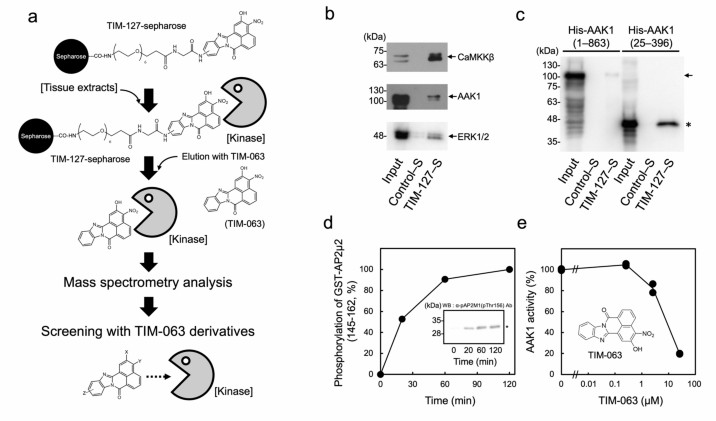
Adapted from Yoshida et al. (2024). Development of a novel AAK1 inhibitor via Kinobeads-based screening. Scientific Reports 14:6723. (CC BY 4.0)
Platform Performance & Deliverables
| Enzyme Class |
Coverage |
Primary Readout |
Throughput |
Key Deliverable |
| Kinases |
300+ (MIBs) / 100+ (biochemical) |
Apparent Kd / IC₅₀ / intracellular IC₅₀ |
High (50K+ cpds/week biochemical) |
Kinome tree, selectivity scores, cellular occupancy data |
| HDACs |
7+ isoforms (class I/IIb/IV) |
IC₅₀ (fluorogenic) / target occupancy (ABPP) |
High (20K+ cpds/week fluorogenic) |
Isoform selectivity heat map, ABPP complex occupancy, histone acetylation PD |
| HATs/KATs |
p300/CBP, PCAF/GCN5, MYST family |
IC₅₀ (fluorescence) / +42 Da mass shift (MALDI-TOF) |
Medium (500+ cpds/week) |
IC₅₀ curves, acetylation site confirmation |
| DUBs |
50+ (ABPP) |
Target occupancy (inhibitor/control ratio) |
Medium (200+ cpds/week) |
DUB-ome target occupancy heat map, linkage selectivity panel |
| Methyltransferases |
Custom panel (5–20 enzymes) |
IC₅₀ (fluorescence/antibody/MS) |
Medium (500+ cpds/week) |
IC₅₀ curves, mechanism of inhibition, selectivity panel |
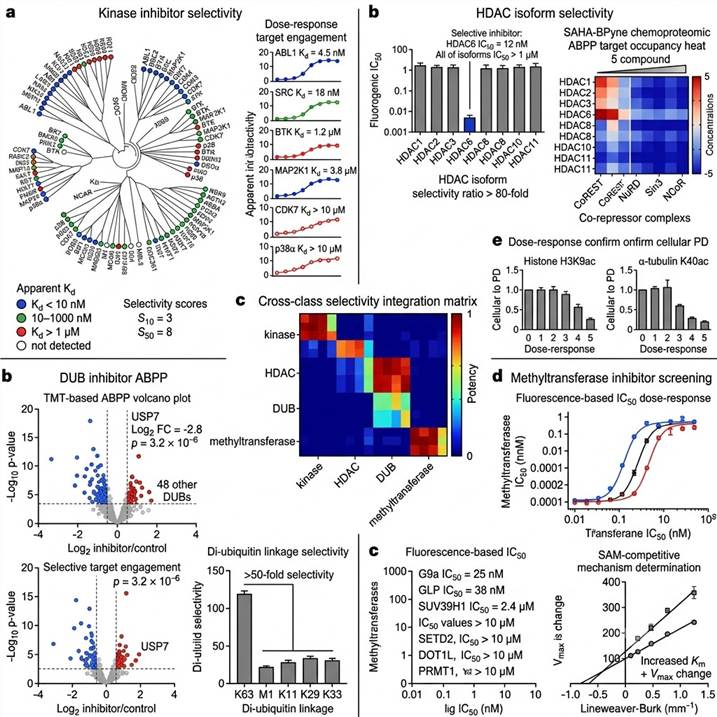
Representative data outputs from our PTM Enzyme Activity & Inhibitor Screening platform. Multi-enzyme-class selectivity profiles, integrated into a single report — kinase kinome tree, HDAC isoform selectivity heat map, DUB ABPP target occupancy panel, and methyltransferase IC₅₀ curves.
Every PTM enzyme activity screening project includes:
- Biochemical activity assay data package — IC₅₀ curves with 95% CI, Z′-factor metrics, selectivity scores, raw plate-reader data for each enzyme class
- Chemoproteomic profiling data package — MIBs kinome Kd or ABPP target occupancy data, enzyme-class-specific selectivity visualizations (kinome tree, DUB-ome heat map, HDAC complex dendrogram), raw MS data (mzML)
- Cellular target engagement data package — NanoBRET intracellular IC₅₀ and residence time (kinases) or cellular thermal stabilization assay data (HDACs, methyltransferases), biochemical-to-cellular potency correlation
- Cellular pathway analysis data package — phosphoproteomics kinase activity scores, histone acetylation/methylation LC-MS/MS quantification, ubiquitin chain profiling
- Cross-class selectivity integration report — unified selectivity matrix across all profiled enzyme classes identifying overlapping off-targets
- Methods documentation — complete protocols and analysis parameters formatted for publication and regulatory reference
Related Services
FAQs
Which PTM enzyme classes can you screen inhibitors against?
We provide activity-based inhibitor screening across all major druggable PTM enzyme classes: protein kinases (MIBs chemoproteomics covering 300+ kinases plus biochemical ADP-Glo panel covering 100+ recombinant kinases), histone deacetylases (class I/IIb/IV HDAC isoforms by fluorogenic assay and chemoproteomic ABPP), histone acetyltransferases (p300/CBP, PCAF/GCN5, MYST family by fluorescence and MALDI-TOF), deubiquitinases (50+ DUBs by ABPP with HA-Ub-probe labeling), protein methyltransferases (G9a, EZH2, DOT1L, PRMT1–9, SETD2, NSD1–3 by fluorescence or MS), and other PTM eraser/writer enzymes (demethylases, SUMO proteases, etc.) with custom assay development available for novel targets. No other provider offers this breadth of PTM enzyme activity screening under one quality system.
How does chemoproteomic target engagement profiling differ from biochemical IC₅₀ assays?
Biochemical IC₅₀ assays use purified recombinant enzymes in optimized buffer — they tell you what a compound can do under ideal conditions. Chemoproteomic profiling (MIBs/kinobeads for kinases, ABPP for HDACs and DUBs) measures inhibitor binding to endogenously expressed, full-length enzymes in their native cellular context — at physiological expression levels, in complex with regulatory proteins, subject to native post-translational modifications. This distinction matters: biochemical selectivity frequently overestimates cellular selectivity because it misses compound behavior against native enzyme complexes. Both are essential — biochemical assays provide the quantitative SAR data for medicinal chemistry; chemoproteomics provides the physiologically relevant selectivity data for candidate selection. We integrate both in a single workflow.
Can you screen the same compound across multiple PTM enzyme classes simultaneously?
Yes — this is a core differentiator of our platform. For compounds with potential polypharmacology (e.g., kinase + HDAC dual inhibitors, or compounds being profiled for off-target liability across enzyme classes), we design integrated screening cascades that test the same compound batch against kinase, HDAC, HAT, DUB, and methyltransferase panels in parallel. All assays use matched biological samples and consistent experimental conditions, enabling direct cross-class selectivity comparison. The integrated report includes a unified cross-enzyme-class selectivity matrix showing which enzyme families are engaged at each compound concentration.
What is the throughput for PTM enzyme inhibitor screening?
Throughput varies by enzyme class and assay format. Biochemical kinase ADP-Glo assays: 50,000+ compounds per week in 384-well HTS format (Z′ > 0.7). Fluorogenic HDAC assays: 20,000+ compounds per week. DUB ABPP: 200+ compounds per week (medium-throughput, MS-based readout). Methyltransferase/HAT assays: 500+ compounds per week. For large compound libraries, we recommend initial biochemical HTS followed by chemoproteomic selectivity profiling of prioritized hits — the most efficient path from library to selective lead.
How do you handle custom assay development for novel PTM enzyme targets?
For PTM enzyme targets without established commercial assay kits, we develop and validate custom assays in a stepwise process: (1) substrate identification — screening candidate peptide or protein substrates informed by literature and known consensus sequences; (2) detection chemistry selection — fluorescence, luminescence, antibody-based, or MS detection based on the specific enzymatic reaction; (3) assay optimization — Km determination for substrates and cofactors, enzyme titration, time-course for linear range, DMSO tolerance; (4) validation — Z′ factor determination, reference inhibitor IC₅₀, inter-day reproducibility (CV < 15%); (5) selectivity panel design — selection of related enzyme family members for counter-screening. Typical turnaround: 4–8 weeks from target to validated screening-ready assay.
What sample types and quantities are required?
For biochemical assays: purified recombinant enzymes (quantities depend on enzyme class — typically 10–100 ng per well). For chemoproteomic profiling (MIBs/ABPP): fresh or flash-frozen cell pellets (1–10 × 10⁶ cells per condition for dose-response), tissue biopsies (10–50 mg), or tumor specimens. Samples must be processed in native, activity-preserving lysis buffers — denaturing buffers (RIPA, urea, SDS) destroy enzyme native structure and cannot be used. Detailed sample preparation guidelines are provided for each enzyme class. For cellular target engagement (NanoBRET): live cells (> 90% viability) transfected with target-enzyme fusion constructs. For cellular pathway analysis (phosphoproteomics, histone PTM LC-MS/MS): 1–10 × 10⁶ cells or 10–50 mg tissue per condition.
How does this service support drug discovery from target validation through candidate selection?
Target validation: chemoproteomic profiling (MIBs, ABPP) identifies which PTM enzymes are active and druggable in disease-relevant cells — confirming target engagement feasibility before investing in a screening campaign. Hit identification: biochemical HTS (ADP-Glo for kinases, fluorogenic for HDACs, custom assays for other enzyme classes) at 20,000–50,000+ compounds per week with counter-screening to eliminate non-selective hits. Hit-to-lead: quantitative IC₅₀ panels and selectivity screening guide medicinal chemistry SAR. Lead optimization: chemoproteomic selectivity profiling (MIBs kinome Kd for 300+ kinases, ABPP for 50+ DUBs) provides the kinome/DUB-ome-wide selectivity landscape needed to prioritize leads. Candidate selection: integrated biochemical + chemoproteomic + cellular target engagement + cellular pathway analysis data provide the comprehensive selectivity and pharmacology package for candidate nomination.
References
- Yoshida A, Ohtsuka S, Matsumoto F, et al. Development of a novel AAK1 inhibitor via Kinobeads-based screening. Scientific Reports. 2024;14:6723.
- Chan WC, Liu X, Magin RS, et al. Accelerating inhibitor discovery for deubiquitinating enzymes. Nature Communications. 2023;14:686.
- Lechner S, Steimbach RR, Wang L, et al. Chemoproteomic target deconvolution reveals Histone Deacetylases as targets of (R)-lipoic acid. Nature Communications. 2023;14:3548.
For research use only. Not for use in diagnostic procedures.